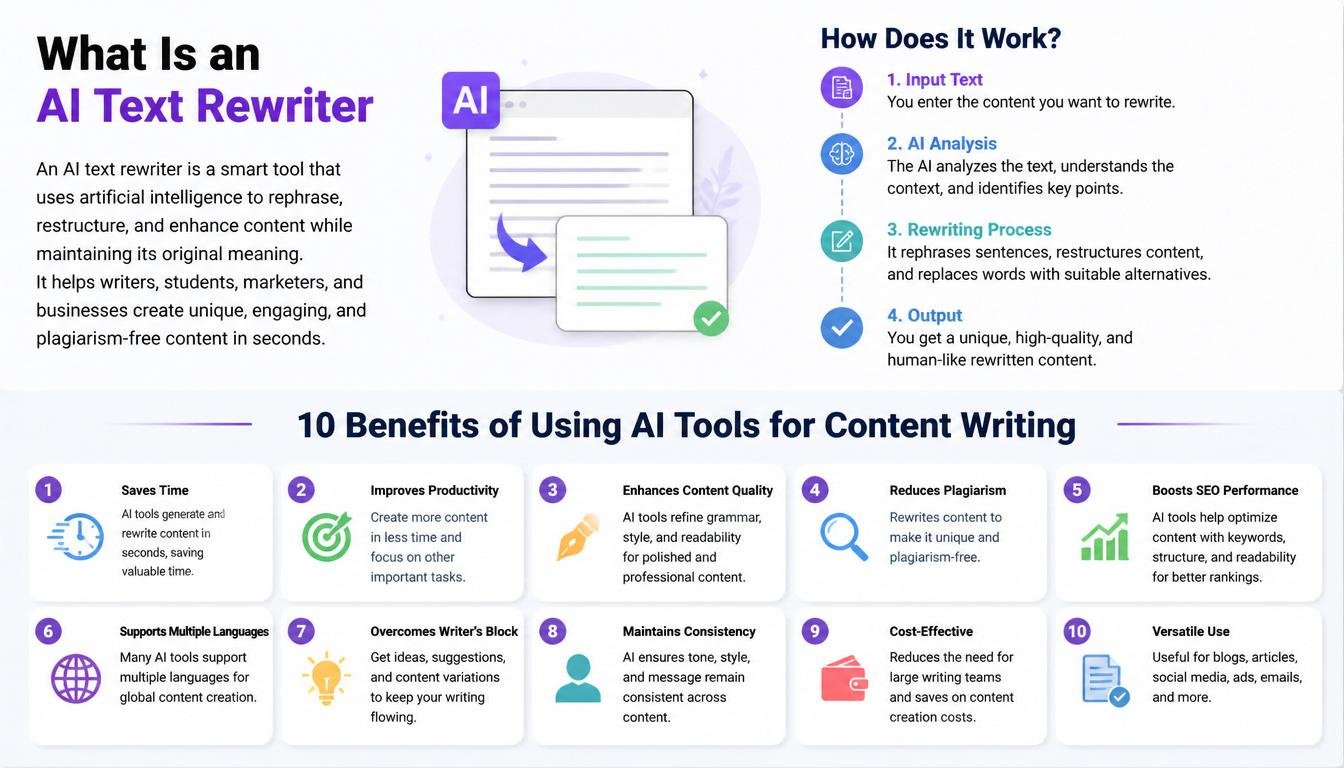
10 Benefits of Using AI Tools for Content Writing
Content is at the heart of the modern internet.
From blog articles and website pages to social media posts, newsletters, product descriptions, advertisements, and video scripts, written content plays an important role in how businesses and creators communicate with their audiences.
But producing high-quality content consistently is not easy.
Writers often have to deal with tight deadlines, writer's block, repetitive editing, research, grammar mistakes, changing audience expectations, and the constant demand for fresh ideas.
This is where AI tools for content writing are becoming increasingly useful.
Artificial intelligence can assist writers with brainstorming, drafting, rewriting, editing, summarizing, improving readability, and adapting content for different audiences. Instead of replacing human creativity, AI can help writers work more efficiently and focus their attention on the parts of content creation that require human judgment and original thinking.
In this article, we will explore 10 major benefits of using AI tools for content writing and explain how they can improve the modern writing workflow.
What Are AI Tools for Content Writing?
AI content writing tools are software applications that use artificial intelligence and language models to assist with writing-related tasks.
Depending on the tool, users may be able to generate or transform text, improve existing drafts, brainstorm ideas, correct grammar, adjust tone, summarize information, and create different versions of content.
Common AI writing tasks include:
Article drafting
Text rewriting
Paraphrasing
Grammar correction
Sentence improvement
Content summarization
Headline generation
Social media writing
Product descriptions
Email writing
Content expansion
Text simplification
The goal is not necessarily to let AI write everything.
Instead, AI can become a writing assistant that helps people complete repetitive tasks faster and improve the overall content creation process.
1. AI Tools Save Valuable Time
The first and most obvious benefit of AI writing tools is time savings.
Writing can take a significant amount of time, especially when a creator needs to produce content regularly.
Imagine that you need to create a 2,000-word article.
Before writing the first paragraph, you may need to:
Research the topic
Decide on the structure
Create headings
Develop an introduction
Write individual sections
Edit sentences
Check grammar
Improve readability
Write a conclusion
AI can assist with several of these steps.
For example, a writer can use AI to brainstorm possible headings or transform a rough paragraph into a clearer version.
Instead of spending 20 minutes trying to find the perfect wording for one section, the writer can generate several possibilities quickly and then select the best one.
This does not mean writers should stop thinking.
It means they can spend less time on repetitive tasks and more time on creative decisions.
2. AI Helps Generate Content Ideas
Coming up with new content ideas can be one of the hardest parts of being a creator.
You may know your industry extremely well but still struggle to decide what to publish next.
AI can help expand the range of possibilities.
For example, if you run a website about digital marketing, an AI tool can help brainstorm topics such as:
Beginner SEO strategies
Social media marketing trends
Email marketing tips
Common content marketing mistakes
How to improve website conversions
AI tools for marketers
Content repurposing strategies
The writer can then evaluate these ideas based on their audience, expertise, and goals.
AI becomes a brainstorming partner rather than the final decision-maker.
This can be especially useful for bloggers who need to maintain a consistent publishing schedule.
3. AI Helps Overcome Writer's Block
Writer's block can affect beginners and experienced writers alike.
Sometimes you have an excellent idea but cannot figure out how to start.
Other times, you may have written several paragraphs but become stuck halfway through an article.
AI can help provide momentum.
A writer can enter a rough idea and ask for different ways to develop it.
For example:
Basic idea:
“AI helps businesses save time.”
AI could suggest several directions:
How businesses automate repetitive writing tasks
How AI improves customer communication
How marketers use AI for content production
How AI helps small businesses compete
The risks of relying too heavily on AI
The writer can then choose the most interesting direction and develop it using their own knowledge.
This can turn a blank page into a starting point.
4. AI Improves Grammar and Writing Quality
Even experienced writers make grammar and spelling mistakes.
When people write quickly, they may overlook:
Punctuation errors
Repeated words
Awkward sentences
Incorrect grammar
Poor sentence structure
Unclear phrases
AI writing tools can help identify many of these issues.
For example, a rough sentence might be:
“Our tool help users to create better content and save their times.”
An AI-assisted correction could be:
“Our tool helps users create better content and save time.”
The improved version is clearer and grammatically correct.
However, writers should still review AI suggestions.
Grammar is only one part of good writing. Context and meaning also matter.
5. AI Makes Rewriting and Paraphrasing Easier
Rewriting is a common task for content creators.
A writer may have a paragraph that contains useful information but needs a different style or structure.
AI tools can quickly provide alternative versions.
For example:
Original:
“Creating quality content regularly can be challenging for busy professionals.”
Rewritten:
“Busy professionals may find it difficult to consistently produce high-quality content.”
The meaning remains similar, but the sentence structure has changed.
This can be useful when editing drafts, adapting content for different audiences, or improving readability.
However, rewriting should not be used as a way to disguise copied content. Transforming someone else's work does not automatically make it original.
The best use of AI rewriting is to improve your own drafts and communicate your own ideas more effectively.
6. AI Helps Adjust Writing Tone
Different situations require different writing styles.
A business email may need a professional tone.
A social media post may need to sound friendly and conversational.
A product advertisement may need persuasive language.
An educational article may need a clear and informative style.
AI tools can help transform content into different tones.
For example, the basic message:
“Our new software helps users write faster.”
could be transformed into a professional version:
“Our new software streamlines the writing process, helping users create content more efficiently.”
Or a friendly version:
“Want to write faster? Our new tool can help you get your ideas onto the page in less time.”
This flexibility can help creators communicate more effectively with different audiences.
7. AI Helps Repurpose Existing Content
Creating new content from scratch every day can be exhausting.
Fortunately, one piece of content can often be transformed into multiple formats.
For example, a detailed blog article can become:
Social media posts
Email newsletters
Video scripts
Short educational posts
Product explanations
FAQ answers
LinkedIn updates
AI tools can help transform the original content into these different formats.
This is known as content repurposing.
Instead of treating every platform as a completely separate content project, creators can use existing research and ideas more efficiently.
For example, a 2,000-word blog article might become five social media posts and a short video script.
The creator still needs to review and adapt each version, but the initial transformation can be much faster.
8. AI Can Improve Content Readability
Good content should be easy to understand.
Long sentences, complicated vocabulary, and unnecessary repetition can make an article difficult to read.
AI writing tools can help identify sections that could be simplified.
Consider this sentence:
“Individuals who are interested in utilizing our platform are required to complete the registration procedure before obtaining access to the available functionality.”
A simpler version is:
“Users must register before they can access the platform's features.”
The second sentence is shorter and easier to understand.
Improved readability can be particularly important for websites because online readers often scan content rather than reading every word.
AI can help creators identify opportunities to make their writing clearer and more direct.
9. AI Supports SEO Content Work
Search engine optimization is an important part of content marketing.
Website owners want their articles to be discovered by search engines and, more importantly, provide useful answers to people searching for information.
AI tools can assist with several SEO-related writing tasks.
They can help generate:
Topic ideas
Headline variations
Meta description drafts
Content outlines
FAQ ideas
Related subtopics
Readability improvements
AI can also help writers understand how a topic might be explained from different perspectives.
However, AI should not be used to produce large amounts of generic content simply for the purpose of ranking.
Google's guidance emphasizes creating helpful, reliable, people-first content rather than content produced primarily to manipulate search rankings.
High-quality SEO content still requires original information, accurate research, useful explanations, and a clear understanding of the reader's needs.
AI can support that process, but it cannot replace good content strategy.
10. AI Increases Overall Content Productivity
The biggest benefit of AI writing tools may be their ability to improve overall productivity.
Consider everything involved in publishing a single article:
Research → Planning → Drafting → Rewriting → Editing → Formatting → Promotion
AI can assist with several stages.
For example:
During planning
AI can help brainstorm topics and create outlines.
During drafting
AI can help expand ideas and develop rough sections.
During editing
AI can identify grammar problems and suggest clearer wording.
During repurposing
AI can transform an article into social media posts or email content.
During optimization
AI can help improve headings, descriptions, and readability.
This does not mean AI should control the entire workflow.
Instead, it can reduce repetitive tasks at multiple points.
That cumulative time saving can be significant for professional content creators.
AI Does Not Replace Human Creativity
Despite these benefits, AI tools should not be viewed as complete replacements for human writers.
AI can generate language quickly, but humans provide many things that make content valuable.
Humans contribute:
Personal experiences
Original research
Opinions
Creativity
Emotional understanding
Expertise
Critical thinking
Editorial judgment
For example, an AI system can write a general article about traveling to a destination.
But a person who has actually visited that destination can provide firsthand details that make the article more useful and authentic.
This is why the strongest approach is usually a combination of AI assistance and human creativity.
How to Use AI Writing Tools Responsibly
The way you use AI matters.
A responsible AI-assisted workflow can look like this:
Step 1: Start With Your Own Research
Understand the topic before generating or transforming content.
Step 2: Develop Your Main Ideas
Determine what you want your audience to learn.
Step 3: Use AI as an Assistant
Use AI for brainstorming, rewriting, editing, or organizing information.
Step 4: Review the Output
Check whether the information is accurate and whether the wording matches your intended meaning.
Step 5: Add Original Value
Include your own experiences, examples, analysis, and insights.
Step 6: Fact-Check
Verify important information before publishing.
Step 7: Perform a Final Human Edit
Make sure the final article sounds natural and genuinely helps the reader.
This approach allows you to benefit from AI without sacrificing quality.
Common Mistakes to Avoid
AI tools are powerful, but there are several mistakes creators should avoid.
Publishing AI Output Without Reviewing It
AI can make mistakes.
Always review important content before publication.
Creating Generic Content
If your article simply repeats information already available everywhere, it may provide little value.
Add original insights and useful examples.
Keyword Stuffing
Do not repeatedly insert the same keyword simply because you want to rank for it.
Use keywords naturally and focus on satisfying the reader's intent.
Copying and Rewriting Other People's Content
AI rewriting does not turn someone else's work into your original work.
Use AI with your own research and ideas.
Depending Completely on AI
If AI creates every idea and every sentence, your content may lose personality.
Use technology as an assistant rather than allowing it to replace your creative thinking.
Who Can Benefit From AI Content Writing Tools?
Almost anyone who regularly works with text can benefit.
Bloggers
Save time researching, drafting, editing, and repurposing articles.
Freelancers
Adapt content for different clients and styles more efficiently.
Businesses
Create and improve website copy, emails, product descriptions, and marketing materials.
Social Media Creators
Generate variations of captions, posts, and promotional messages.
Students
Improve clarity, grammar, and understanding while following their institution's rules for AI use.
Marketers
Develop multiple content variations and campaign ideas.
Website Owners
Improve existing pages and create useful content more efficiently.
The Future of AI Content Writing
AI writing technology is developing quickly.
Future tools will likely become more personalized and better at understanding context, audience, brand voice, and individual writing preferences.
Instead of simply asking an AI tool to “rewrite this text,” users may be able to give detailed instructions such as:
“Rewrite this article in our brand voice, make it easier for beginners, preserve the technical information, remove repetition, and keep the tone professional and friendly.”
This could make AI an even more powerful writing assistant.
However, as AI-generated content becomes easier to produce, originality may become even more important.
When everyone can generate thousands of words quickly, valuable human experiences, expert knowledge, original research, and unique perspectives will help content stand out.
Final Thoughts
AI tools for content writing are changing the way people create and manage written content.
They can save time, generate ideas, overcome writer's block, improve grammar, simplify language, rewrite paragraphs, change tone, repurpose content, support SEO workflows, and increase overall productivity.
But the real value of AI comes from how people use it.
The goal should not be to produce the largest possible amount of content.
The goal should be to create better, clearer, more useful content in less time.
Human creativity remains essential.
AI can help with the repetitive work.
Humans provide the ideas, experience, judgment, originality, and purpose.
When these strengths are combined, content creators can build a more efficient workflow while maintaining the quality their audiences expect.
The future of content writing is not simply about AI writing for humans.
It is about humans using AI to write smarter.