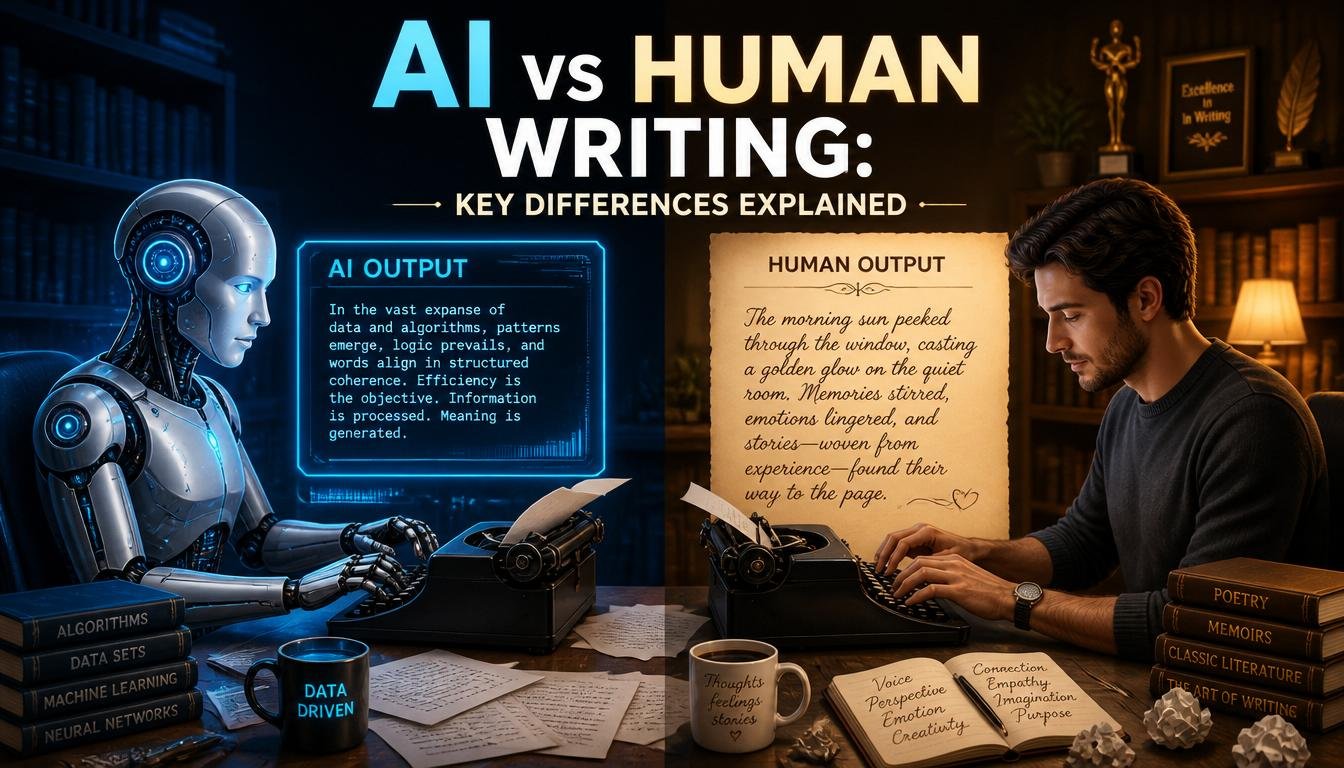
AI vs Human Writing: Key Differences Explained.
Artificial intelligence has changed the way people create content.
A few years ago, writing an article usually meant sitting in front of a computer, researching information, organizing ideas, writing a draft, and spending hours editing it. Today, AI-powered writing tools can help generate, rewrite, summarize, and improve text within seconds.
This rapid development has created an important debate:
AI writing vs. human writing—which is better?
The answer is not as simple as choosing one over the other.
AI and humans have different strengths. Artificial intelligence can process language quickly, generate multiple versions of text, and assist with repetitive writing tasks. Humans bring creativity, personal experience, emotional understanding, critical thinking, and original perspectives.
Understanding the differences between AI and human writing can help bloggers, businesses, freelancers, marketers, students, and content creators decide when to use each approach.
In this article, we will explore the key differences between AI-generated writing and human-written content, including creativity, speed, accuracy, originality, emotion, personalization, SEO, productivity, and the future of content creation.
What Is AI Writing?
AI writing refers to text created or assisted by artificial intelligence systems.
Modern AI writing tools use language models trained on large amounts of text to generate responses based on user instructions.
Depending on the tool, AI can help create:
Blog articles
Product descriptions
Social media posts
Emails
Headlines
Advertisements
Scripts
Summaries
Rewritten content
Paraphrases
Website copy
AI can also transform existing content by changing its wording, tone, structure, or level of complexity.
For example, a user could provide a paragraph and request:
“Rewrite this in a professional and concise tone.”
The AI can then produce an alternative version within seconds.
What Is Human Writing?
Human writing is content created primarily through human thought, experience, research, and creativity.
Human writers use their knowledge, emotions, observations, opinions, and communication skills to develop ideas.
Human writing can include:
Personal stories
Journalism
Academic papers
Blog articles
Books
Essays
Business communication
Creative writing
Reviews
Opinion pieces
Unlike AI, human writers have direct personal experiences and can intentionally communicate emotions, beliefs, memories, and perspectives.
This creates qualities that can be difficult for AI to reproduce authentically.
1. Speed: AI Has the Advantage
One of the biggest differences between AI and human writing is speed.
AI can generate a large amount of text extremely quickly.
A writer may spend hours creating a detailed article.
An AI system can produce a draft in a much shorter amount of time.
This makes AI particularly useful for:
Brainstorming
Drafting
Rewriting
Summarizing
Creating variations
Generating outlines
Human writers generally require more time because they must think, research, formulate ideas, and write each section.
However, speed does not automatically equal quality.
An AI-generated article may require substantial human editing before it is ready to publish.
Winner for speed: AI
2. Creativity: Humans Have the Advantage
Creativity is one of the strongest differences between humans and AI.
AI can generate creative-looking text based on patterns learned from existing language.
But human creativity comes from lived experience, imagination, emotion, observation, culture, and personal perspective.
A human writer can say:
“I remember sitting alone in that tiny café during a rainy afternoon in London.”
That statement can come from actual experience.
AI can generate a similar sentence, but it does not personally remember sitting in a café.
Human creativity is especially important for:
Storytelling
Poetry
Personal essays
Brand stories
Opinion writing
Emotional narratives
Creative campaigns
AI can help generate ideas, but humans often provide the deeper creative direction.
Winner for authentic creativity: Human
3. Personal Experience
Human writers can write from direct experience.
This is a major advantage.
Consider a travel article.
A human traveler can explain:
What the destination actually felt like
What surprised them
What mistakes they made
What they would do differently
Which places were unexpectedly good
What local interactions were memorable
AI can provide general information about the destination, but it does not have personal travel memories.
This difference becomes particularly important for content where firsthand experience matters.
Examples include:
Travel reviews
Product experiences
Restaurant reviews
Personal development stories
Case studies
Expert commentary
Winner for firsthand experience: Human
4. Emotional Understanding
Humans experience emotions.
They understand happiness, disappointment, fear, excitement, frustration, humor, nostalgia, and empathy through lived experience.
AI can recognize emotional language and generate text designed to sound emotional.
But generating emotional language is different from actually experiencing emotion.
A human writer who has experienced grief may communicate that experience in a deeply personal way.
An AI can produce a sympathetic paragraph, but it does not experience grief.
This distinction matters when writing requires emotional authenticity.
Winner for genuine emotional expression: Human
5. Consistency: AI Has an Advantage
AI can be extremely consistent.
It can follow instructions about:
Tone
Formatting
Length
Structure
Vocabulary
Style
For example, a company might want hundreds of product descriptions written in a similar format.
AI can help create these consistently.
Human writers may naturally introduce variations in tone and structure.
This can be good for creative writing, but businesses often need consistency across large amounts of content.
Winner for repetitive consistency: AI
6. Originality: It Depends on the Process
Originality is more complicated.
Human writing can be highly original because humans can create ideas from personal experience and unique perspectives.
However, humans can also copy other people's work.
AI can generate new combinations of language, but its output may sometimes sound generic or similar to common patterns.
The important issue is not simply whether the text was generated by AI or humans.
The real question is:
Does the content provide original value?
A human-written article that copies another website is not necessarily more valuable than an AI-assisted article containing original research.
Likewise, an AI-generated article that simply repeats information found everywhere may provide little value.
Originality depends heavily on the research, ideas, perspective, and editorial process behind the content.
7. Accuracy: Neither Is Automatically Perfect
AI is often considered highly knowledgeable, but AI can make mistakes.
It may:
Misinterpret information
Produce incorrect statements
Present outdated information
Invent unsupported details
Misunderstand context
Human writers can also make mistakes.
They may misunderstand sources, remember facts incorrectly, or publish outdated information.
This means neither AI nor humans should be assumed to be automatically accurate.
Fact-checking remains important.
For important subjects, writers should verify information using reliable sources.
Winner: Neither—verification is essential
8. Research and Critical Thinking
AI can process and organize information quickly.
It can help identify related topics, generate research questions, and summarize information.
However, human critical thinking remains essential.
A human researcher can ask:
Is this source reliable?
What evidence supports this claim?
Is there another explanation?
Does the research have limitations?
Who funded the study?
Is this information still current?
AI can assist with research, but users should not blindly accept its output.
Critical evaluation is particularly important for academic, scientific, medical, legal, financial, and news-related content.
Winner for independent judgment: Human
9. Productivity: AI and Humans Work Best Together
Productivity is where AI can provide significant benefits.
A writer can use AI to reduce repetitive tasks.
For example:
Human: Develops the main idea.
AI: Creates outline suggestions.
Human: Writes the core argument.
AI: Suggests alternative wording.
Human: Reviews accuracy.
AI: Helps improve readability.
Human: Performs the final edit.
This workflow allows humans to maintain control while using AI for efficiency.
Instead of thinking about AI as a replacement for writers, it may be more useful to think of it as a productivity tool.
10. Understanding Audience and Context
Human writers can develop a deep understanding of their audience.
A brand manager may know exactly how their customers communicate.
A journalist may understand the cultural context surrounding a story.
A teacher may know which explanation will make sense to their students.
AI can adapt text based on instructions, but the quality of those instructions often depends on the user's understanding of the audience.
Human knowledge of context remains extremely important.
Winner: Human, especially when deep context is required
11. SEO and AI Writing
AI has become increasingly popular for SEO content creation.
AI can help with:
Topic ideas
Content outlines
Headline variations
Meta descriptions
FAQ ideas
Rewriting
Readability
But SEO is not simply a matter of generating large quantities of text.
Search engines aim to provide useful information to users.
Google's guidance emphasizes helpful, reliable, people-first content rather than content created primarily to manipulate search rankings.
Therefore, AI can support an SEO workflow, but websites still need useful information, accurate research, original perspectives, and content that satisfies the reader's needs.
12. Writing Style
Human writers often develop recognizable writing styles over time.
Readers may recognize an author's voice from:
Sentence patterns
Humor
Vocabulary
Storytelling
Opinions
Rhythm
AI can imitate or adapt to different styles when instructed.
However, generic AI writing can sometimes sound repetitive or predictable.
The strongest results often come when writers use AI as a starting point and then add their own personality.
Best approach: AI assistance + human voice
13. Handling Repetitive Content
AI is particularly useful for repetitive writing tasks.
For example, an e-commerce business may have thousands of products.
Each product might require:
A short description
A detailed description
Key features
Marketing copy
Writing each one manually can take a significant amount of time.
AI can help create initial drafts and variations.
Humans can then review the content for accuracy and brand consistency.
Winner for repetitive tasks: AI
14. Storytelling
Storytelling is one area where human writers can have a significant advantage.
Great stories often depend on:
Character development
Personal experience
Emotional tension
Cultural understanding
Unexpected details
Human relationships
AI can help brainstorm plot ideas or improve sentences.
But powerful storytelling often comes from understanding what it means to be human.
A personal story about failure, friendship, loss, success, or transformation can carry emotional weight because it comes from lived experience.
Winner for authentic storytelling: Human
15. Editing and Rewriting
This is an area where AI can be extremely useful.
A writer may have a strong draft but need help improving it.
AI can suggest:
Clearer sentences
Shorter paragraphs
Alternative wording
Different tones
Grammar corrections
Better transitions
This is particularly useful for people who understand what they want to communicate but struggle with wording.
Human editors still play an important role because they can judge whether the changes actually improve the content.
AI vs Human Writing: Quick Comparison
| Feature | AI Writing | Human Writing |
|---|---|---|
| Speed | Excellent | Moderate |
| Repetitive tasks | Excellent | Time-consuming |
| Grammar assistance | Excellent | Good |
| Personal experience | Limited | Excellent |
| Emotional authenticity | Limited | Excellent |
| Creativity | Strong with direction | Excellent |
| Consistency | Excellent | Variable |
| Critical thinking | Limited | Excellent |
| Original perspective | Depends on input | Strong potential |
| Scalability | Excellent | Limited |
| Final judgment | Limited | Excellent |
| Storytelling | Good | Excellent |
The comparison shows that neither approach wins in every category.
When Should You Use AI Writing?
AI can be particularly useful when you need:
Quick brainstorming
Content outlines
Drafting assistance
Sentence rewriting
Grammar improvement
Summaries
Content variations
Social media adaptations
Repetitive descriptions
Readability improvements
AI is especially useful when the task is repetitive or language-focused.
When Should You Use Human Writing?
Human writing is particularly important when content requires:
Personal experience
Original reporting
Expert judgment
Emotional storytelling
Strong opinions
Sensitive communication
Complex analysis
Unique creative direction
For these types of content, human involvement should remain central.
The Best Solution: Human-AI Collaboration
The most effective future may not involve choosing between AI and humans.
Instead, it may involve combining both.
Consider this workflow:
Step 1: Human Research
The writer researches the topic and identifies reliable information.
Step 2: Human Ideas
The writer decides what the article should communicate.
Step 3: AI Assistance
AI helps create an outline, rewrite sentences, or generate alternatives.
Step 4: Human Review
The writer checks accuracy, context, and meaning.
Step 5: Human Creativity
The writer adds personal insights, examples, experiences, and opinions.
Step 6: AI Editing
AI can help identify grammar or readability problems.
Step 7: Final Human Approval
The writer decides what gets published.
This approach combines the speed of AI with the intelligence and creativity of humans.
The Future of Writing
The future of writing will likely involve more collaboration between people and artificial intelligence.
AI tools will probably become better at understanding:
Individual writing styles
Brand voices
Audience preferences
Context
Cultural differences
Specialized terminology
Writers may spend less time performing mechanical editing and more time developing ideas.
The role of the writer may evolve from simply producing sentences to becoming a creative director, researcher, strategist, and editor.
As AI-generated content becomes more common, authentic human contributions may become even more valuable.
Personal experiences, original research, expert opinions, and unique perspectives can help content stand out.
Final Thoughts
The debate over AI vs human writing is not really about which one is universally better.
AI is faster.
Humans are more capable of drawing from lived experience.
AI is highly scalable.
Humans provide personal perspective.
AI can generate and transform language quickly.
Humans provide purpose, judgment, emotion, and creativity.
The strongest writing workflow combines these strengths.
Use AI for repetitive tasks, brainstorming, rewriting, editing, and productivity.
Use human creativity for original ideas, personal experiences, critical thinking, storytelling, and final decisions.
The future of writing will not necessarily belong to AI or humans alone.
It will belong to people who know how to use AI effectively while preserving the qualities that make human communication valuable.
AI can help create the words. Humans decide what those words should mean.