Common Punctuation Mistakes and How to Avoid Them
Punctuation might seem like a minor detail compared to word choice or sentence structure, but small punctuation errors can genuinely change meaning, create confusion, or make otherwise strong writing look careless. Most punctuation mistakes fall into a handful of recurring categories. Understanding these common errors — and the simple rules that prevent them — can noticeably sharpen the clarity and professionalism of your writing.
Why Punctuation Matters More Than It Seems
Punctuation guides readers through a sentence the way road signs guide drivers through a route. It signals where to pause, where one idea ends and another begins, and how different parts of a sentence relate to each other. Get it wrong, and even grammatically correct sentences can become confusing or, in some cases, mean something entirely different than intended.
Consider the classic example: "Let's eat, Grandma" versus "Let's eat Grandma." A single comma is the difference between an invitation to dinner and a much more alarming statement.
Mistake 1: Comma Splices
A comma splice happens when two complete sentences (independent clauses) are joined with only a comma, without a coordinating conjunction.
Incorrect: "I finished the report, I sent it to my manager."
Correct options:
- Use a period: "I finished the report. I sent it to my manager."
- Use a semicolon: "I finished the report; I sent it to my manager."
- Add a coordinating conjunction: "I finished the report, and I sent it to my manager."
Comma splices are one of the most common punctuation errors, especially in fast, informal writing, but they're easy to fix once you know to watch for two complete sentences joined by only a comma.
Mistake 2: Misusing the Apostrophe in Possessives and Contractions
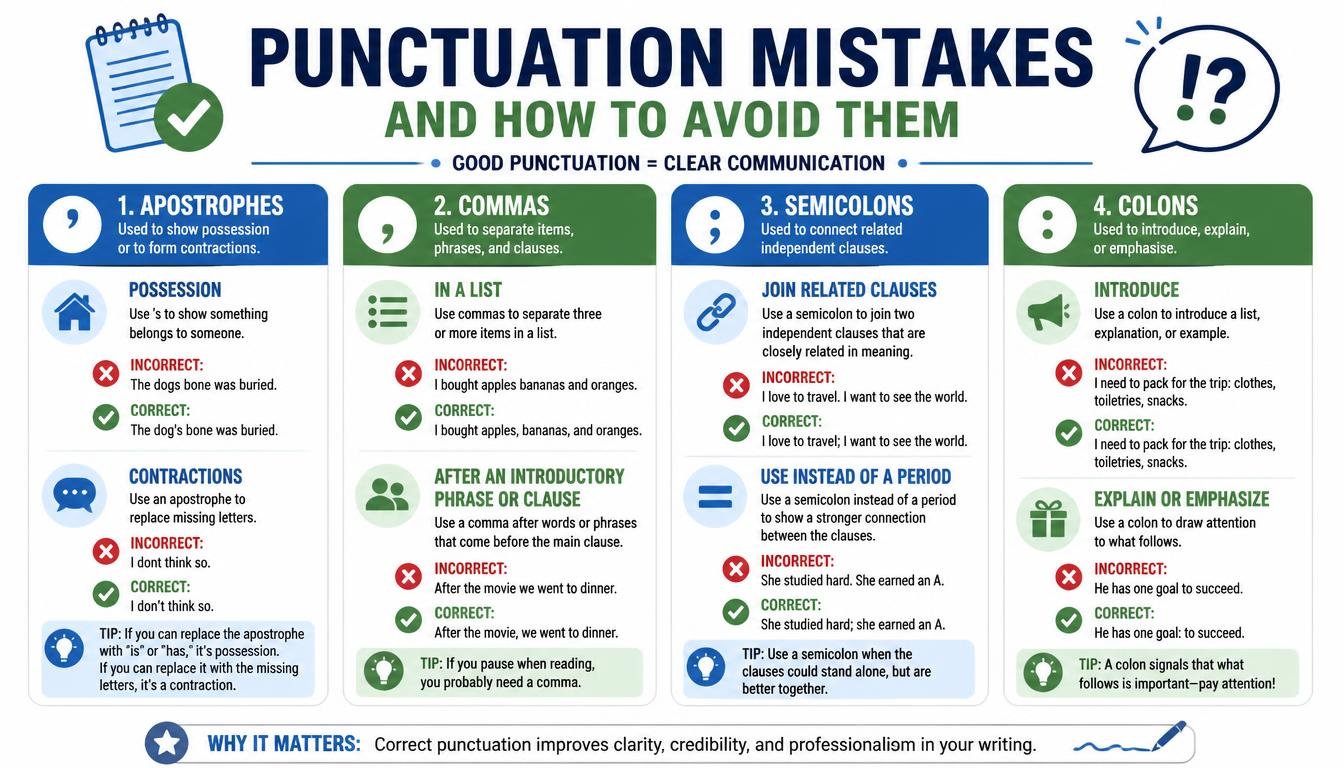
Apostrophes cause confusion primarily around two situations: possessives and contractions.
Its vs. It's
- "Its" shows possession (no apostrophe): "The company updated its policy."
- "It's" is a contraction of "it is" or "it has": "It's been a long week."
Plural vs. possessive confusion
- Plural (no apostrophe): "The reports were due Friday." (multiple reports)
- Possessive singular: "The report's conclusion was clear." (belonging to one report)
- Possessive plural: "The reports' conclusions were consistent." (belonging to multiple reports)
A quick test: if you can replace the word with "it is" or "it has" and the sentence still makes sense, use "it's." Otherwise, use "its."
Mistake 3: Overusing or Underusing Commas
Commas are among the most frequently misused punctuation marks, in both directions.
Missing comma before a coordinating conjunction joining two independent clauses:
Incorrect: "The meeting ran long and everyone left frustrated." Correct: "The meeting ran long, and everyone left frustrated."
Missing comma after an introductory phrase:
Incorrect: "After the meeting everyone went home." Correct: "After the meeting, everyone went home."
Unnecessary commas that break up a sentence's natural flow:
Incorrect: "The team, worked hard, to finish the project." Correct: "The team worked hard to finish the project."
A helpful guideline: if you can read the sentence aloud and a comma reflects a natural pause tied to a grammatical break (like separating clauses or introductory phrases), it likely belongs. If it just interrupts the sentence without a clear grammatical reason, it probably doesn't.
Mistake 4: Confusing Semicolons and Colons
Semicolons and colons serve different purposes, and mixing them up is common.
Semicolons connect two closely related independent clauses without a conjunction, or separate items in a complex list.
Correct: "The presentation went well; the client asked several follow-up questions."
Colons introduce a list, explanation, or elaboration that directly follows a complete sentence.
Correct: "The project requires three things: time, budget, and clear communication."
A common error is using a colon after an incomplete sentence.
Incorrect: "The things we need are: time, budget, and communication." Correct: "We need three things: time, budget, and communication."
The rule of thumb: a colon should follow a grammatically complete sentence, not lead directly out of a verb or preposition.
Mistake 5: Misplacing Quotation Marks With Other Punctuation
In American English, commas and periods typically go inside closing quotation marks, while other punctuation (like question marks or exclamation points) depends on whether it's part of the quoted material.
Correct (American style): "She said, 'I'll be there by five.'" Correct: "Did she really say, 'I'll be there by five'?"
In the second example, the question mark goes outside the quotation marks because the question belongs to the full sentence, not the quoted material itself. British English conventions differ slightly, so consistency within a single piece of writing matters more than rigidly following one specific national standard, unless a style guide specifies otherwise.
Mistake 6: Run-On Sentences From Missing Punctuation Entirely
A run-on sentence occurs when multiple independent clauses are joined with no punctuation or connecting word at all.
Incorrect: "The deadline moved up we had to work through the weekend."
Correct: "The deadline moved up, so we had to work through the weekend." or "The deadline moved up. We had to work through the weekend."
Run-ons often happen when writers are moving quickly and haven't paused to identify where one complete thought ends and another begins.
Mistake 7: Inconsistent Use of the Oxford Comma
The Oxford comma (also called the serial comma) is the comma placed before "and" or "or" in a list of three or more items.
With Oxford comma: "I bought apples, oranges, and bananas." Without Oxford comma: "I bought apples, oranges and bananas."
Neither approach is inherently wrong, but consistency matters — and in certain cases, omitting the Oxford comma can create genuine ambiguity.
Ambiguous without Oxford comma: "I'd like to thank my parents, Beyoncé and God." (This could be read as calling the parents "Beyoncé and God.") Clear with Oxford comma: "I'd like to thank my parents, Beyoncé, and God."
Choosing to consistently use or omit the Oxford comma throughout a piece of writing, based on whichever style guide applies, prevents this kind of confusion.
Mistake 8: Hyphen vs. Dash Confusion
Hyphens (-) and dashes (– or —) look similar but serve different functions.
Hyphens join compound words or modifiers: "a well-known author," "a five-year plan."
En dashes (–) typically indicate ranges: "pages 10–15," "the 2020–2021 season."
Em dashes (—) set off parenthetical information or create emphasis, similar to how commas or parentheses might be used: "The results — though preliminary — suggest a clear trend."
Using a hyphen where an em dash belongs (or vice versa) is a subtle but noticeable inconsistency in more polished or professional writing.
A Quick Self-Check Strategy
When reviewing your own writing for punctuation issues, try these steps:
- Read sentences aloud. Natural pauses often reveal where commas are needed or unnecessary.
- Identify independent clauses. Check whether sentences joined by commas actually need a period, semicolon, or conjunction instead.
- Check every apostrophe. Confirm whether it's showing possession, forming a contraction, or has been mistakenly added to a simple plural.
- Look for run-ons. Long sentences without clear punctuation breaks are worth reading slowly to check for missing structure.
Final Thoughts
Punctuation mistakes are rarely about a lack of intelligence or writing skill — they're usually about small, learnable patterns that become second nature with practice and attention. Mastering these common trouble spots — comma splices, apostrophes, comma placement, semicolons and colons, quotation marks, run-ons, the Oxford comma, and hyphens versus dashes — goes a long way toward making your writing clearer, more polished, and easier for readers to trust.