How AI Can Help Non-Native English Speakers Write Better.
Writing in English can be challenging when it is not your first language.
Millions of people around the world use English for education, business, freelancing, online communication, research, and content creation. Many of these people understand English well but may still struggle to express their ideas naturally and confidently in written form.
Common challenges include grammar mistakes, limited vocabulary, confusing sentence structures, incorrect word choices, punctuation problems, and uncertainty about tone.
Artificial intelligence has introduced new tools that can help non-native English speakers overcome many of these challenges.
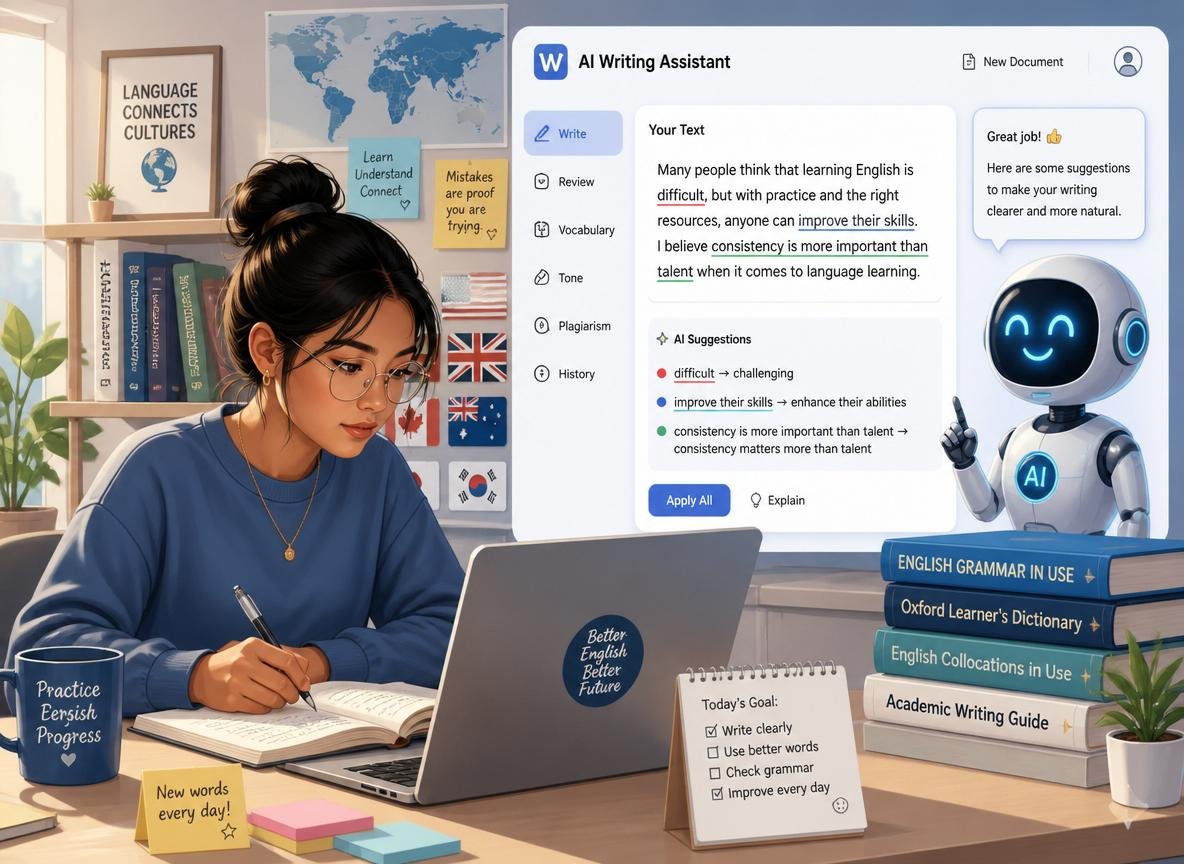
AI-powered writing and text transformation tools can provide suggestions, rewrite sentences, explain grammar, improve readability, and help users communicate their ideas more naturally.
However, AI should not replace language learning. Instead, it can act as a personal writing assistant that helps users identify problems, understand corrections, and become more confident writers.
In this article, we will explore how AI can help non-native English speakers write better, the most useful ways to use AI writing tools, potential limitations, and practical strategies for improving English writing skills.
Why English Writing Can Be Difficult for Non-Native Speakers
Learning English involves more than memorizing vocabulary.
A writer must understand:
Grammar
Sentence structure
Vocabulary
Punctuation
Word choice
Tone
Context
Idioms
Cultural conventions
Formal and informal communication
A sentence can be grammatically correct but still sound unnatural.
For example:
“I am having a confusion about this matter.”
A learner may understand every word, but a more natural expression would be:
“I am confused about this matter.”
This difference illustrates one of the challenges of learning English.
The goal is not simply to create grammatically correct sentences.
The goal is to communicate naturally and effectively.
1. AI Can Correct Grammar Mistakes
Grammar is one of the most common challenges for people learning English.
Depending on their native language, learners may struggle with:
Verb tenses
Articles
Prepositions
Subject-verb agreement
Plural forms
Word order
Conditional sentences
Pronouns
AI writing tools can identify many common grammar problems.
For example:
Incorrect:
“She go to university every day.”
Correct:
“She goes to university every day.”
A useful AI tool can do more than simply provide the corrected version.
It can explain why the correction is necessary.
Understanding the reason behind a correction is important because it helps the learner avoid making the same mistake again.
2. AI Can Improve Sentence Structure
Sometimes non-native English speakers know exactly what they want to say but struggle to organize the sentence naturally.
For example:
“Yesterday I to the market went because I needed some vegetables.”
A writing assistant can suggest:
“I went to the market yesterday because I needed some vegetables.”
The second sentence follows a more natural English structure.
AI can help identify:
Awkward word order
Unnecessary phrases
Confusing sentence structures
Repeated words
Missing connections
This can be particularly useful for people who have strong ideas but lack confidence in English sentence construction.
3. AI Can Suggest Better Vocabulary
Vocabulary is another major challenge for English learners.
Sometimes a person knows a basic word but wants a more appropriate alternative.
For example:
“The product is very good.”
Depending on the context, alternatives might include:
Effective
Reliable
High-quality
Useful
Powerful
Impressive
However, vocabulary suggestions should be used carefully.
A more complicated word is not always a better word.
The best vocabulary is the vocabulary that communicates the intended meaning clearly.
AI can help users understand different word choices and their contexts.
4. AI Can Explain Difficult Grammar Concepts
English grammar can sometimes be confusing.
A learner may understand that a sentence is wrong without understanding why.
AI can act as an interactive explanation tool.
For example, a user can ask:
“Why should I use ‘has’ instead of ‘have’ in this sentence?”
The AI can explain the relevant grammar rule and provide examples.
This creates an interactive learning experience.
Instead of searching through a grammar textbook for one specific question, learners can ask about the exact sentence they are struggling with.
5. AI Can Improve Readability
Writing may be grammatically correct but still difficult to read.
AI can help identify:
Long sentences
Repeated ideas
Complicated vocabulary
Weak transitions
Large blocks of text
For example:
Original:
“Due to the fact that the software contains a considerable number of advanced features, users who are unfamiliar with this type of technology may experience difficulties when attempting to use it for the first time.”
A simpler version could be:
“Because the software has many advanced features, new users may find it difficult to use at first.”
The second sentence is shorter and easier to understand.
6. AI Can Help With Professional Emails
Writing professional emails can be particularly difficult for non-native English speakers.
The writer must consider:
Grammar
Politeness
Formality
Tone
Clarity
Cultural expectations
A sentence that sounds normal in one language may sound too direct or informal in English.
AI can help transform a message into a professional email.
For example:
Basic message:
“Send me the file quickly because I need it.”
A professional version could be:
“Could you please send me the file as soon as possible? I need it for an upcoming task.”
The message remains the same, but the tone becomes more professional.
7. AI Can Help Freelancers Communicate With Clients
Many freelancers work with international clients.
English communication may involve:
Proposals
Project updates
Client messages
Invoices
Reports
Negotiations
Feedback
Follow-up emails
Clear communication can help freelancers build trust.
AI can assist by checking whether a message sounds:
Professional
Friendly
Confident
Respectful
Clear
This can be especially useful when English is not the freelancer's first language.
8. AI Can Help Students Improve Academic Writing
Non-native English-speaking students often face additional challenges when writing academic assignments.
Academic writing requires:
Formal language
Clear arguments
Logical organization
Appropriate vocabulary
Accurate grammar
Evidence
Citations
AI tools can help students identify unclear sentences and improve readability.
For example, a student may write:
“Many people think that technology is good and it makes education better in many ways.”
An AI-assisted revision might be:
“Many researchers argue that technology can improve education by expanding access to information and supporting flexible learning.”
The second sentence is more specific and academically appropriate.
However, students should follow their institution's academic integrity policies and should not use AI to misrepresent generated work as their own where prohibited.
9. AI Can Help With Pronunciation and Language Learning
Some AI language tools go beyond writing.
Depending on the application, AI can support:
Vocabulary practice
Conversation exercises
Pronunciation feedback
Grammar practice
Reading comprehension
Translation
Interactive questions
This creates opportunities for learners to practice English more frequently.
A person who does not have access to a native English-speaking teacher can use AI-powered exercises as an additional learning resource.
10. AI Can Adapt Writing to Different Tones
English communication changes depending on the situation.
A message to a close friend is different from an email to a manager.
A social media post is different from an academic report.
AI can help users adapt text to different tones.
For example:
Casual:
“Hey, can you send me the details?”
Professional:
“Could you please send me the details when you have a moment?”
Formal:
“I would appreciate it if you could provide the relevant details at your earliest convenience.”
The information is similar, but the tone changes according to the context.
11. AI Can Help With Business Writing
Non-native English speakers working in international businesses may need to produce English content regularly.
This can include:
Business proposals
Reports
Presentations
Marketing copy
Product descriptions
Customer support messages
Internal communication
AI can help improve clarity and consistency.
However, the writer should always verify important information before sending or publishing business content.
12. AI Can Help Content Creators
English-speaking audiences represent a large portion of the global internet.
For non-native English content creators, writing high-quality English can be a major challenge.
AI tools can help with:
Blog posts
YouTube scripts
Social media captions
Headlines
Product reviews
Newsletters
Video descriptions
For example, a creator can write their ideas in simple English and then use AI to improve grammar and readability.
This allows the creator to focus more on their knowledge and creativity.
13. AI Can Preserve the Writer's Original Idea
One of the most useful applications of text transformation technology is rewriting.
A non-native speaker may have a good idea but express it awkwardly.
AI can help improve the wording without changing the central message.
For example:
Original:
“I want to explain this product because many people don't understand how it can help them in their daily work.”
Possible improved version:
“I want to explain this product because many people do not realize how it can simplify their daily work.”
The core idea remains intact.
This is important because language assistance should improve communication rather than replace the writer's original thinking.
14. AI Can Explain Corrections Instead of Just Making Them
For language learners, explanations are often more valuable than corrections.
Suppose AI changes:
“He don't like coffee.”
to:
“He doesn't like coffee.”
The learner can ask:
“Why?”
The explanation can introduce subject-verb agreement and the use of “doesn't” with “he.”
This creates a learning opportunity.
Instead of simply accepting the correction, learners should try to understand it.
15. AI Can Help Build Confidence
Writing in a second language can create anxiety.
A person may know what they want to say but worry:
“Is my grammar correct?”
“Does this sound professional?”
“Will people understand me?”
AI can provide an initial review before the message is sent.
This can increase confidence.
However, confidence should come from learning, not permanent dependence on an AI tool.
The ultimate goal should be to gradually improve your independent writing ability.
16. AI Can Help Identify Repeated Mistakes
One of the most useful ways to learn is to identify recurring errors.
For example, a learner might frequently make mistakes involving:
Articles
Prepositions
Verb tenses
Plural nouns
Word order
If the learner reviews corrections over time, patterns become easier to recognize.
You can even create a personal list:
My Common English Mistakes
Articles
Prepositions
Past tense
Subject-verb agreement
Word order
Then focus your learning on these areas.
17. AI Can Make Learning More Personalized
Traditional language lessons often follow the same structure for everyone.
AI can provide more personalized exercises.
For example, a learner could ask for:
“Give me ten exercises about English articles at an intermediate level.”
After completing them, the learner can request:
“Explain my mistakes and create five more questions focusing on the areas I got wrong.”
This creates a personalized learning cycle.
18. Use AI to Improve, Not Replace, Your Writing
There is an important difference between:
“Write this for me.”
and:
“Improve my writing and explain the changes.”
For language development, the second approach can be more valuable.
If AI writes everything, the learner may become dependent on it.
If AI helps improve the learner's own writing, the learner can gradually become better.
A useful process is:
Write → Review → Correct → Understand → Practice → Rewrite
This turns AI into a learning assistant.
How to Use an AI Text Rewriter Effectively
A text transformation tool can be especially helpful for non-native English speakers.
A simple workflow is:
Step 1: Write Your Original Idea
Do not worry about making every sentence perfect.
Focus on communicating your meaning.
Step 2: Ask AI to Review It
Request grammar, clarity, and readability suggestions.
Step 3: Read the Changes
Do not simply copy the output.
Compare it with your original.
Step 4: Understand the Corrections
Ask why specific changes were made.
Step 5: Create Your Own Version
Rewrite the paragraph yourself using what you learned.
This process turns editing into language practice.
What AI Cannot Replace
Despite its benefits, AI has limitations.
It cannot replace:
Personal experience
Human judgment
Genuine creativity
Cultural understanding
Professional expertise
Personal opinions
AI may also make mistakes.
Therefore, users should verify important information and review every significant piece of writing.
This is especially important for:
Academic work
Legal documents
Medical information
Financial communication
Professional contracts
Business-critical content
Common Mistakes When Using AI for English Learning
Copying Everything Without Learning
If you always accept AI corrections without understanding them, your English may improve more slowly.
Using Unnecessarily Complicated Words
AI may sometimes suggest advanced vocabulary that does not fit your natural communication style.
Losing Your Personal Voice
Your writing should still sound like you.
Trusting AI Completely
AI is a tool, not an infallible authority.
Ignoring Context
A sentence that is appropriate in a business email may not be appropriate in a casual conversation.
Best Practices for Non-Native English Writers
To get the most benefit from AI, follow these principles.
Write First
Try to express your ideas yourself before asking AI for help.
Ask for Explanations
Do not just ask for corrections. Ask why the correction is necessary.
Keep a Mistake Journal
Record common mistakes and review them regularly.
Practice Regularly
Short daily practice is often more useful than occasional long sessions.
Read High-Quality English
Read books, articles, reputable websites, and professional publications.
Study Context
Learn how words are actually used in real situations.
Maintain Your Voice
Use AI to improve communication, not to erase your personality.
The Future of AI-Assisted English Writing
AI-powered language tools will likely become more sophisticated.
Future systems may provide more personalized feedback based on an individual's:
Language level
Native language
Writing history
Common mistakes
Professional field
Communication goals
Instead of simply correcting grammar, AI may function more like an always-available language coach.
This could make English writing assistance more accessible to people around the world.
However, the fundamental principle will remain the same:
Technology should help people communicate better, not prevent them from developing their own skills.
Final Thoughts
Writing in English as a non-native speaker can be challenging, but modern AI tools provide valuable assistance.
They can help correct grammar, improve sentence structure, expand vocabulary, simplify complicated language, adapt tone, increase readability, and provide explanations for common mistakes.
For students, freelancers, professionals, bloggers, and content creators, these capabilities can make English communication faster and more accessible.
But the best way to use AI is not to let it write everything for you.
Instead, use it as a learning and editing partner.
Write your ideas first.
Ask AI to identify problems.
Understand the corrections.
Practice the areas where you struggle.
Then write again.
Over time, this approach can help you become more confident and independent.
AI can provide the correction, the suggestion, or the alternative sentence—but you remain the person who provides the ideas, purpose, experience, and meaning.
The goal is not simply to make your English look better.
The goal is to help you communicate your ideas clearly, naturally, and confidently.