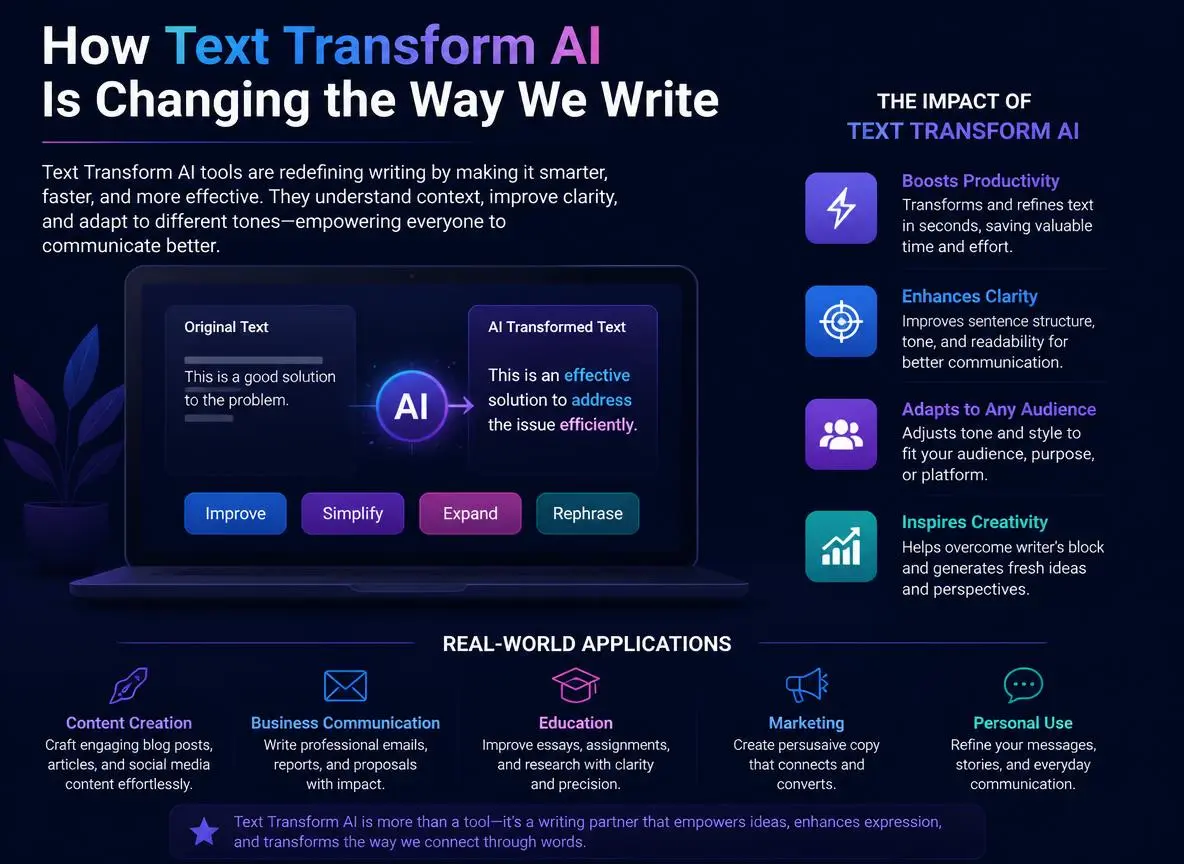
How Text Transform AI Is Changing the Way We Write
Writing has always been one of the most important ways humans communicate ideas. From handwritten letters and printed books to blogs, social media posts, and digital marketing, the way we create and share written content has changed dramatically over time.
Today, another major transformation is taking place: Text Transform AI is changing the way people write, edit, rewrite, and communicate online.
Text Transform AI refers to artificial intelligence tools that can transform existing text into a different form while preserving its original meaning. Depending on the tool and the user's goal, AI can rewrite sentences, paraphrase paragraphs, simplify complicated language, improve grammar, adjust tone, shorten content, expand ideas, or make writing more engaging.
For students, freelancers, bloggers, marketers, businesses, and everyday internet users, these tools can significantly reduce the time required to turn an idea into polished content.
But Text Transform AI is not simply about making writing faster. It is changing the entire writing process.
What Is Text Transform AI?
Text Transform AI is a type of artificial intelligence technology designed to understand written language and generate an improved or transformed version of that text.
Instead of simply replacing individual words with synonyms, modern AI systems can analyze the context and relationship between words and sentences. This allows them to restructure content while attempting to maintain the original meaning.
For example, a simple sentence such as:
“This tool helps users write better content faster.”
could be transformed into:
“This tool enables users to create high-quality content in less time.”
The basic idea remains the same, but the wording and sentence structure have changed.
Depending on the purpose, a Text Transform AI tool may offer several functions, including:
Text rewriting
Sentence rephrasing
Paragraph paraphrasing
Grammar improvement
Spelling correction
Tone adjustment
Content expansion
Text summarization
Simplifying complex writing
Making content more professional
Making writing more conversational
Improving readability
This makes AI-powered text transformation useful across many different industries and writing situations.
Why Are People Using AI to Transform Text?
One of the biggest reasons is simple: time.
Writing high-quality content can take hours. A person may have a good idea but struggle to organize it, choose the right words, or maintain a consistent writing style.
AI can help with these repetitive tasks.
For example, a blogger might write a rough paragraph and use an AI rewriting tool to improve its structure. A freelancer might need to create several variations of a product description. A student may want to simplify a difficult paragraph so that it is easier to understand.
Instead of starting from a blank page every time, users can begin with existing text and use AI to transform it.
This changes writing from a purely manual process into a collaborative process between humans and technology.
AI Is Becoming a Writing Assistant, Not Just a Generator
One of the biggest misconceptions about artificial intelligence writing tools is that they are only designed to generate content from scratch.
In reality, one of the most useful applications of AI is assisting human writers.
A writer may already know what they want to say but have difficulty expressing it clearly. AI can help turn rough ideas into readable sentences.
For example, a writer can provide:
“Our software makes writing easier and saves time for users.”
An AI tool can help transform this into a more polished sentence:
“Our software simplifies the writing process, helping users create content more efficiently while saving valuable time.”
The human still provides the original idea. AI simply helps improve the presentation.
This approach can make the writing process faster without removing the human element.
How Text Transform AI Helps Bloggers
Blogging requires more than simply writing words.
Successful bloggers need to research topics, organize information, create engaging introductions, improve readability, write headings, develop conclusions, and often update older content.
Text Transform AI can assist with many of these tasks.
For example, a blogger can use AI to:
Rewrite an unclear introduction.
Create alternative headings.
Simplify long paragraphs.
Improve sentence flow.
Turn notes into readable paragraphs.
Create different versions of a description.
Shorten lengthy explanations.
Expand brief ideas into detailed sections.
However, AI should not replace research and human judgment.
Google's guidance emphasizes that content should provide value to people and demonstrate qualities such as experience, expertise, authoritativeness, and trustworthiness. Simply producing large amounts of automatically generated text without adding meaningful value can create problems.
Therefore, the best approach is to use AI as a writing assistant while keeping human review and originality at the center of the process.
Text Transform AI and SEO
Search engine optimization has also been affected by AI writing technology.
In the past, writers often focused heavily on inserting exact keywords into articles. Modern search engines are much better at understanding context, intent, synonyms, and relationships between concepts.
This means that good SEO writing is increasingly about answering the user's question clearly rather than simply repeating keywords.
AI can help writers identify unclear sections, improve readability, create logical structures, and produce useful variations of language.
However, using AI does not automatically make content rank higher.
Google has stated that AI-generated content does not receive a special ranking advantage. Content needs to be useful, original, and created primarily for people rather than for manipulating search rankings.
Google's newer guidance also emphasizes creating unique, valuable, non-commodity content that offers something beyond information that could easily be generated or repeated elsewhere.
That means website owners should avoid publishing hundreds of generic AI-generated pages simply because they can.
Instead, AI should help improve the quality of content.
Rewriting vs. Copying
There is an important difference between transforming content and copying content.
A good Text Transform AI tool attempts to understand the meaning of the original text and express it differently. But rewriting someone else's article does not automatically make it original or valuable.
For example, taking an existing article from another website, running it through an AI rewriter, and publishing the result without adding new information, experience, analysis, or sources is unlikely to create meaningful value for readers.
The goal should not be:
“How can I rewrite existing content as quickly as possible?”
A better question is:
“How can I use AI to create something more useful for my audience?”
That difference is extremely important for modern content creators.
How Students Can Use Text Transform AI
Students are another group that can benefit from text transformation technology.
Students often need to understand difficult information and communicate their ideas clearly.
AI tools can help them:
Simplify complicated sentences
Improve grammar
Make explanations easier to understand
Rephrase notes
Improve clarity
Create summaries
Adjust writing tone
Identify awkward sentences
For example, a complex academic sentence can be transformed into simpler language without losing the main concept.
However, students should use these tools responsibly. AI should support learning rather than replace it.
Understanding the subject, developing original ideas, and following academic rules should always remain the student's responsibility.
How Freelancers Can Save Time
Freelancers often work with multiple clients and different types of content.
One client might need professional website copy. Another might need casual social media posts. A third might require product descriptions.
Changing writing style repeatedly can take significant time.
Text Transform AI can help freelancers adapt content to different audiences.
A single idea can potentially be transformed into:
A professional business description
A social media caption
An email
A short advertisement
A blog introduction
A product description
A conversational explanation
This flexibility allows freelancers to spend more time on strategy, research, and creativity instead of repetitive editing.
Businesses Are Using AI to Improve Communication
Businesses produce enormous amounts of written communication every day.
Emails, product descriptions, customer support responses, advertisements, reports, website pages, internal documents, and social media posts all require writing.
Text transformation tools can help businesses maintain consistency across these different formats.
For example, a company may have a technical product description that is accurate but difficult for ordinary customers to understand.
AI can transform the technical explanation into simpler customer-friendly language.
Similarly, a casual internal message can be transformed into a professional business communication.
This can improve both productivity and communication quality.
AI Can Help Improve Readability
Good writing is not necessarily complicated writing.
In many situations, simple and clear language is more effective than complex vocabulary.
Text Transform AI can help identify unnecessarily complicated sentences and transform them into easier-to-read versions.
For example:
“Users are required to utilize the application in order to facilitate the completion of the process.”
could become:
“Users need to use the application to complete the process.”
The second sentence is shorter and easier to understand while communicating the same basic idea.
This is particularly useful for websites, instructions, customer support pages, and educational content.
Changing the Tone of Written Content
Another powerful feature of AI text transformation is tone adjustment.
The same information can sound completely different depending on how it is written.
A sentence can be transformed into a:
Professional tone
Friendly tone
Casual tone
Persuasive tone
Academic tone
Formal tone
Conversational tone
Marketing-focused tone
For example:
Basic:
“Try our new writing tool.”
Professional:
“Discover a more efficient way to improve and transform your written content.”
Friendly:
“Want to make your writing better? Give our new tool a try!”
The information is similar, but the emotional impact is different.
This gives writers greater control over how their message is communicated.
Multilingual Writing and Global Communication
AI is also helping people communicate across languages.
A person can write an idea in one language and transform it into another language or style.
This can be useful for international businesses, freelancers, travelers, students, and website owners.
Instead of creating every version manually, AI can assist with translating and adapting content for different audiences.
However, translation and localization are not always the same thing.
A direct translation may be grammatically correct but still sound unnatural to a native speaker.
Human review remains valuable when accuracy, cultural context, or professional communication is important.
The Human Writer Still Matters
Despite the rapid development of AI, human creativity remains extremely important.
AI can recognize patterns and generate language, but people provide personal experiences, opinions, emotions, judgment, creativity, and real-world expertise.
Consider two articles about the same topic.
One simply summarizes information available across the internet.
The other includes:
Personal experience
Original research
Real examples
Unique opinions
Expert insights
Practical recommendations
The second article can provide much greater value to readers.
Google's current guidance specifically encourages creators to provide unique viewpoints, firsthand experience, useful analysis, and content that goes beyond simply repeating information available elsewhere.
AI can help polish that content, but the human experience is what can make it genuinely distinctive.
The Risks of Overusing Text Transform AI
Like any technology, AI writing tools have limitations.
One major problem is that AI can sometimes produce inaccurate information.
It may also:
Change the original meaning
Remove important context
Produce repetitive language
Make writing sound generic
Introduce unsupported claims
Create an unnatural tone
Overuse certain phrases
For this reason, users should always review transformed content before publishing it.
The more important the subject, the more carefully the content should be checked.
This is particularly important for medical, financial, legal, scientific, and other high-stakes topics.
Will AI Replace Human Writers?
The more realistic answer is that AI is more likely to change the role of writers than completely eliminate writers.
Writing jobs may evolve.
Instead of spending most of their time correcting grammar or rewriting simple sentences, writers may increasingly focus on:
Research
Strategy
Creativity
Storytelling
Brand voice
Original opinions
Fact-checking
Editing
Audience understanding
In this environment, writers who know how to use AI effectively may have an advantage over writers who refuse to adapt.
The future may not be “AI versus writers.”
It may be writers using AI versus writers who do not use AI effectively.
The Future of Text Transform AI
Text transformation technology is likely to become more sophisticated.
Future tools may better understand context, audience, brand identity, cultural differences, and individual writing styles.
Instead of simply asking AI to “rewrite this paragraph,” users may be able to define detailed preferences such as:
Write in my personal style.
Keep my original meaning.
Make the explanation easier for beginners.
Use a professional but friendly tone.
Remove unnecessary words.
Preserve important technical terminology.
Make the content more engaging without exaggeration.
This could turn AI into a highly personalized writing assistant.
At the same time, the importance of originality and authenticity will likely increase.
As more people gain access to AI writing tools, generic content becomes easier to produce. Therefore, unique experiences, expertise, opinions, research, and creativity can become even more valuable.
How to Use Text Transform AI the Right Way
The most effective workflow is not to let AI do everything.
A better process looks like this:
Step 1: Start With Your Own Idea
Know what you want to communicate before using AI.
Step 2: Create a Rough Draft
Write your key points, facts, experiences, or arguments.
Step 3: Use AI for Transformation
Ask the tool to improve clarity, grammar, structure, tone, or readability.
Step 4: Review the Output
Check whether the transformed version still represents your original meaning.
Step 5: Add Human Value
Include examples, experience, opinions, research, and useful information that makes the content genuinely yours.
Step 6: Fact-Check
Verify important claims and update outdated information.
Step 7: Publish for People
Your final goal should be to satisfy the reader—not simply to produce text.
This approach aligns with Google's people-first content guidance, which emphasizes useful, reliable, original information rather than content created primarily to attract search-engine traffic.
Final Thoughts
Text Transform AI is changing the way we write by making rewriting, editing, paraphrasing, simplifying, and adapting content faster and more accessible.
For bloggers, students, freelancers, marketers, businesses, and everyday users, AI can reduce repetitive work and make the writing process more efficient.
But the real power of this technology comes from combining artificial intelligence with human creativity.
AI can help transform words.
Humans provide the ideas, experience, judgment, and purpose behind those words.
The future of writing will therefore probably not be about choosing between humans and AI. Instead, it will be about learning how to use AI responsibly while preserving the qualities that make writing valuable: originality, accuracy, creativity, personality, and genuine usefulness.
As Text Transform AI continues to evolve, the writers who learn to work with these tools—not simply depend on them—will be best positioned to communicate effectively in the next generation of the internet.