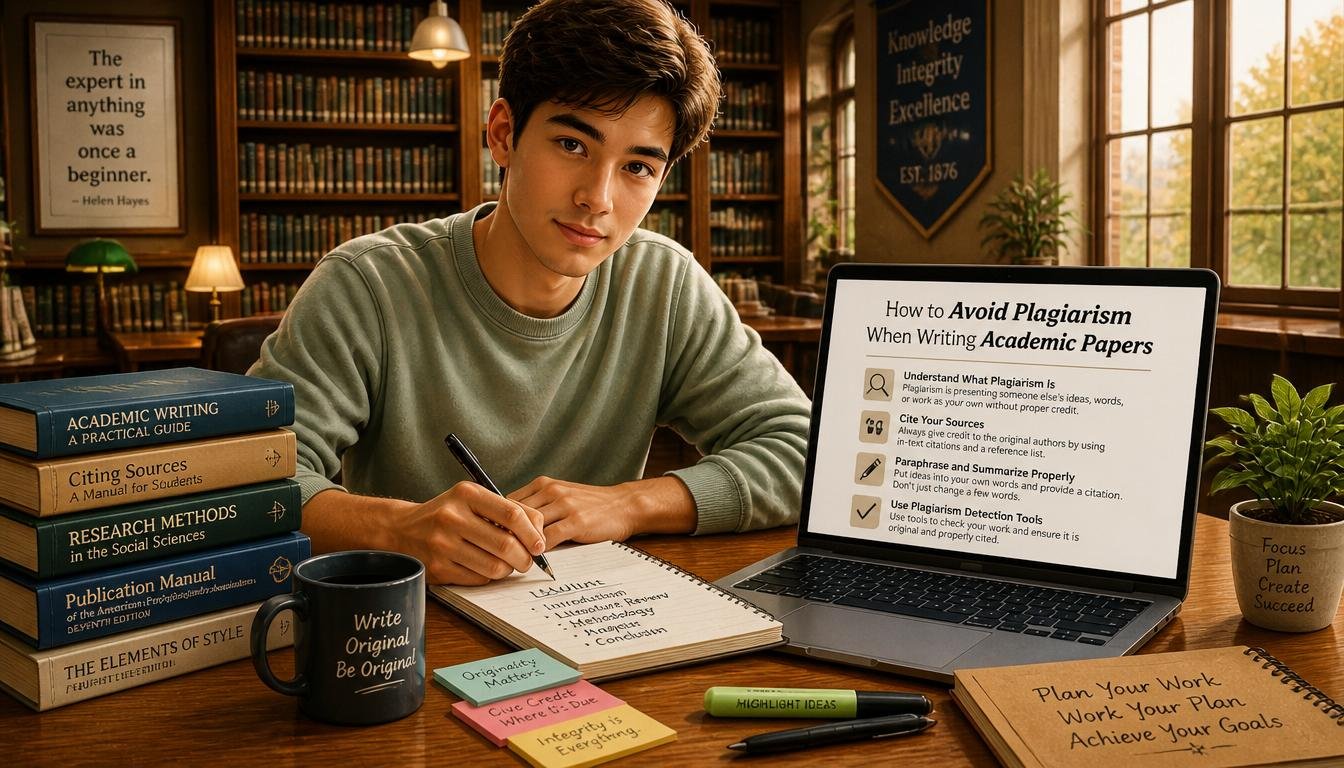
How to Avoid Plagiarism When Writing Academic Papers.
Academic writing is built on ideas, research, evidence, and careful communication. Whether you are writing a university assignment, research paper, thesis, dissertation, literature review, or academic essay, using information from other sources is an important part of the process.
However, using someone else's words or ideas without giving proper credit can result in plagiarism.
Plagiarism is a serious concern in academic writing because it can affect a student's grades, academic reputation, and, in some situations, their academic standing. The good news is that plagiarism is usually avoidable when writers understand how to research, take notes, paraphrase, quote, cite, and organize their sources correctly.
In this guide, we will explain practical ways to avoid plagiarism when writing academic papers and how tools such as AI text rewriters can be used responsibly as part of the writing and editing process.
What Is Plagiarism?
Plagiarism generally means presenting another person's words, ideas, research, or creative work as your own without appropriate acknowledgment.
It can happen intentionally or accidentally.
For example, copying a paragraph from a website and submitting it without a citation is plagiarism.
But plagiarism can also happen unintentionally when a student forgets where an idea came from or paraphrases a source too closely without providing a citation.
Common examples include:
Copying text without attribution
Using someone else's ideas without citation
Closely paraphrasing a source without credit
Submitting another person's work as your own
Reusing previous work without following applicable rules
Misrepresenting sources
Using quotations without proper citation
Failing to distinguish your notes from source material
Understanding these different forms is the first step toward avoiding them.
Why Is Avoiding Plagiarism Important?
Academic work is based on intellectual honesty.
When you submit a research paper, you are expected to clearly distinguish between your own contribution and information obtained from other sources.
Proper citation allows readers and instructors to see:
Where information came from
Which ideas belong to other researchers
Which statements are supported by evidence
How your argument relates to previous research
Citations also make your paper more credible.
A well-researched academic paper does not need to pretend that every idea is original. Academic writing normally builds on existing knowledge.
The important thing is to acknowledge the sources you use.
1. Understand Your Assignment Before You Start
One of the easiest ways to create plagiarism problems is to begin writing without understanding the assignment.
Before researching, determine:
What topic are you expected to discuss?
What type of sources are allowed?
Does your instructor require academic journals?
What citation style should you use?
How many sources are required?
Are AI tools permitted?
Is collaboration allowed?
Can you reuse material from previous assignments?
Different institutions and instructors may have different policies.
For example, an instructor may require APA style, while another may require MLA or Chicago style.
AI policies can also vary significantly.
Before using an AI writing or rewriting tool for an academic assignment, check your institution's rules.
2. Research From Reliable Sources
Good academic writing starts with good research.
Use reliable sources that are appropriate for your subject.
Depending on your assignment, these may include:
Peer-reviewed journal articles
Academic books
University publications
Government reports
Official organizations
Research databases
Conference papers
Avoid relying entirely on random websites or anonymous online content.
Reliable sources make it easier to identify the original authors and provide accurate citations.
When researching online, save the source information immediately.
Record details such as:
Author
Title
Publication
Date
Page number, when applicable
DOI or URL, when required
Publisher
Doing this while researching is much easier than trying to reconstruct your sources at the end.
3. Keep Detailed Research Notes
Good note-taking is one of the best ways to prevent accidental plagiarism.
When taking notes, clearly distinguish between:
Your own thoughts
and
Information taken from a source.
For example, you might organize your notes like this:
My idea:
Social media may influence how university students communicate.
Source information:
Researcher X found a relationship between social media use and communication patterns among students.
Direct quotation:
“[Short quotation from source]”
Keeping these categories separate reduces the risk of accidentally copying source language into your final paper.
Always record the source next to the relevant note.
4. Learn the Difference Between Quoting and Paraphrasing
Quoting and paraphrasing are not the same thing.
Quoting
A quotation uses the original author's exact words.
When you quote, you generally need to:
Use quotation marks for a short quotation, according to your style guide
Identify the source
Provide the required citation
Include page or location information when required by the citation style
For example:
“Quoted material goes here” (Author, Year, p. 10).
The exact format depends on your required citation style.
Paraphrasing
Paraphrasing means expressing information from a source in your own words and sentence structure.
A paraphrase still requires a citation because the underlying idea came from another source.
Changing only a few words is not enough.
5. Learn How to Paraphrase Properly
Paraphrasing is one of the most important skills in academic writing.
Poor paraphrasing often happens when students take a source sentence and replace a few words with synonyms.
For example, imagine the original source says:
“Regular physical activity can contribute to improved mental well-being among university students.”
A weak paraphrase might be:
“Regular exercise can contribute to better mental health among college students.”
Although some words have changed, the structure and wording remain very similar.
A stronger paraphrase would reorganize the idea:
“University students may experience psychological benefits when physical activity becomes part of their regular routine.”
The sentence structure has changed more substantially.
However, even a good paraphrase still needs a citation because the underlying information comes from the source.
6. Do Not Use Synonyms as a Substitute for Paraphrasing
One common mistake is using a thesaurus or AI rewriter to replace words while keeping the original sentence structure.
For example:
Original:
“Technology has significantly changed the way students access educational resources.”
Weak rewrite:
“Technology has greatly altered the way students obtain educational materials.”
Although the vocabulary is different, the structure remains almost identical.
Good paraphrasing requires understanding the source first and then expressing the idea independently.
A useful method is:
Read the original passage.
Understand its meaning.
Look away from the source.
Explain the idea in your own words.
Compare your version with the original.
Add the appropriate citation.
This approach encourages genuine understanding rather than word substitution.
7. Use Direct Quotes Selectively
Quotations can be valuable, but academic papers should not normally consist primarily of quotations.
Use a direct quote when the exact wording is particularly important.
For example, a quotation may be useful when:
A researcher provides an important definition
The original wording is especially precise
You are analyzing the author's language
The statement is historically significant
The exact wording is central to your argument
For most ordinary information, paraphrasing may be more effective.
Always follow the citation requirements of your chosen academic style.
8. Cite Ideas, Not Just Words
Many students think citations are only required when copying exact words.
That is incorrect.
You may also need to cite information when you use another researcher's:
Argument
Theory
Finding
Interpretation
Data
Statistics
Method
Unique idea
Even if you completely rewrite the wording, the underlying idea may still belong to the original author.
Therefore, changing the language does not remove the need for attribution.
9. Understand Common Knowledge
Not every statement requires a citation.
Common knowledge generally refers to information that is widely known and not reasonably attributed to one particular source.
For example:
“The Earth revolves around the Sun.”
This is widely established knowledge.
However, specific statistics, research findings, controversial claims, historical interpretations, or specialized information generally require sources.
When you are uncertain, checking the relevant citation requirements or asking your instructor is safer than assuming that something is common knowledge.
10. Keep Track of Every Source
Source management becomes especially important when writing longer papers.
You may read 20, 30, or even 50 sources during research.
If you do not organize them, it becomes easy to forget where a particular fact or argument came from.
Consider maintaining a research table with columns such as:
| Source | Main Idea | Useful Information | Citation Needed |
|---|---|---|---|
| Article A | Main research finding | Key statistic | Yes |
| Book B | Theoretical framework | Theory explanation | Yes |
| Report C | Industry data | Recent figures | Yes |
This simple system can save significant time during the writing process.
11. Use Citation Management Tools
Citation management software can make academic research easier.
Depending on your needs, tools such as reference managers can help organize sources and generate citations.
However, automated citation tools are not perfect.
Always verify the final citation against the requirements of your institution or citation style.
Check:
Author names
Publication dates
Titles
Journal names
Volume and issue
Page numbers
DOI
Formatting
Never assume that a generated citation is automatically correct.
12. Be Careful When Using AI Writing Tools
AI tools can be useful in academic writing, but their use should be responsible.
Depending on your institution's rules, AI may be permitted for tasks such as:
Brainstorming
Grammar improvement
Language practice
Outlining
Clarifying difficult concepts
Editing your own draft
Other institutions may impose stricter restrictions.
Always check the rules before using AI for assessed work.
AI should not be used to disguise copied content or misrepresent generated work as your own when that violates academic policies.
Can an AI Text Rewriter Help Avoid Plagiarism?
An AI text rewriter can help improve the wording of your own draft, but it should not be treated as a plagiarism solution.
For example, if you copy a published article and run it through an AI rewriter, the result may still be derived from someone else's work.
Changing the words does not change the ownership of the underlying ideas.
A responsible approach is to:
Research the source.
Understand the information.
Write your own explanation.
Cite the original source.
Use AI, if permitted, to improve clarity.
Review the final version yourself.
The citation remains important.
13. Check Your Paper Before Submission
Before submitting an academic paper, perform a final plagiarism and citation review.
Read each section and ask:
Did I use information from another source here?
If yes:
Did I provide the appropriate citation?
Also check whether your bibliography includes every source cited in the paper.
Look for:
Missing citations
Incorrect citations
Unmarked quotations
Closely paraphrased passages
Missing page numbers where required
Sources listed in the bibliography but never cited
Citations that are missing from the bibliography
This final review can catch many problems.
14. Use Plagiarism Detection Tools Responsibly
Plagiarism detection software can help identify text that resembles existing sources.
These tools can be useful during editing, but their results should not be interpreted as a simple measure of academic honesty.
A similarity score does not automatically mean plagiarism.
For example, properly cited quotations, common phrases, titles, references, and standard terminology may produce similarities.
Likewise, a low similarity score does not automatically guarantee that a paper is academically sound.
The important question is whether sources have been properly acknowledged and whether the work follows your institution's academic standards.
15. Avoid Self-Plagiarism
Plagiarism is not always about copying another person.
In some academic contexts, reusing your own previously submitted work without permission or disclosure can also create problems. This is sometimes referred to as self-plagiarism or inappropriate text reuse.
For example, suppose you previously submitted an essay for one course.
You then copy large sections into a new assignment for another course without permission.
Even though you wrote the original text, the reuse may violate your institution's rules.
If you want to reuse previous research or writing, check your instructor's policy first.
16. Write From Understanding, Not From Copying
One of the strongest ways to avoid plagiarism is to genuinely understand the topic.
Instead of collecting sentences that sound useful, focus on understanding the underlying ideas.
Ask:
What is the author arguing?
What evidence supports the argument?
How does this source relate to my research question?
Do I agree or disagree?
How can I explain this concept to my reader?
How does this information support my argument?
Once you understand the material, it becomes much easier to write an independent explanation.
17. Add Your Own Analysis
Academic writing should not simply be a collection of information from other sources.
Your paper should demonstrate your ability to analyze and connect ideas.
For example, instead of writing:
“Researcher A found X. Researcher B found Y. Researcher C found Z.”
You could explain how these findings relate to one another.
Perhaps the studies support each other.
Perhaps they disagree.
Perhaps they used different methods.
Perhaps their results apply to different populations.
Your analysis creates original academic value while still giving appropriate credit to the researchers.
A Simple Anti-Plagiarism Workflow
A practical workflow can make plagiarism prevention easier.
Step 1: Research
Find reliable sources relevant to your topic.
Step 2: Record Sources
Save complete citation information immediately.
Step 3: Take Organized Notes
Clearly distinguish your thoughts from source material.
Step 4: Understand the Research
Read and interpret the information before writing.
Step 5: Draft in Your Own Words
Develop your argument and explanations independently.
Step 6: Cite Sources
Add citations wherever you use another person's ideas, data, or words.
Step 7: Review Paraphrases
Make sure your paraphrases are genuinely your own wording and structure.
Step 8: Check Quotations
Confirm that every direct quotation is clearly identified and properly cited.
Step 9: Check References
Make sure your bibliography or reference list is complete and correctly formatted.
Step 10: Run a Final Review
Use an appropriate plagiarism or similarity checker if available and permitted.
Final Thoughts
Avoiding plagiarism does not mean avoiding other people's research.
Academic writing depends on building upon existing knowledge.
The key is to clearly distinguish between your contribution and the contributions of other researchers.
Research carefully.
Take organized notes.
Understand what you read.
Paraphrase genuinely rather than simply replacing words.
Use direct quotations when appropriate.
Cite ideas as well as exact words.
Keep accurate records of your sources.
And always follow your institution's rules regarding citations, collaboration, previous work, and AI tools.
AI text rewriters and other AI writing tools can support the editing and writing process when their use is permitted, but they should never be treated as a method for hiding copied material.
Ultimately, good academic writing is built on three things:
Original thinking, responsible use of sources, and proper attribution.
When you combine those principles, you can create academic papers that are not only safer from plagiarism but also clearer, more credible, and more intellectually valuable.