
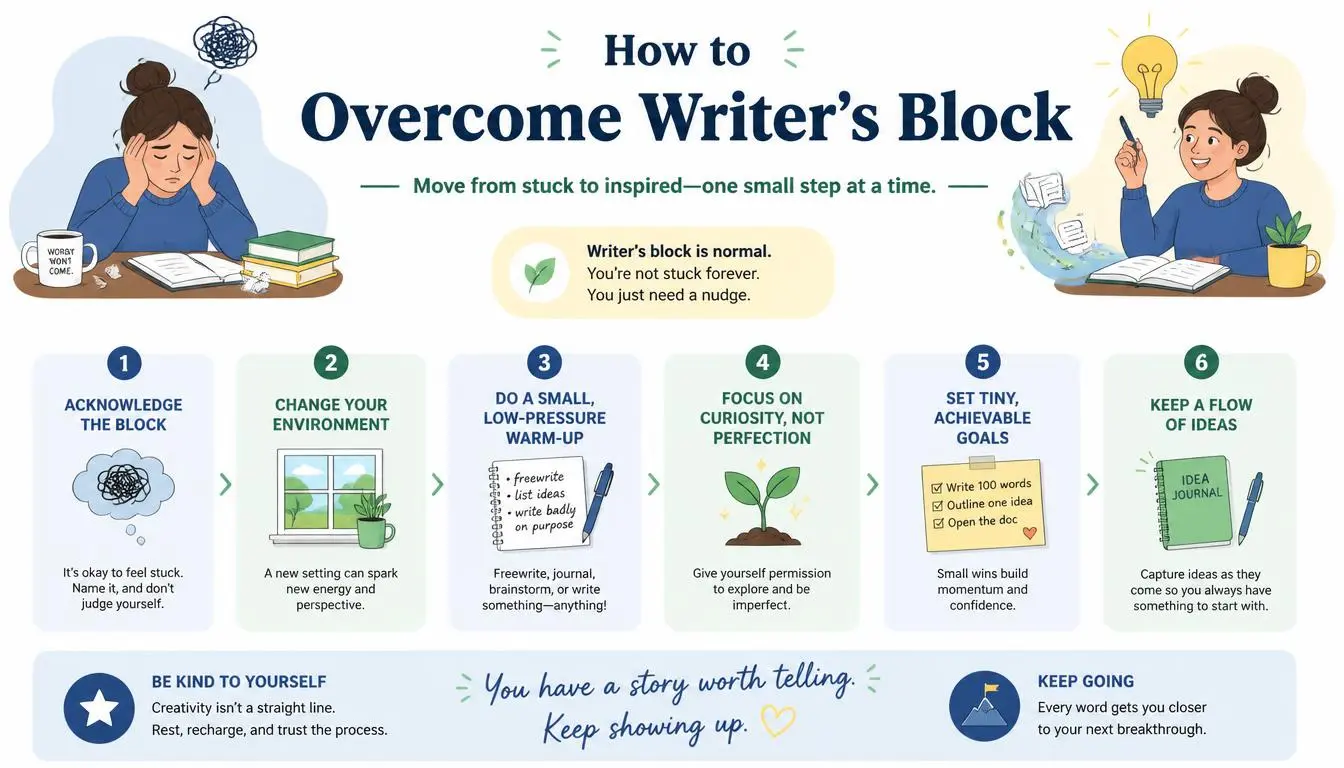
How to Overcome Writer's Block
Every writer, regardless of experience level, encounters periods where words simply will not come. Writer's block can feel mysterious and frustrating, but it usually has identifiable causes and, more importantly, practical solutions. This guide covers why writer's block happens and concrete techniques for working through it.
Understanding What Causes Writer's Block
Perfectionism.
Trying to write a perfect sentence on the first attempt creates enormous pressure that can freeze the writing process entirely. Many cases of writer's block stem not from a lack of ideas, but from an unwillingness to write anything less than ideal.
Unclear direction.
Sitting down to write without a clear sense of what you are trying to say or accomplish often produces a blank-page paralysis, since there is no specific starting point to latch onto.
Mental fatigue or burnout.
Writer's block sometimes reflects genuine cognitive exhaustion rather than a technique problem, particularly after periods of sustained, demanding writing work.
Fear of judgment.
Concern about how a piece will be received, whether by an editor, a boss, or a public audience, can create enough anxiety to block the writing process, especially for high-stakes pieces.
Practical Techniques to Break Through.
Lower the bar for your first draft.
Give yourself explicit permission to write badly. Remind yourself that first drafts exist to be revised, not published. This single mindset shift resolves a significant portion of perfectionism-driven writer's block.
Write out of order.
If you are stuck on an introduction or a specific section, skip it and write whatever part feels most accessible right now. Momentum in any part of the piece often makes the harder sections easier to tackle afterward.
Use freewriting to loosen up.
Set a timer for five or ten minutes and write continuously about your topic without stopping to edit, even if what comes out feels disorganized or bad. This technique separates the generative and critical parts of your brain, often unlocking ideas that structured, careful writing was suppressing.
Change your environment.
A different physical location, a change in background noise, or even switching from typing to handwriting can disrupt an unproductive mental pattern and create fresh momentum.
Talk through your ideas out loud.
Explaining what you are trying to say to another person, or even to yourself, often clarifies your thinking in ways that staring at a blank page does not. Many writers find it easier to speak an idea clearly before they can write it clearly.
Set a very small, specific goal.
Rather than aiming to "write the article," aim to "write one paragraph explaining the main problem." Smaller, well-defined goals feel far more achievable than vague, large ones, which reduces the psychological barrier to starting.
Take a genuine break.
If you have been staring at the same section for an extended period without progress, stepping away — for a walk, a different task, or rest — often resolves a mental block more effectively than continuing to force output.
Building Long-Term Resistance to Writer's Block.
Separate drafting from editing as a habit,
not just an occasional technique. Consistently allowing yourself to write rough first drafts, with editing reserved for a later pass, prevents much of the perfectionism that causes blocks in the first place.
Keep a running list of ideas
for future writing, captured whenever they occur to you rather than only when you sit down to write. Starting a writing session with an existing idea, rather than searching for one cold, significantly reduces blank-page anxiety.
Establish a consistent writing routine.
Writing at a similar time and place regularly trains your brain to shift into a writing mindset more easily over time, reducing the friction of getting started on any individual day.
When Writer's Block Signals Something Deeper
Occasional writer's block is a normal part of the creative process. If blocks are frequent, prolonged, or accompanied by significant anxiety or low mood extending beyond writing specifically, it may be worth considering whether broader stress, burnout, or other factors are contributing, and whether it would help to talk to someone about it.
Final Thought
Writer's block is rarely a sign that you have run out of ideas; more often, it reflects pressure, unclear direction, or fatigue getting in the way of ideas you already have. Lowering the stakes of a first draft, breaking the task into smaller pieces, and giving yourself permission to write imperfectly are usually enough to get the words moving again.