
How to Structure a Blog Post That Keeps Readers Engaged
A blog post can contain genuinely valuable information and still fail to hold readers' attention if it's poorly structured. Structure is often the invisible factor separating blog posts that readers finish, share, and return for, from posts that get abandoned after the first few lines. This guide breaks down the core structural elements that make blog posts easy to read, easy to scan, and effective at delivering on what they promise.
Why Structure Matters as Much as Content
Most web readers decide within seconds whether a blog post is worth their continued attention, often based more on how approachable the page looks than on the actual quality of the writing itself. A wall of dense, unbroken text signals effort required, while a well-structured post with clear headings, appropriate paragraph length, and visual breathing room signals that the content will be easy to consume.
This doesn't mean substance is unimportant — it means that even excellent content needs the right structural presentation to actually get read.
Start With a Strong, Specific Headline
The headline is the single most important structural element of a blog post, since it determines whether someone clicks in the first place. Effective blog headlines are typically:
- Specific rather than vague ("7 Proven Ways to Reduce Email Overload" rather than "Tips for Better Email Habits")
- Clear about the value readers will get — what will they learn, solve, or gain?
- Realistic — headlines that overpromise relative to the actual content lead to disappointed readers and higher bounce rates
Open With a Strong Introduction
The introduction has a narrow window — often just the first sentence or two — to convince a reader to keep going. An effective blog introduction typically accomplishes a few things quickly:
- Establishes the problem or topic the post addresses
- Signals relevance to the specific reader who clicked
- Previews the value the reader will get by continuing
Weak opening: "In today's fast-paced world, communication has become more important than ever."
Stronger opening: "If your inbox has over 200 unread emails right now, this post will show you exactly how to get it back under control in under a week."
The second version immediately signals specific, actionable value rather than opening with a broad, generic statement that could apply to almost any topic.
Use Descriptive Subheadings Throughout
Subheadings serve two critical purposes: they help readers scan the post to find relevant sections, and they break up long stretches of text into visually manageable chunks.
Effective subheadings are specific enough that a reader scanning only the headings could still understand the post's overall structure and key points. Vague headings like "Tip 1," "Tip 2," and "Tip 3" provide far less scanning value than descriptive ones like "Batch Process Emails Twice a Day" or "Turn Off Non-Essential Notifications."
Keep Paragraphs Short
Web readers, especially on mobile devices, are discouraged by dense blocks of text. As a general guideline, most blog paragraphs work best at 2-4 sentences, occasionally shorter for emphasis. This doesn't mean sacrificing depth — it means breaking naturally longer explanations into multiple shorter paragraphs rather than one dense block.
Use Bullet Points and Numbered Lists Strategically
Lists are one of the most effective structural tools for presenting information that's naturally sequential (steps in a process) or comparative (options, features, pros and cons). They allow scanning readers to quickly extract key information without reading full sentences.
However, lists shouldn't replace all prose — overusing lists for content that would be better explained in connected sentences can make a post feel choppy and disconnected, losing the natural flow and reasoning that paragraph form provides.
Include Visual Breaks
Beyond subheadings and lists, other structural elements help break up long-form content and give readers visual rest points:
- Images or screenshots relevant to the content
- Pull quotes highlighting a particularly important point
- Bold text sparingly used to emphasize key phrases
- Dividers or section breaks for especially long posts covering multiple distinct topics
Structure for Different Blog Post Types
How-to and tutorial posts benefit from clear numbered steps, often with a brief overview at the top summarizing what the reader will accomplish.
Listicles (numbered list posts) work best when each list item has a consistent format — a subheading, brief explanation, and any relevant example or supporting detail — so readers can predict and navigate the structure easily.
Opinion or thought-leadership posts often benefit from a clear argument structure: stating a position early, supporting it with reasoning and examples, addressing counterpoints, and closing with a clear takeaway.
Comparison posts (Product A vs. Product B) work well with parallel structure — covering the same categories or criteria for each option in the same order, making it easy for readers to compare directly.
End With a Clear Conclusion
A blog post's conclusion should reinforce the main takeaway and, where appropriate, guide the reader toward a next step. This might include:
- A brief summary of the key points, especially useful for longer posts
- A call to action — subscribing, trying a related tool, reading a related post, or leaving a comment
- A forward-looking thought that leaves the reader with something to consider beyond the immediate content
Avoid simply trailing off after the last point without any concluding wrap-up — readers benefit from a clear signal that the post is reaching its intended conclusion.
Internal Linking Within the Post
Where relevant, linking to related content on your own site — other blog posts, tools, or resource pages — serves two purposes: it helps readers find genuinely related content they might be interested in, and it supports overall site structure and SEO by distributing authority across pages.
Internal links work best when they're contextually relevant rather than forced ("check out our other tools!" dropped randomly into unrelated content), and when the anchor text clearly describes what the linked page covers.
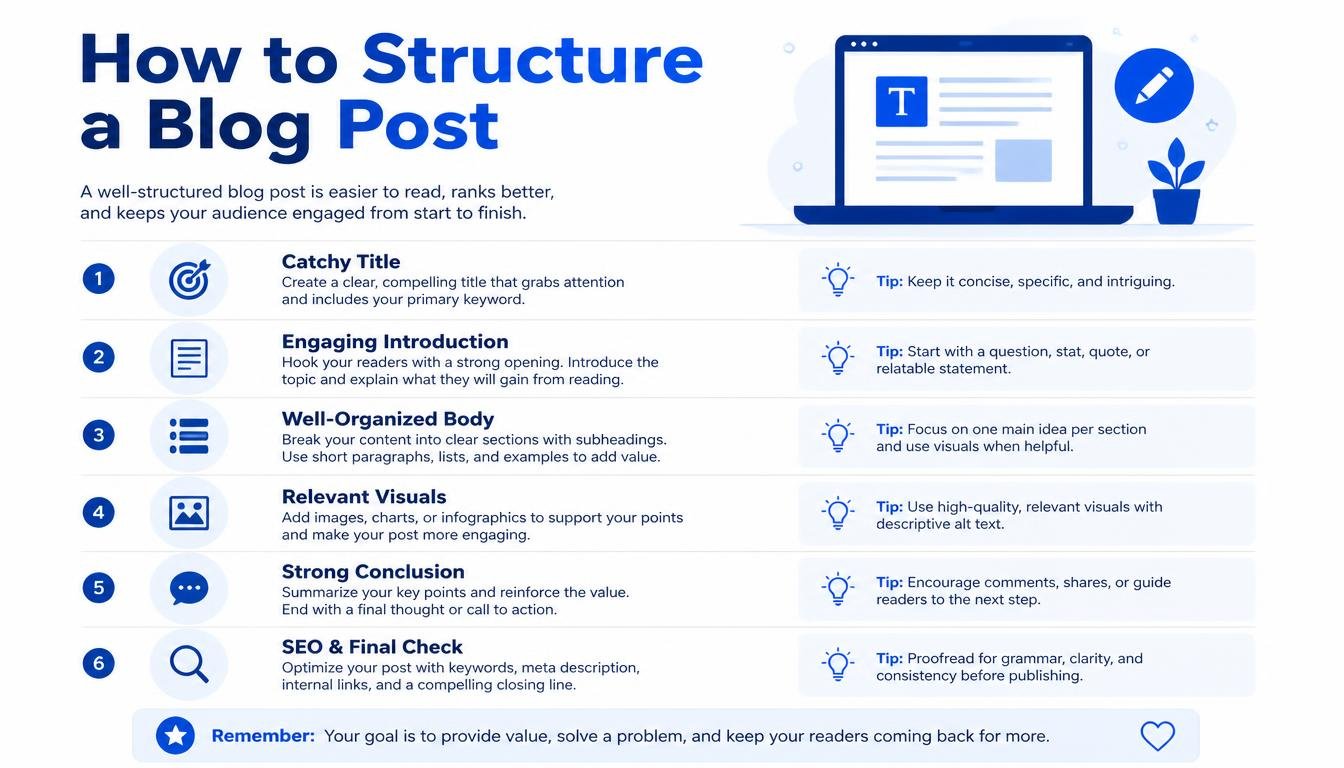
A General Blog Post Structure Template
While not every post needs to follow this exactly, this structure works well as a reliable default:
- Headline — specific, value-clear
- Introduction (2-4 short paragraphs) — hook, problem, value preview
- Body sections with descriptive subheadings, broken into scannable paragraphs and lists as appropriate
- Visual elements where they genuinely add clarity
- Conclusion — summary and clear next step or call to action
Common Structural Mistakes to Avoid
Long, unbroken walls of text. Even excellent content becomes difficult to engage with if it isn't broken into manageable visual sections.
Vague subheadings that don't aid scanning. Generic labels like "Introduction," "Tip 1," or "More Info" waste the scanning value that good subheadings provide.
Burying the main point. If readers have to read through several paragraphs before understanding the post's core value or argument, many will leave before getting there.
Inconsistent formatting. Switching randomly between different structural approaches (sometimes lists, sometimes dense paragraphs, inconsistent heading styles) can make a post feel disorganized even when the underlying content is solid.
No clear conclusion. Ending abruptly without summarizing or guiding the reader toward a next step leaves the post feeling incomplete.
Final Thoughts
Strong blog post structure isn't about rigid formatting rules — it's about respecting how readers actually engage with web content: scanning first, committing to deeper reading only when the structure signals it's worth their time. Clear headlines, scannable subheadings, appropriately short paragraphs, and a well-organized flow from introduction to conclusion make the difference between a blog post that genuinely serves its readers and one that gets abandoned halfway through, regardless of how valuable the underlying content actually is.