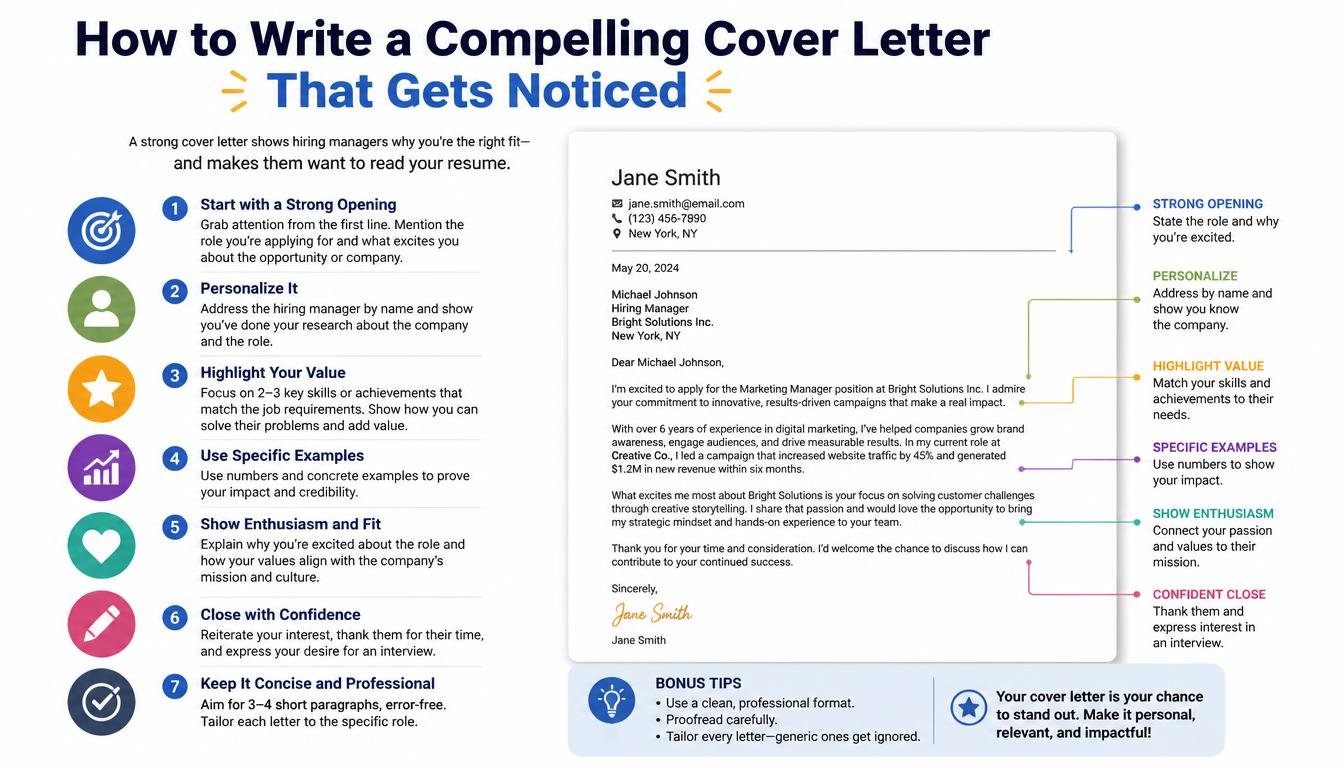
How to Write a Compelling Cover Letter That Gets Noticed.
A well-written cover letter can make a significant difference when you apply for a job.
While your resume summarizes your education, experience, skills, and achievements, a cover letter gives you an opportunity to explain why you are interested in the position, why you are a strong candidate, and what you can bring to the organization.
Unfortunately, many job seekers make the same mistake: they write a generic cover letter and send it to every employer.
A strong cover letter should feel relevant, specific, and professional. It should demonstrate that you understand the role and have taken the time to explain why you are a good fit.
In a competitive job market, your cover letter does not need to tell your entire career story. Instead, it should quickly capture the employer's attention and encourage them to look more closely at your resume.
This guide explains how to write a compelling cover letter, what sections to include, common mistakes to avoid, how to tailor your letter to a specific job, and how AI writing tools can help improve your application.
What Is a Cover Letter?
A cover letter is a short professional document submitted with a job application.
Its primary purpose is to introduce you to an employer and provide context for your application.
A cover letter typically explains:
Which position you are applying for
Why you are interested in the role
What makes you qualified
Which relevant achievements or skills you offer
Why you are interested in the company
How the employer can contact you
Your resume provides detailed career information.
Your cover letter connects that information to the specific job.
Why Is a Cover Letter Important?
Not every employer requires a cover letter, but when one is requested, submitting a thoughtful letter can strengthen your application.
A good cover letter can demonstrate:
Professionalism
A carefully written letter shows attention to detail.
Interest
A customized letter demonstrates that you are genuinely interested in the specific position.
Communication Skills
Your writing provides an early example of how effectively you communicate.
Relevant Experience
You can highlight experiences that directly relate to the position.
Personality
A resume is often structured and factual. A cover letter gives you more room to communicate your motivation and professional personality.
Research the Job Before Writing
Before writing your cover letter, carefully read the job description.
Look for:
Required qualifications
Preferred skills
Responsibilities
Experience requirements
Company information
Keywords
Specific challenges mentioned in the posting
For example, if a company is looking for a content writer who can create SEO articles, your letter should emphasize relevant experience with:
SEO writing
Keyword research
Content strategy
Editing
Web publishing
Do not simply list every skill you possess.
Focus on the skills that matter most for the position.
Research the Company
A generic cover letter can often be identified immediately.
Instead of writing:
“I am interested in working for your company because it is a great organization.”
Explain why the organization interests you.
You might mention:
A product
A recent project
The company's mission
Its industry
Its culture
A specific initiative
Its approach to customers
The goal is to demonstrate genuine interest without exaggerating your knowledge.
Start With a Strong Opening
The first paragraph matters because it determines whether the reader wants to continue.
Avoid weak openings such as:
“I am writing to apply for the position advertised on your website.”
This is not necessarily wrong, but it is generic.
A stronger opening connects your experience to the role.
For example:
“During the past three years, I have helped small businesses increase their organic website traffic through SEO-focused content, and I am excited to bring that experience to your content marketing team.”
This immediately communicates:
Experience
Relevant expertise
A measurable focus
Interest in the position
Mention the Specific Job Title
Make it clear which position you are applying for.
For example:
“I am excited to apply for the Digital Marketing Specialist position at ABC Company.”
This helps the hiring manager understand your purpose immediately.
It is particularly important when a company is recruiting for multiple positions.
Explain Why You Want the Job
Employers want to know why the position interests you.
Avoid focusing only on what the job can provide for you.
Instead, connect your interests to the company's needs.
Weak:
“I want this job because it will help me develop my career.”
Better:
“I am particularly interested in this role because it combines content strategy, SEO, and data-driven marketing—areas where I have developed practical experience through previous projects.”
The second version explains a logical connection between your experience and the position.
Highlight Relevant Skills
Your cover letter should not repeat your entire resume.
Instead, select two or three skills that are particularly relevant.
For example, if you are applying for a project management role, you might highlight:
Project planning
Team coordination
Budget management
Communication
Problem-solving
Then demonstrate these skills through examples.
Instead of saying:
“I am an excellent project manager.”
Write:
“In my previous role, I coordinated a cross-functional team of eight people while managing project schedules and ensuring key milestones were completed on time.”
Evidence is more persuasive than unsupported claims.
Use Achievements Instead of Just Responsibilities
One of the most effective ways to improve a cover letter is to focus on achievements.
Compare:
Responsibility:
“I managed social media accounts.”
Achievement:
“I managed social media campaigns across three platforms and increased average monthly engagement by 35%.”
The second example provides measurable evidence.
Whenever possible, include:
Numbers
Percentages
Revenue
Time saved
Projects completed
Customers served
Team size
Performance improvements
Do not invent numbers.
Only include results you can honestly support.
Use the STAR Approach
The STAR method can help you describe professional achievements clearly.
STAR stands for:
Situation
What was happening?
Task
What needed to be done?
Action
What did you do?
Result
What happened because of your actions?
For example:
“After website traffic declined significantly, I was asked to improve the site's organic performance. I conducted keyword research, reorganized existing content, and developed a new internal linking strategy. Within six months, organic traffic increased by 42%.”
This gives the employer a clear picture of your ability.
Show How You Can Help the Employer
A compelling cover letter should answer:
“What can this person contribute to our organization?”
Instead of focusing entirely on your needs, demonstrate the value you can provide.
For example:
“My experience developing SEO content and analyzing search performance would allow me to contribute to your goal of expanding organic visibility.”
This is more effective than:
“I believe this job would be a great opportunity for me.”
Keep the Language Clear
A cover letter does not need complicated vocabulary.
Clear writing is more professional than unnecessarily complex writing.
Instead of:
“I would like to take this opportunity to express my profound interest in potentially becoming a member of your esteemed organization.”
Use:
“I am excited about the opportunity to join your team.”
The second version is shorter, clearer, and more confident.
Use a Professional Tone
Your cover letter should generally sound:
Confident
Professional
Positive
Respectful
Natural
Avoid sounding:
Desperate
Arrogant
Overly casual
Robotic
Excessively formal
Confidence means presenting your qualifications clearly without making unrealistic claims.
Personalize the Greeting
If possible, address your letter to a specific person.
For example:
“Dear Ms. Johnson,”
is generally more personal than:
“To Whom It May Concern,”
If you cannot find the hiring manager's name, a professional general greeting can still work.
For example:
“Dear Hiring Manager,”
The important thing is to avoid inventing a person's name.
Structure of a Strong Cover Letter
A typical cover letter can contain four or five main sections.
1. Contact Information
Include relevant contact details according to the application requirements.
2. Greeting
Address the hiring manager or appropriate recipient.
3. Opening Paragraph
State the position and briefly explain why you are interested.
4. Main Body
Highlight relevant skills, experience, and achievements.
5. Closing Paragraph
Express interest in discussing the opportunity and provide a professional closing.
Keep It Concise
Hiring managers often review many applications.
A cover letter should generally be concise enough to read quickly.
In most cases, one page is sufficient.
You do not need to describe every job you have ever held.
Focus on the experiences that are most relevant to the position.
A useful question is:
“Does this sentence help demonstrate why I am a strong candidate?”
If not, consider removing it.
Tailor Your Cover Letter to Every Job
One of the biggest mistakes job seekers make is using exactly the same letter for every application.
Instead, customize:
Company name
Position title
Relevant skills
Examples
Achievements
Motivation
Industry terminology
For example, a marketing position at a technology company may require a different emphasis than a marketing position at a nonprofit organization.
The core experience may be the same, but the presentation should reflect the employer's needs.
Use Keywords Naturally
Many companies use applicant tracking systems, commonly known as ATS, to help organize applications.
Using relevant terms from the job description can help your application clearly communicate its relevance.
If the job description repeatedly mentions:
Content strategy
SEO
Google Analytics
Keyword research
and you genuinely have these skills, use the appropriate terms naturally.
Do not stuff keywords into every sentence.
Your cover letter should still sound like natural human writing.
Address Employment Gaps Carefully
If you have an employment gap, you do not always need to explain it in detail.
If the gap is important to the application, briefly explain what you were doing.
For example:
“During my career break, I completed professional courses in digital marketing and worked on several independent content projects.”
Keep the explanation positive and concise.
Writing a Cover Letter With Little Experience
Students and recent graduates often worry that they do not have enough experience.
You can still create a strong cover letter by highlighting:
Internships
University projects
Freelance work
Volunteer experience
Relevant coursework
Personal projects
Transferable skills
For example:
“Although I am beginning my professional career, my university projects and freelance assignments have given me practical experience in research, content creation, and project management.”
Focus on what you can contribute rather than apologizing for what you lack.
Writing a Cover Letter for a Career Change
Career changers should explain the connection between their previous experience and the new role.
For example:
“After several years working in customer service, I developed strong communication and problem-solving skills. I am now looking to apply those skills to a customer success position where I can work more directly on long-term client relationships.”
This helps the employer understand why the transition makes sense.
Avoid Generic Compliments
Statements such as:
“Your company is amazing.”
or:
“I have always admired your world-class organization.”
do not provide much information.
Be specific.
Instead, mention something meaningful about the organization and explain why it connects to your interests.
Specificity makes your letter more credible.
Avoid Repeating Your Resume Word for Word
Your cover letter should complement your resume.
If your resume says:
“Managed content strategy for five websites.”
Your cover letter could explain the impact:
“In my previous role, I developed content strategies for five websites, using search data and audience research to identify opportunities for organic growth.”
The cover letter adds context rather than simply repeating the same bullet point.
Show Enthusiasm Without Overdoing It
Employers want candidates who are interested in the position.
But excessive enthusiasm can sound unnatural.
Instead of:
“I am unbelievably excited beyond words about the opportunity to work for your incredible company!”
Use:
“I am excited about the opportunity to contribute my experience to your team.”
Professional enthusiasm is more credible.
Proofread Your Cover Letter
A spelling mistake in a cover letter can create a negative impression.
Before submitting, check:
Spelling
Grammar
Punctuation
Company name
Position title
Recipient name
Dates
Contact information
Also read the letter aloud.
Reading aloud can help you identify awkward sentences that you might overlook when reading silently.
Use AI Tools to Improve Your Cover Letter
AI-powered writing tools can help job seekers improve their cover letters.
They can assist with:
Grammar correction
Sentence clarity
Tone adjustment
Rewriting
Structure
Conciseness
Brainstorming
For example, you can write your own draft and ask an AI tool:
“Improve the clarity and professionalism of this cover letter without changing my experience or achievements.”
This approach allows AI to act as an editing assistant.
Don't Let AI Write a Generic Cover Letter for You
One potential problem with AI-generated applications is that they can sound generic.
For example:
“I am a highly motivated professional with excellent communication skills and a passion for success.”
Thousands of applicants could write the same sentence.
Your cover letter becomes stronger when it includes specific details about:
Your experience
Your achievements
The employer
The role
Your motivation
Use AI to improve your writing, not to replace your personal story.
A Simple Cover Letter Writing Formula
A useful formula is:
Position + Interest + Relevant Experience + Achievement + Employer Value + Closing
For example:
Position
“I am applying for the Content Writer position.”
Interest
“I am particularly interested because the role combines SEO and long-form content.”
Experience
“I have three years of experience creating SEO-focused articles.”
Achievement
“My content contributed to a 30% increase in organic traffic.”
Employer Value
“I can bring this experience to help expand your search visibility.”
Closing
“I would welcome the opportunity to discuss how my experience could contribute to your team.”
This structure keeps your letter focused.
Common Cover Letter Mistakes
Mistake 1: Making It Too Long
Hiring managers do not need your entire life story.
Mistake 2: Using the Same Letter Everywhere
Generic applications are easier to overlook.
Mistake 3: Repeating the Resume
Add context and explanation instead.
Mistake 4: Focusing Only on Yourself
Explain how your skills can benefit the employer.
Mistake 5: Using Excessive Jargon
Keep the language clear.
Mistake 6: Making Unsupported Claims
Avoid saying you are “the best candidate” without evidence.
Mistake 7: Failing to Proofread
Errors can damage an otherwise strong application.
Mistake 8: Using an Incorrect Company Name
This can immediately reveal that you reused a template.
Cover Letter Final Checklist
Before submitting your application, ask:
Is the position clearly identified?
The employer should immediately know what job you want.
Is the letter customized?
Does it mention the company and relevant role?
Does it highlight relevant experience?
Focus on what matters for the position.
Are achievements included?
Use evidence whenever possible.
Is the tone professional?
Make sure it sounds confident and natural.
Is it concise?
Remove unnecessary information.
Is it error-free?
Proofread carefully.
Does it complement your resume?
Avoid simply repeating it.
Does it explain your value?
Show how you can contribute to the organization.
Frequently Asked Questions
How long should a cover letter be?
In most cases, one page is enough. The exact length depends on the position and your experience, but concise and relevant writing is generally preferable.
Should every job application have a cover letter?
Not always. Follow the employer's instructions. If a cover letter is requested, make sure to submit one.
Can I use the same cover letter for multiple jobs?
You can use a basic structure, but you should customize the content for each position.
Can AI help write a cover letter?
Yes. AI can help with brainstorming, grammar, structure, tone, and editing. However, your final letter should accurately reflect your own experience and qualifications.
Should I mention salary expectations?
Only mention salary if the employer specifically requests it or the application instructions require it.
What if I do not know the hiring manager's name?
“Dear Hiring Manager” is a professional alternative when a specific name is unavailable.
Final Thoughts
A compelling cover letter does not need to be complicated.
It needs to be relevant, specific, concise, and authentic.
Start by understanding the job description and researching the company. Then explain why you are interested in the role and highlight the experience and achievements that matter most to the employer.
Avoid generic statements.
Use real examples.
Quantify achievements when possible.
Keep your writing clear.
And always proofread before submitting.
AI-powered writing tools can help improve grammar, readability, structure, and tone, but they should not replace your personal experience or professional judgment.
The strongest cover letter is not necessarily the one with the most impressive vocabulary.
It is the one that makes the employer quickly understand:
Who you are, what you can do, why you want the position, and how you can contribute to the organization.
Take the time to customize your letter for every important application. A thoughtful, targeted cover letter can help your application stand out and give employers a stronger reason to take a closer look at your resume.