
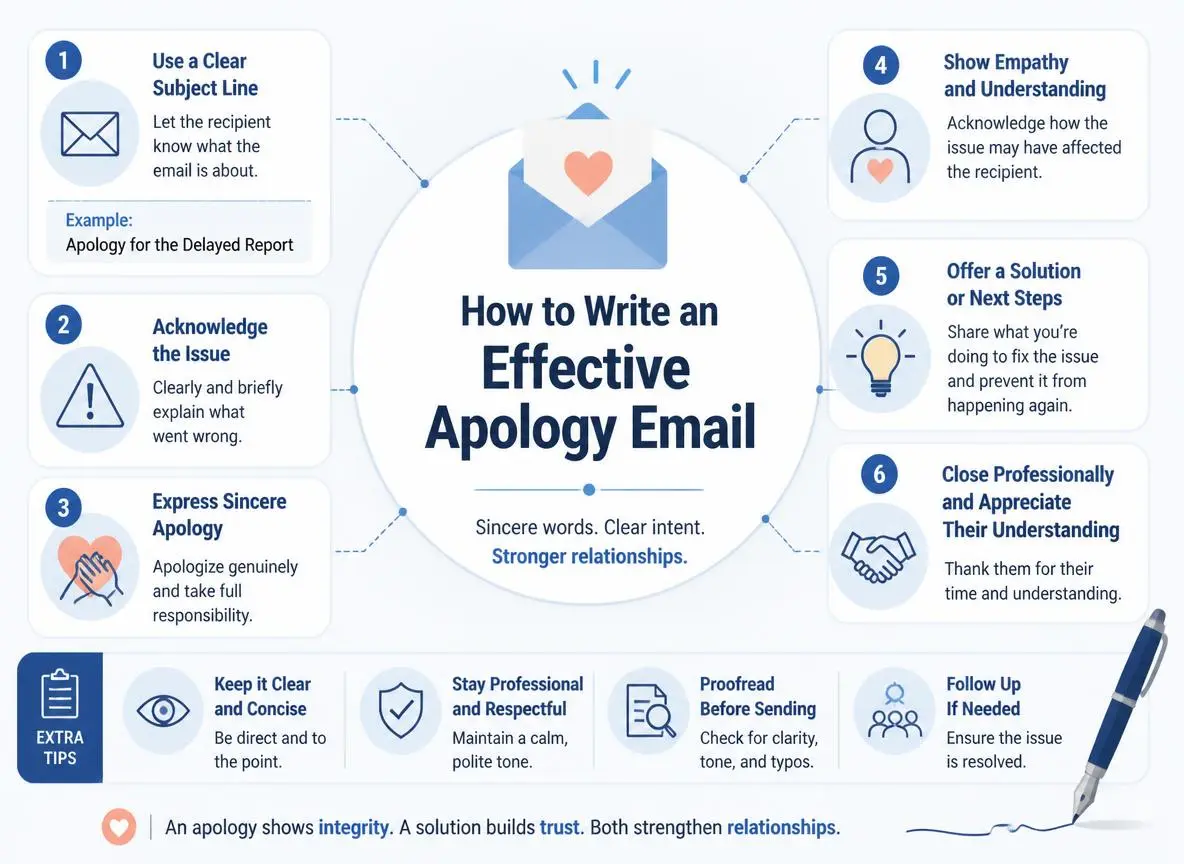
How to Write an Effective Apology Email
Mistakes happen in every workplace — a missed deadline, a shipping error, a miscommunication that upset a client. How you apologize afterward often matters more than the mistake itself. A well-written apology email can preserve trust and even strengthen a relationship, while a poorly written one can make a bad situation significantly worse. This guide covers what makes an apology email genuinely effective.
Why Most Apology Emails Fail
Many apology emails fail not because the writer isn't sorry, but because the email focuses on the wrong things. Common failure patterns include over-explaining the cause of the mistake, using vague language that avoids directly naming the error, or shifting blame subtly through passive voice ("mistakes were made" instead of "I made a mistake"). Recipients can sense these patterns immediately, and they undermine the sincerity of even a well-intentioned apology.
The Core Structure of an Effective Apology
1. Name the mistake directly. Start by clearly stating what went wrong, without hedging or minimizing. "I sent the wrong invoice to your team yesterday" is far stronger than "There seems to have been some confusion with the invoice."
2. Take ownership without over-explaining. A brief explanation of context is fine, but avoid turning the email into a lengthy justification. One sentence of context is usually enough; more than that starts to sound like excuse-making.
3. Acknowledge the impact. Show that you understand how the mistake affected the recipient specifically — their time, their trust, their own deadlines or reputation. This demonstrates genuine empathy rather than a generic, boilerplate apology.
4. State what you are doing to fix it. A concrete corrective action matters more than any amount of apologetic language. "I've corrected the invoice and it's attached to this email" resolves the issue far more effectively than repeated apologies alone.
5. Note what you are changing to prevent recurrence, if relevant. For significant errors, briefly mentioning a process change signals that you have taken the issue seriously beyond this single instance.
6. Close with a forward-looking, professional tone. End on a note that moves the relationship forward rather than dwelling further on the mistake.
Example
Subject: Correction to Yesterday's Invoice
"Hi Sarah, I made an error in yesterday's invoice — it listed the wrong billing period, which I know creates extra work on your end right before your monthly close. I've attached the corrected version, and I've also added a review step to my process to catch this before it happens again. Thank you for catching it and flagging it so quickly. Let me know if anything else needs adjusting."
Phrases to Avoid
- "I'm sorry if you were offended" (conditional apologies suggest the recipient's reaction was the problem, not the mistake)
- "Mistakes were made" (passive voice avoids ownership)
- Excessive repetition of "sorry" without concrete action
Final Thought
A strong apology email is short, direct, and action-oriented. It takes ownership clearly, addresses the real impact, and moves quickly toward resolution — treating the recipient's time and trust with the respect that rebuilding it requires.