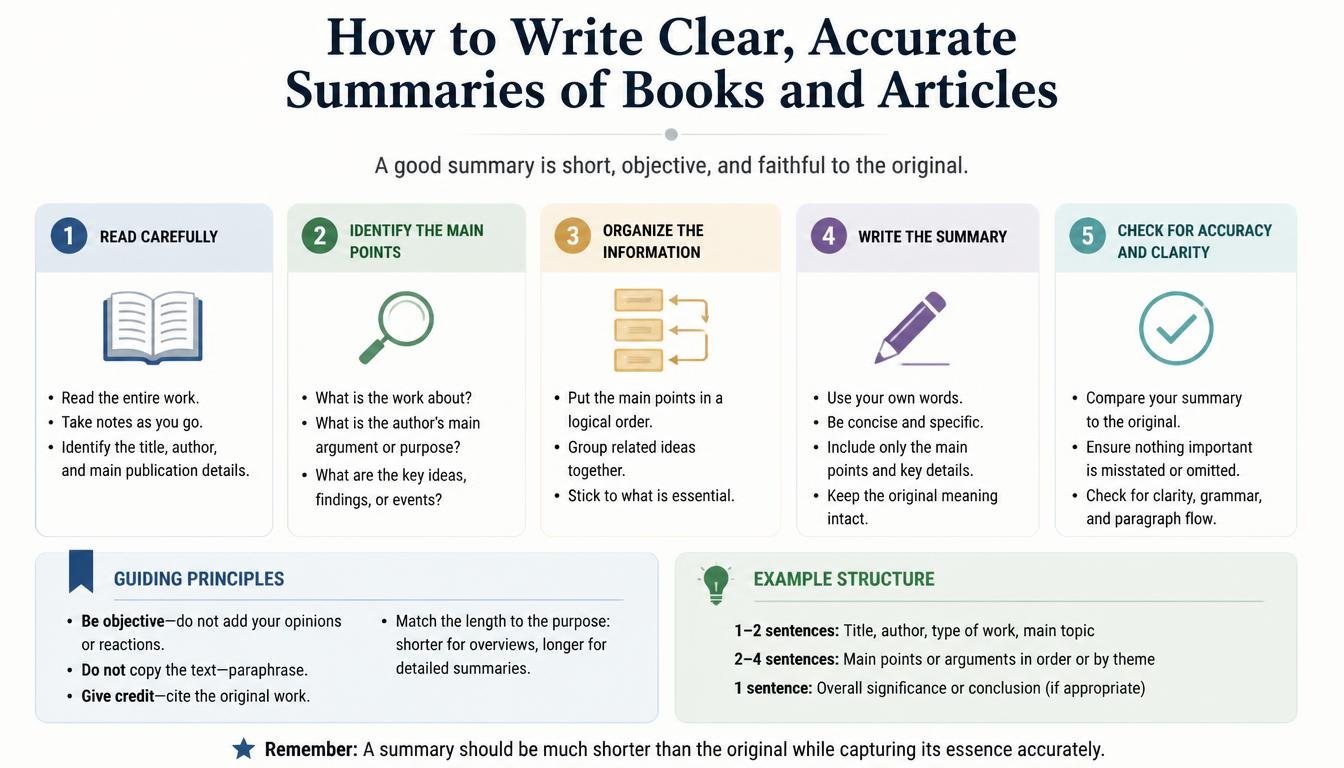
How to Write Clear, Accurate Summaries of Books and Articles
Whether you are a student condensing a textbook chapter, a professional summarizing a report for busy colleagues, or a content creator distilling a book into a digestible post, summary writing is one of the most practical skills you can develop. A good summary saves the reader time while preserving the essential meaning of the original. A poor summary either loses critical information or, just as commonly, simply restates too much of the original text without truly condensing it. This guide walks through the principles and practical steps behind writing summaries that are accurate, concise, and genuinely useful.
What Makes a Summary Good
Before diving into technique, it helps to define what a strong summary actually accomplishes. A good summary:
- Captures the main ideas and central argument of the original text
- Omits minor details, examples, and supporting evidence that are not essential to understanding the core message
- Is written in the summarizer's own words, not lifted phrasing from the source
- Is significantly shorter than the original
- Remains objective, representing the source's ideas without inserting the summarizer's own opinions unless explicitly asked to do so
A summary is not a shortened copy-paste of the original text. It is a re-expression of the source's key ideas, built from genuine understanding rather than mechanical compression.
Step 1: Read for Understanding, Not for Copying
The biggest mistake people make when summarizing is starting to write before they have fully understood the source material. This leads to summaries that either miss the point or accidentally string together lifted phrases because the writer has not internalized the ideas enough to express them independently.
Read the source material fully at least once before attempting to summarize it. For longer works like books, this might mean reading chapter by chapter and taking brief notes on the main idea of each section as you go, rather than trying to hold the entire structure in your head.
As you read, ask yourself: What is this piece actually trying to say? What is the core argument, finding, or story? Everything else in your summary should serve to support and clarify that central idea.
Step 2: Identify the Main Idea and Supporting Points
Once you have finished reading, separate the content into two categories: the main idea (or ideas) and the supporting details.
For a nonfiction article or report, the main idea is often the central claim or finding — the "so what" of the piece. Supporting points are the evidence, examples, statistics, or sub-arguments that build the case for that main idea.
For a book, particularly fiction, the "main idea" might be the central plot arc and the key themes the author explores, while supporting details include specific scenes, secondary characters, and subplots.
A useful exercise is to try to state the main idea in a single sentence before you write anything else. If you cannot do this, you likely need to reread the material or think more carefully about what the author was truly trying to communicate.
Step 3: Organize by Importance, Not by Original Order
A common instinct when summarizing is to follow the same structure as the original, condensing each section proportionally. This often produces a summary that is technically shorter but still somewhat rambling, because it treats every part of the original as equally important.
Instead, organize your summary around what matters most. Lead with the central idea, then include supporting points roughly in order of significance rather than strictly following the original's sequence. This produces a tighter, more useful summary, especially for readers who might only read the first few sentences.
Step 4: Write in Your Own Words
This is the single most important rule of ethical, effective summarizing: express the ideas using your own sentence structures and vocabulary, not the author's original phrasing.
This matters for two reasons. First, using your own words is a strong signal that you have genuinely understood the material rather than simply extracting sentences. Second, copying phrasing too closely, even without formal quotation marks, raises real concerns about plagiarism, particularly in academic or professional contexts.
A practical technique for this: after reading a section, close the source material and try to explain the key point to yourself out loud, as if explaining it to a friend who has not read it. Then write down what you just said. This forces genuine paraphrasing rather than subconscious copying, since you are working from your own understanding rather than the visible text.
Step 5: Cut Ruthlessly
Once you have a first draft of your summary, look for anything that can be removed without losing essential meaning. Common candidates for cutting include:
Redundant restatements. If you have said the same idea twice in slightly different words, keep only the clearer version.
Minor examples. If the author used three examples to illustrate a point, one is usually enough in a summary, or none at all if the point is clear without an example.
Background context that does not affect the core argument. Historical context, biographical details about the author, or tangential information can often be cut entirely from a summary focused on the main content.
Overly specific numbers or details. Unless a specific statistic or detail is central to the argument, general language often works better in a summary. "The study found a significant increase in productivity" may be sufficient without citing the exact percentage, depending on the summary's purpose.
Step 6: Match Length to Purpose
There is no single correct length for a summary; the right length depends entirely on its purpose.
A one-sentence summary (sometimes called a "logline" or "elevator pitch") captures just the absolute core idea, often used for quick previews or recommendations.
A one-paragraph summary covers the main idea plus the two or three most important supporting points, suitable for a book review snippet or an executive summary of a short report.
A full-page summary allows for more supporting detail and nuance, appropriate for academic summaries or detailed briefing documents where the reader needs a fuller picture without reading the entire original.
Before writing, clarify for yourself (or ask, if summarizing for someone else) what length and level of detail the summary needs to serve its purpose.
Special Considerations for Summarizing Fiction
Summarizing a novel or short story requires some adjustments to the process described above, since the "main idea" of a narrative work often includes plot, character development, and theme simultaneously.
Include the essential plot arc. A fiction summary generally needs to cover the setup, central conflict, and resolution, even if briefly, since removing any of these leaves an incomplete picture of the story.
Avoid unnecessary spoilers if the summary is meant to entice rather than fully inform. A book jacket summary, for instance, typically stops short of revealing the ending, while an academic or study-guide summary usually needs to cover the full arc, including the resolution.
Capture theme alongside plot. A summary that describes only "what happens" without touching on what the story is fundamentally about often misses the deeper purpose of the work. A single sentence noting the central theme can add significant value.
Special Considerations for Summarizing Academic or Technical Material
Academic articles and technical reports often follow a predictable structure — introduction, methodology, results, discussion — which can guide how you approach summarizing them.
Focus heavily on the findings and their significance. Readers of a summary are usually most interested in what was discovered and why it matters, more so than the technical details of how the research was conducted.
Preserve necessary technical accuracy. While you should simplify language where possible, be careful not to distort technical claims through oversimplification. If a finding was described with important caveats or limitations, a good summary should at least briefly acknowledge them rather than presenting the conclusion as more certain than the original source intended.
Note the scope of the claim. Academic writing is often carefully hedged, distinguishing between a broad claim and a narrower, more specific one. A summary should preserve this distinction rather than generalizing beyond what the original source actually supports.
Common Mistakes to Avoid
Summarizing every paragraph instead of the whole. Some writers mistakenly summarize each paragraph of a source in sequence, producing a summary that is proportionally shorter but still tracks the original too closely in both structure and length.
Inserting personal opinion without indication. Unless specifically asked for an evaluative summary, keep your own judgments separate from the objective content of the source. If you do want to include an opinion, clearly signal it as your own perspective rather than blending it into the objective summary.
Losing the "so what." A summary that lists facts or events without conveying why they matter or what the author's larger point was has failed at the core task of summarizing, even if it is accurate and concise.
Making the summary too similar in length to the original. If your summary is not meaningfully shorter than the source, it has not actually served its core function, regardless of how well-written it is.
A Simple Process to Follow
- Read the entire source once for overall understanding.
- Identify the main idea in a single sentence.
- List the two to five most important supporting points.
- Draft the summary in your own words, without looking at the source text while writing.
- Compare your draft against the original to check for accuracy, not to copy phrasing.
- Cut anything that is not essential to understanding the main idea.
- Adjust length to match the intended purpose and audience.
Summarizing well is ultimately an exercise in genuine comprehension. The clearer your understanding of a piece, the more naturally a tight, accurate summary will follow — because you are not compressing sentences, you are distilling ideas you have truly absorbed.