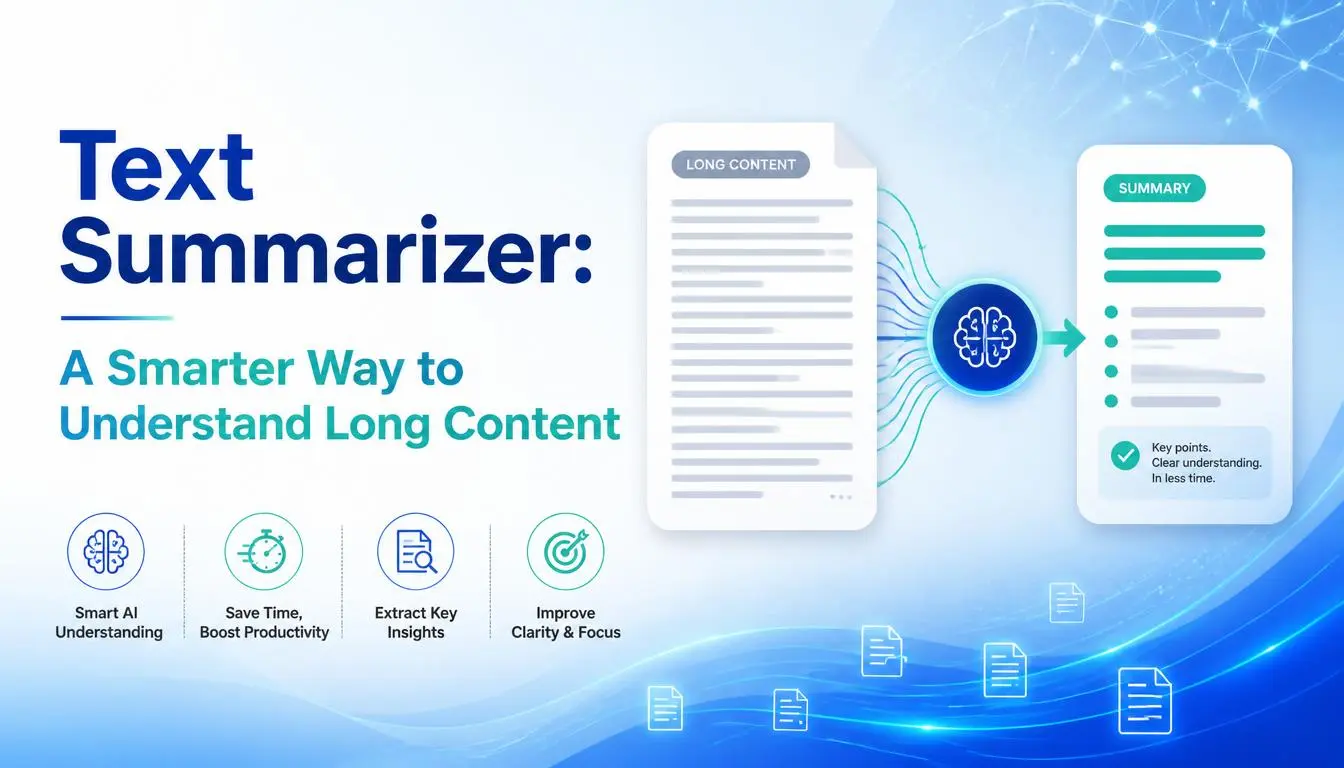
# Text Summarizer: A Smarter Way to Understand Long Content
We live in a world filled with information.
Every day, people read articles, reports, research papers, emails, news stories, product descriptions, documents, and social media posts. The problem isn't always finding information. The real challenge is finding the important information quickly.
A long article may contain valuable insights, but you may not always have enough time to read every paragraph carefully.
That's where a Text Summarizer can help.
A Text Summarizer is a tool that takes longer content and creates a shorter version containing the main ideas. Instead of spending a lot of time going through every sentence, you can use a summary to understand the central points more quickly.
For students, researchers, writers, professionals, bloggers, and everyday internet users, summarization can make information easier to process.
## What Is a Text Summarizer?
A Text Summarizer is an online tool that analyzes written content and produces a shorter version of it.
The purpose isn't simply to delete random sentences.
A useful summary should focus on the most important information while keeping the original topic and overall meaning understandable.
For example, imagine you have a 2,000-word article explaining the benefits of exercise.
A summary might reduce that article to a few paragraphs covering the main ideas, such as:
- Regular exercise supports overall health.
- Physical activity can improve fitness.
- Exercise may support mental well-being.
- Consistency is more important than occasional intense workouts.
The summary gives you the central message without requiring you to read the entire article immediately.
## Why Do People Need Text Summarization?
Time is limited.
A student may have several research papers to review.
A professional may receive a long report before a meeting.
A researcher may need to examine dozens of articles.
A business owner may receive lengthy documents from clients.
A blogger may need to understand a source before creating an article.
Reading everything word for word isn't always practical.
Text summarization helps reduce the amount of information you need to process at the beginning.
Instead of asking, "Do I have time to read all of this?"
you can first ask:
"What are the main ideas?"
Once you understand the basic content, you can decide whether the full document deserves a deeper read.
## Text Summarizer for Students
Students can benefit significantly from summarization tools.
Academic reading can involve textbooks, articles, reports, lecture materials, and research papers.
A student may use a summarizer to get an initial overview of a long piece of content.
For example, before reading a research paper in detail, a student can summarize it to understand:
- The main topic
- The central argument
- Major findings
- Important conclusions
This can help the student decide which sections deserve closer attention.
However, students should not rely on summaries alone when an assignment requires detailed understanding.
Important evidence, examples, qualifications, and citations can sometimes be missed in a short summary.
## Text Summarizer for Research
Researchers regularly work with large amounts of information.
Imagine you're researching a topic and have collected 20 academic articles.
Reading every article in full may take a significant amount of time.
Summarization can help create a quick overview of each source.
You can then identify which articles are most relevant and read those in greater detail.
This creates a useful workflow:
Collect Sources → Summarize → Identify Relevant Sources → Read Carefully → Take Notes
A summary should be treated as a starting point, not a replacement for the original research.
## Text Summarizer for Bloggers
Bloggers often research topics before writing.
They may read several articles to understand the subject and identify useful ideas.
A Text Summarizer can help them quickly understand long source material.
For example, if you find a 3,000-word report about online marketing trends, you can create a short summary to understand the report's main findings before deciding whether to read it in full.
This can make the research stage more efficient.
However, bloggers should always verify important facts against the original source rather than relying entirely on an automated summary.
## Text Summarizer for Content Creators
Content creators frequently consume large amounts of information.
A YouTube creator might research a topic using articles, reports, interviews, and documents.
A summarized version can help organize the basic information before creating a script.
For example, a creator researching artificial intelligence might summarize several reports and use those summaries to identify important themes.
The creator can then return to the original sources to verify specific facts, statistics, and quotations.
This approach combines speed with accuracy.
## Text Summarizer for Professionals
Professionals receive long documents regularly.
These might include:
- Business reports
- Meeting documents
- Market research
- Project updates
- Internal communications
- Industry reports
- Proposals
A summary can provide a quick overview before a meeting or discussion.
For example, instead of opening a 20-page report immediately, you might first review a summary and identify the sections that matter most to your role.
This can help you use your reading time more efficiently.
## Text Summarizer for News
News articles can vary significantly in length.
Sometimes you want to understand the main event without spending several minutes reading every detail.
A summarizer can provide a shorter overview.
This can be particularly useful when comparing multiple reports about the same topic.
However, news can contain important context, and a short summary may leave out details that change how the story should be understood.
For significant or sensitive topics, reading the original reporting is still important.
## How Does a Text Summarizer Work?
Different summarization systems use different methods.
At a basic level, the process involves analyzing the text and determining which information is most important.
Some systems focus on selecting important sentences from the original text.
This approach is often called extractive summarization.
Other systems can generate a new summary using their understanding of the source.
This is generally known as abstractive summarization.
An abstractive system may express the same idea using different words rather than simply copying sentences from the original.
The quality of the result depends on the technology, the source material, and the complexity of the content.
## Extractive vs. Abstractive Summarization
Understanding the difference is useful.
### Extractive Summarization
An extractive summary selects important sentences or phrases from the original content.
Advantages include:
- Stays close to the original wording
- Can preserve important statements
- Often easier to trace back to the source
The downside is that selected sentences may not always flow perfectly together.
### Abstractive Summarization
An abstractive summary generates a new version of the information.
Advantages include:
- Can sound more natural
- Can combine related ideas
- Can make complex information easier to understand
However, generated summaries should be reviewed carefully because automated systems can occasionally misunderstand context or produce inaccurate statements.
## Why You Should Check AI-Generated Summaries
Automation is powerful, but it isn't perfect.
A summarizer may occasionally:
- Miss an important detail
- Misinterpret a sentence
- Oversimplify an argument
- Leave out an important qualification
- Produce an inaccurate statement
This matters especially when the source contains technical, legal, financial, scientific, or otherwise important information.
For casual reading, a quick summary may be enough.
For serious decisions, always verify critical information against the original source.
## Text Summarizer and Academic Work
Summarization is an important academic skill.
Students are often asked to explain a source using their own words.
A summarization tool can help demonstrate how a long text can be reduced to its core ideas.
But using an automated summary doesn't eliminate the need for proper citation.
If an idea comes from another person's work, you should acknowledge the source according to the required academic style.
A summary should not be presented as your original research simply because a tool helped create it.
## Summarization vs. Paraphrasing
Summarization and paraphrasing are related but different.
A paraphrase usually expresses a specific passage in different words while keeping roughly the same amount of information.
A summary significantly reduces the amount of information and focuses on the main ideas.
For example:
Original:
A long paragraph contains several explanations, examples, and supporting details.
Paraphrase:
The same paragraph is rewritten using different wording but retains most of the original information.
Summary:
The paragraph is reduced to one or two sentences containing only its central idea.
Knowing the difference helps you choose the right tool for the job.
## Text Summarizer for Email
Long emails can be difficult to process.
You might receive a message containing several paragraphs, multiple requests, background information, and a long explanation.
A summary can help you quickly identify the main points.
For example, a long project update might be reduced to:
- Project milestone completed
- One issue remains
- Client approval required
- New deadline proposed
You can then return to the full email for the details.
## Text Summarizer for Meeting Notes
Meeting discussions can generate a lot of information.
If you have a transcript or detailed notes, summarization can help organize the key points.
A useful summary might identify:
- Main decisions
- Action items
- Important questions
- Deadlines
- Responsibilities
This can make it easier for team members to understand what happened without reading an entire transcript.
Still, important decisions should be verified against the original notes or recording when accuracy matters.
## Text Summarizer for Long Documents
Some documents are simply too long to review casually.
Examples include:
- Reports
- Manuals
- Research papers
- White papers
- Business proposals
- Policy documents
A summary provides an initial map of the document.
Once you understand the structure and major ideas, you can focus your attention on the sections most relevant to you.
This is especially helpful when you need to prioritize your time.
## How to Use a Text Summarizer
Using a Text Summarizer is generally simple.
### Step 1: Find the Text
Choose the article, document, notes, or other content you want to summarize.
### Step 2: Copy the Content
Select and copy the text.
### Step 3: Paste It Into the Tool
Place the text into the summarizer.
### Step 4: Generate the Summary
Run the tool and allow it to analyze the content.
### Step 5: Read the Summary
Check whether it accurately represents the original text.
### Step 6: Verify Important Details
If the information is important, return to the original source and confirm key facts.
### Step 7: Use the Summary
You can use the summary for studying, planning, research organization, or deciding whether deeper reading is necessary.
## Tips for Getting Better Summaries
The quality of a summary can depend on the quality of the input.
If possible, provide complete and well-structured text.
Avoid pasting unrelated sections together.
For very long documents, summarizing one section at a time may sometimes produce more useful results.
You should also clearly understand your purpose.
Do you want:
- A very short overview?
- Main bullet points?
- A paragraph summary?
- Key findings?
- Important conclusions?
Knowing what you need makes the summarization process more effective.
## Benefits of Using a Text Summarizer
There are several reasons people use summarization tools.
### Saves Time
You can understand the main ideas more quickly.
### Helps Manage Information
Large amounts of content become easier to process.
### Supports Research
You can quickly identify relevant sources.
### Helps With Study
Long educational material can be reduced into key concepts.
### Improves Productivity
You can prioritize what deserves deeper attention.
### Supports Content Creation
Creators can understand source material more efficiently.
### Makes Long Documents More Accessible
A shorter overview can provide an easier starting point.
## Who Should Use a Text Summarizer?
A summarizer can be useful for:
- Students
- Teachers
- Researchers
- Bloggers
- Freelancers
- Writers
- Content creators
- Business professionals
- Marketers
- Website owners
Anyone who regularly works with large amounts of written information may find it helpful.
## When Should You Read the Full Text?
A summary is useful, but there are situations where the original document matters.
Read the full source when:
- You need exact details
- You're conducting serious research
- You're making an important decision
- The document contains legal information
- You need precise statistics
- You are studying a complex subject
- You need to understand the author's full argument
- You need to verify a quotation
A summary gives you the big picture.
The original provides the complete picture.
## Frequently Asked Questions
### What is a Text Summarizer?
A Text Summarizer is a tool that analyzes longer content and creates a shorter version containing the most important information.
### Can students use a Text Summarizer?
Yes. Students can use it to review study materials, understand research papers, organize notes, and get an overview of long content.
### Does summarization copy the original text?
It depends on the method. Extractive summarization selects parts of the original text, while abstractive summarization generates a new summary.
### Can a Text Summarizer replace reading?
Not always. It is best used as a quick overview or research aid. Important documents should still be read carefully.
### Is a summary the same as a paraphrase?
No. A paraphrase generally preserves more of the original information, while a summary focuses on the main ideas and is significantly shorter.
### Can bloggers use a Text Summarizer?
Yes. Bloggers can use summaries to quickly understand research material before reading important sources in greater detail.
## Final Thoughts
Information is everywhere, but time is limited.
A Text Summarizer helps solve that problem by turning lengthy content into a shorter overview of the main ideas.
Whether you're a student reviewing research material, a professional preparing for a meeting, a blogger researching an article, or simply someone trying to understand a long document, summarization can make your workflow more efficient.
The key is to use the tool wisely.
Don't treat every generated summary as a perfect replacement for the original.
Use it as a starting point.
Let it help you discover the main ideas, decide what deserves closer attention, and organize large amounts of information.
Then, whenever accuracy really matters, return to the original source.
The best approach isn't about choosing between humans and technology.
It's about using technology to handle repetitive information-processing tasks while keeping human judgment at the center.
A good summary can save you time.
A careful reader makes sure that time is spent on the information that matters most.