
The Difference Between American and British English
English is spoken differently around the world, but American and British English represent the two most widely referenced standard varieties, particularly in professional and published writing. Understanding their differences matters for writers who need to match a specific audience's expectations, whether for a client, a publication, or a global business. This guide covers the main areas where the two varieties diverge.
Spelling Differences
Spelling is the most immediately noticeable difference between the two varieties.
- -or vs -our:
- American "color," British "colour"; American "favor," British "favour"
- -er vs -re:
- American "center," British "centre"; American "theater," British "theatre"
- -ize vs -ise:
- American "organize," British "organise" (though "-ize" is also accepted in some British style guides)
- Single vs double consonants:
- American "traveled," British "travelled"; American "canceled," British "cancelled"
- -og vs -ogue:
- American "catalog," British "catalogue" (though usage varies)
Vocabulary Differences
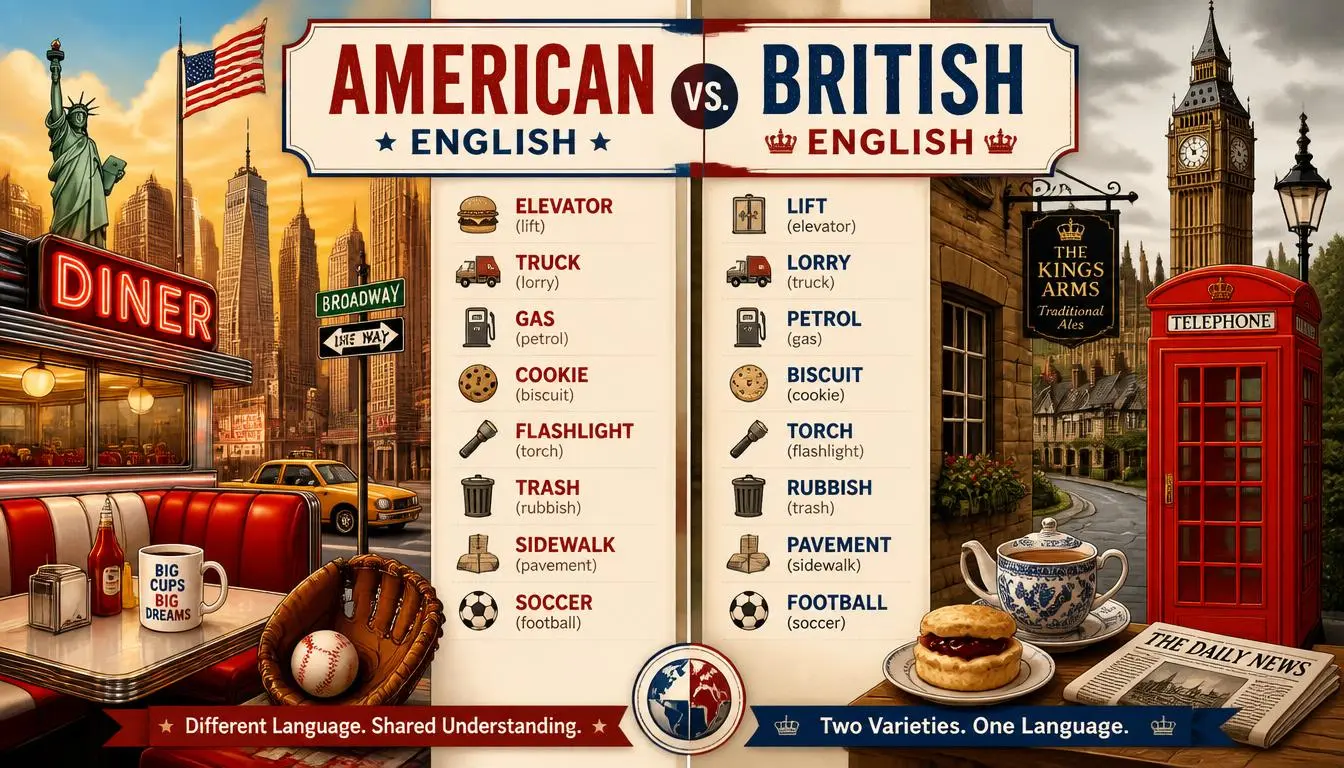
Many everyday words differ entirely between the two varieties:
| American English | British English |
|---|---|
| Apartment | Flat |
| Elevator | Lift |
| Truck | Lorry |
| Sidewalk | Pavement |
| Trash can | Bin |
| Vacation | Holiday |
| Cell phone | Mobile phone |
| Cookie | Biscuit |
| Fall (season) | Autumn |
| Gas | Petrol |
For content aimed at a specific regional audience, using the correct regional vocabulary matters significantly for feeling natural and credible to that audience.
Grammar Differences
Collective nouns.
American English typically treats collective nouns as singular ("the team is winning"), while British English often treats them as plural ("the team are winning"), particularly when emphasizing the individual members.
Present perfect vs. simple past.
British English tends to favor the present perfect for recent past actions with present relevance ("I've just eaten"), while American English more often uses the simple past in the same context ("I just ate").
Prepositions.
Small but noticeable differences exist, such as American "on the weekend" versus British "at the weekend," or American "different from/than" versus British "different to."
Punctuation Differences.
Quotation marks.
American English typically uses double quotation marks for primary quotes ("like this"), while British English often uses single quotation marks ('like this'), with the reverse convention for quotes within quotes.
Placement of punctuation with quotes.
American English generally places periods and commas inside closing quotation marks, while British English often places them outside unless they are part of the quoted material itself.
Date formatting.
American English typically uses month-day-year (March 3, 2026), while British English typically uses day-month-year (3 March 2026), which can create real ambiguity in numeric-only formats like 03/04/2026.
Which Should You Use?
The right choice depends entirely on your audience. Content aimed primarily at American readers should use American spelling, vocabulary, and conventions consistently. Content aimed at British, and often broader international, readers typically works better with British conventions. For global audiences without a single dominant regional base, consistency matters more than which specific variety you choose — mixing British and American conventions within the same piece looks inconsistent and unpolished regardless of which is more "correct."
Practical Tips for Writers.
Set your word processor's language setting to the correct regional variety, which helps catch spelling inconsistencies automatically as you write.
Create a personal style reference if you frequently write for both audiences, noting your organization's preferred conventions to maintain consistency across different pieces and writers.
When adapting existing content for a different regional audience, check not just spelling but vocabulary and grammar conventions as well, since these differences are easy to overlook compared to more obvious spelling variants.
Final Thought
Neither American nor British English is more "correct" than the other; they are simply different standardized conventions that evolved from the same root language. The key for professional writing is consistency within a single piece and appropriateness for your specific intended audience, rather than treating either variety as a universal default.