
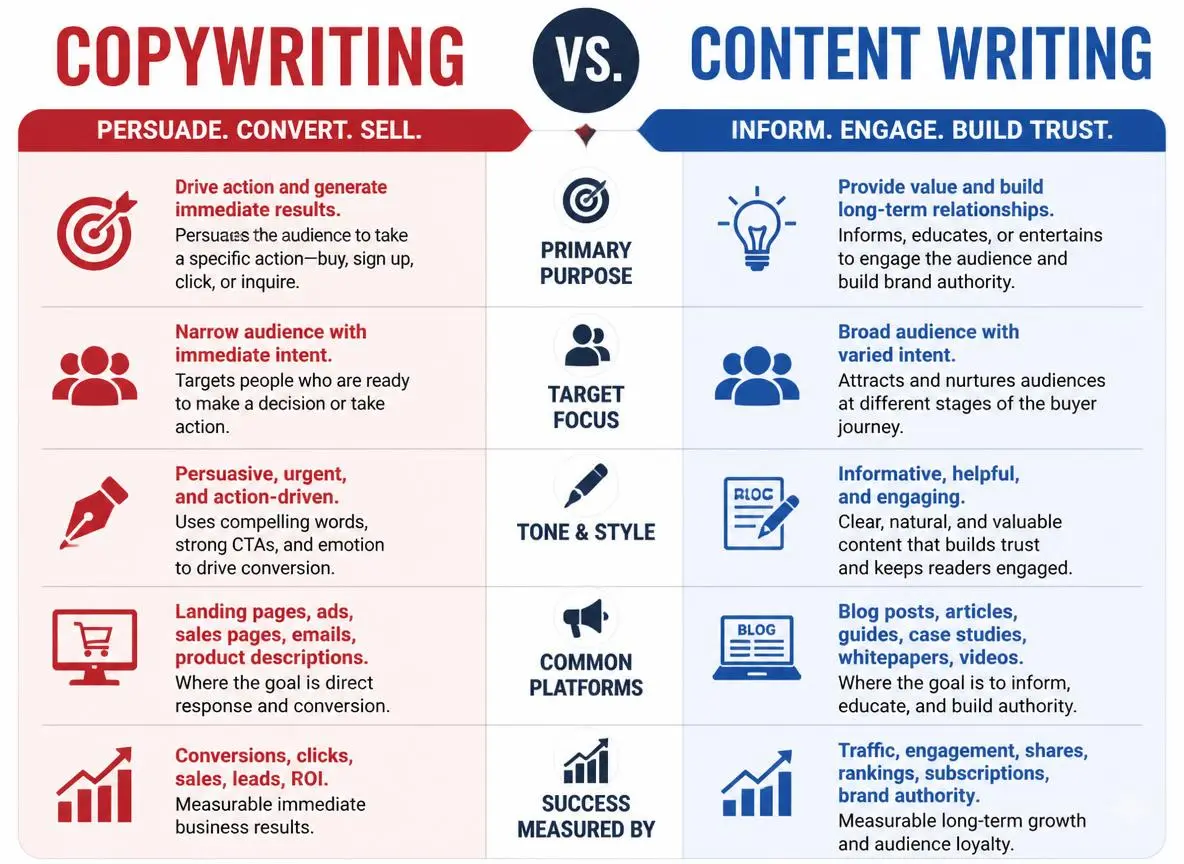
The Difference Between Copywriting and Content Writing.
The terms "copywriting" and "content writing" are often used interchangeably, but they refer to genuinely different disciplines with different goals, techniques, and success metrics. Understanding the distinction matters whether you are hiring a writer, building a writing career, or simply trying to improve your own skills in the right direction for a specific task.
What Copywriting Is
Copywriting is writing designed to persuade a reader to take a specific, immediate action: buying a product, signing up for a newsletter, clicking a button, or requesting a demo. Copywriting appears in advertisements, sales pages, email campaigns, product descriptions, and calls to action.
Copywriting is typically short, punchy, and highly focused on a single conversion goal. Every sentence works toward moving the reader closer to that specific action. Success is measured directly: conversion rates, click-through rates, and sales.
What Content Writing Is
Content writing is writing designed to inform, educate, or entertain, building trust and engagement over a longer time horizon rather than driving one immediate action. Content writing appears in blog posts, articles, guides, and educational resources.
Content writing tends to be longer and more thorough, prioritizing genuine value and depth over persuasion toward a single action. Success is measured more broadly: time on page, search rankings, social shares, and long-term audience building.
Key Differences in Approach
Purpose.
Copywriting sells; content writing informs. This single distinction drives most of the other differences between the two.
Length.
Copywriting is often quite short — a headline, a paragraph, a product description. Content writing is often substantially longer, covering a topic in depth.
Tone and urgency.
Copywriting frequently creates urgency ("Limited time offer," "Only 3 left in stock") to prompt immediate action. Content writing generally avoids manufactured urgency, instead building credibility through thoroughness and accuracy.
Structure.
Copywriting is built around a persuasive structure, often following frameworks like AIDA (Attention, Interest, Desire, Action). Content writing is built around logical, informative structure, often organized by subtopic or by answering a sequence of related questions.
Relationship to SEO.
Content writing is frequently written with search engine optimization as a central goal, since organic search traffic is often content writing's primary distribution channel. Copywriting may incorporate SEO but is often distributed through paid channels, email, or direct placement rather than relying primarily on search rankings.
Where the Two Overlap
In practice, many pieces blend both disciplines. A blog post (content writing) often ends with a persuasive call to action (copywriting). A product page might combine informative content writing about features with persuasive copywriting designed to drive the purchase decision. Skilled writers often need to shift fluidly between both modes within a single piece.
Which Skill Should You Develop?
For businesses building long-term organic traffic and audience trust, strong content writing is essential. For businesses focused on direct conversion and sales, strong copywriting delivers more immediate measurable impact. Most marketing teams and successful solo creators eventually need both skills, applied deliberately depending on the specific goal of each piece of writing.
Final Thought
Neither discipline is inherently more valuable than the other; they simply serve different purposes in a complete communication or marketing strategy. Recognizing which mode a given piece of writing calls for, and writing deliberately within that mode, produces far more effective results than blending the two without a clear sense of which goal you are actually trying to achieve.