The Difference Between Paraphrasing and Plagiarism.
Writing original content can be challenging, especially when you need to use information from books, articles, research papers, websites, or other sources.
Students, bloggers, researchers, freelancers, and content creators frequently use existing information to support their own writing. However, there is an important difference between responsible paraphrasing and plagiarism.
Many people assume that changing a few words is enough to make copied content original. Unfortunately, that is not always true.
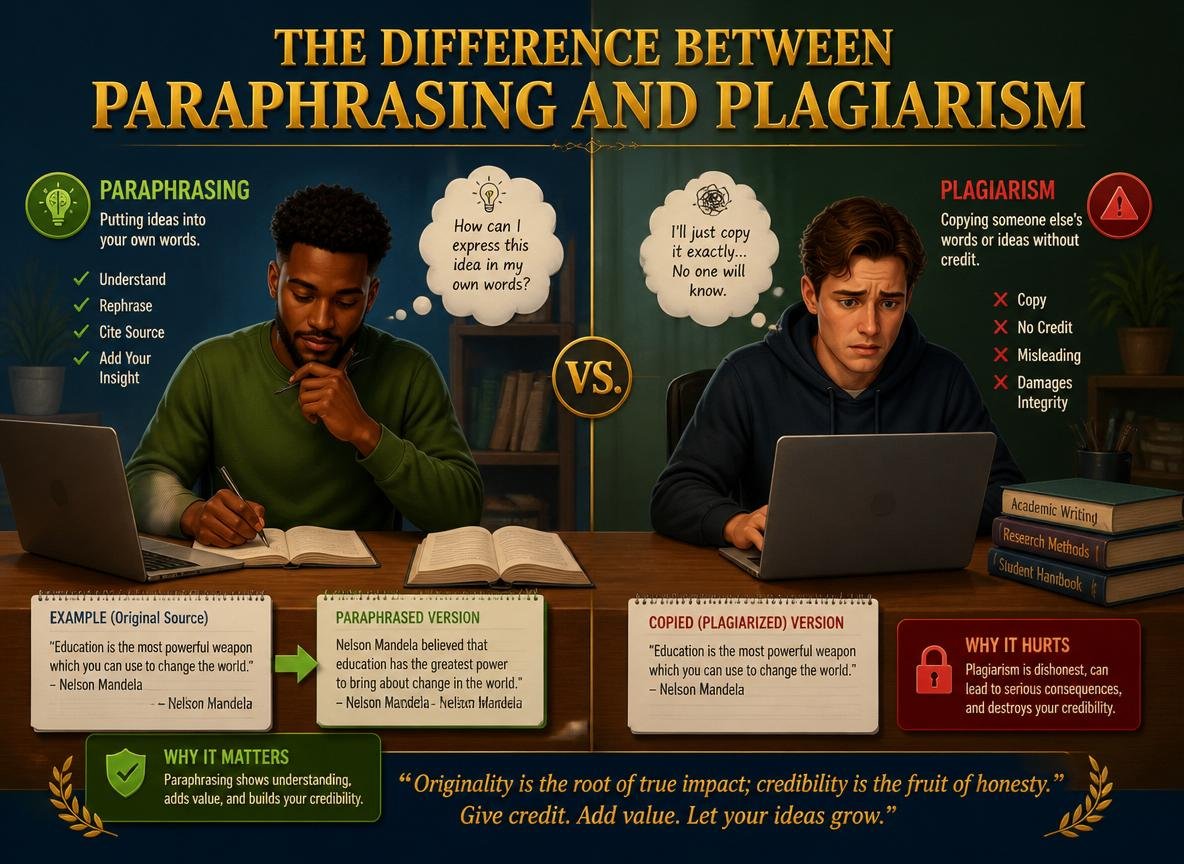
Paraphrasing involves expressing someone else's ideas in your own words while preserving the original meaning. Plagiarism, on the other hand, generally involves presenting another person's words, ideas, or work as your own without appropriate acknowledgment.
Understanding this difference is essential for anyone who creates written content.
In this guide, we will explain what paraphrasing and plagiarism mean, how they differ, common mistakes, how to paraphrase correctly, how citations work, and how AI-powered text transformation tools can be used responsibly.
What Is Paraphrasing?
Paraphrasing means rewriting information from an existing source using your own words and sentence structure while maintaining the original idea.
A good paraphrase does not simply replace individual words with synonyms.
Instead, the writer should:
Understand the original passage
Identify the important ideas
Restructure the information
Use appropriate vocabulary
Preserve the original meaning
Give credit to the original source when required
For example:
Original:
“Regular physical activity can improve cardiovascular health and may reduce the risk of several chronic diseases.”
Paraphrase:
“Maintaining an active lifestyle can support heart health and potentially lower the likelihood of developing certain long-term illnesses.”
The wording and sentence structure have changed, but the central meaning remains similar.
If the idea came from a source, that source may still need to be cited.
What Is Plagiarism?
Plagiarism occurs when someone uses another person's work, words, ideas, or creative expression without appropriate acknowledgment and presents it as their own.
Plagiarism can take different forms.
It may involve:
Copying text word for word
Copying paragraphs without citation
Closely imitating the structure of a source
Using another person's ideas without acknowledgment
Submitting someone else's work as your own
Reusing your own previously submitted work where prohibited
Using unattributed material from online sources
Plagiarism is not limited to students.
It can also affect:
Bloggers
Journalists
Researchers
Freelancers
Businesses
Authors
Website owners
The consequences depend on the situation and the rules involved.
Paraphrasing vs. Plagiarism: The Key Difference
The simplest distinction is:
Paraphrasing changes how an idea is expressed while acknowledging the source when required.
Plagiarism uses another person's work or ideas without appropriate acknowledgment.
Consider the following example.
Original Source
“Online education provides students with greater flexibility because they can often access course materials from different locations and at different times.”
Plagiarism
“Online education gives students greater flexibility because they can often access course materials from different locations and at different times.”
Only one word has changed.
The sentence structure and wording remain extremely close to the source.
Better Paraphrase
“Digital learning allows students to study more flexibly by giving them access to educational materials without requiring them to be in a particular place at a specific time.”
This version substantially changes the expression while preserving the central idea.
If the underlying idea comes from the source, appropriate attribution may still be required.
Why Changing a Few Words Is Not Enough
One of the most common mistakes in paraphrasing is replacing individual words with synonyms.
Suppose the original sentence is:
“Social media has transformed how businesses communicate with their customers.”
A weak paraphrase might be:
“Social media has changed how companies communicate with their clients.”
Although some words have changed, the sentence remains almost identical.
This technique is sometimes called patchwriting or overly close paraphrasing.
A better approach is to understand the idea first and then express it independently.
For example:
“Businesses now have direct digital channels through which they can interact with customers and respond to their needs.”
The structure is significantly different.
How to Paraphrase Correctly
Effective paraphrasing can be broken into several steps.
Step 1: Read the Original Carefully
Read the source until you understand the meaning.
Do not focus only on individual words.
Understand the complete idea.
Step 2: Identify the Main Point
Ask:
“What is the author actually saying?”
Write down the key concepts mentally or in your notes.
Step 3: Look Away From the Source
Once you understand the idea, stop looking at the original sentence.
Explain the concept in your own words.
This reduces the temptation to copy the original structure.
Step 4: Change the Structure
Reorganize the sentence or paragraph.
You might:
Change the order of information
Combine sentences
Separate long sentences
Change active voice to passive voice when appropriate
Change passive voice to active voice
Use a different grammatical structure
Step 5: Choose Natural Vocabulary
Use words that naturally fit the context.
Do not replace every word with a synonym.
The goal is clarity, not artificial complexity.
Step 6: Compare With the Original
Check whether:
The meaning remains accurate
Important details are preserved
The wording is sufficiently independent
Step 7: Add the Appropriate Citation
If the idea belongs to another source, acknowledge that source according to the relevant citation requirements.
Does Paraphrasing Still Require a Citation?
This is an important question.
Usually, yes, when the underlying idea, information, research, argument, or interpretation comes from another source.
Changing the wording does not make the underlying idea yours.
For example, imagine a researcher discovers something important.
You read the research and explain the finding in your own words.
The words are yours, but the research finding belongs to the researcher.
Therefore, depending on the context, you should credit the original source.
A useful principle is:
Your words do not necessarily mean your idea.
Paraphrasing vs. Summarizing
Paraphrasing should also be distinguished from summarizing.
Paraphrasing
A paraphrase usually preserves the main information and level of detail of a particular passage while changing its wording and structure.
Summarizing
A summary condenses a larger piece of information into a shorter version containing only the most important points.
For example, imagine a 1,000-word research article.
A paraphrase might rewrite one important paragraph.
A summary might explain the entire research article in 100 words.
Both may require attribution if the information comes from someone else's work.
Direct Quotes vs. Paraphrasing
Another option is direct quotation.
A direct quote reproduces the source's exact wording and normally requires quotation marks or another appropriate quotation format, along with attribution.
For example:
Direct quote:
The author states that “...”
A paraphrase communicates the same idea using your own expression.
When Should You Quote?
Direct quotations can be useful when:
The exact wording is important
You are analyzing the author's language
A statement is particularly precise
The wording itself is part of the evidence
When Should You Paraphrase?
Paraphrasing is often useful when:
You want to integrate research naturally
The exact wording is not important
You want to explain complex information
You want your writing to maintain a consistent voice
Common Types of Plagiarism
Understanding different forms of plagiarism can help writers avoid them.
1. Direct Plagiarism
This occurs when someone copies text directly from a source without proper acknowledgment.
2. Paraphrasing Plagiarism
This happens when someone changes a few words or rearranges a sentence while keeping the original wording and structure too closely.
3. Idea Plagiarism
A person may use another person's original idea without giving appropriate credit.
Even if no exact sentence is copied, the underlying intellectual contribution may belong to someone else.
4. Source-Based Plagiarism
This can involve misleading or inaccurate attribution of sources.
For example, a writer might cite a source that does not actually support the claim being made.
5. Self-Plagiarism
In some academic or publishing contexts, reusing your own previously submitted or published work without disclosure can be considered self-plagiarism.
Rules vary by institution and publication.
Common Paraphrasing Mistakes
Mistake 1: Synonym Swapping
Changing words one by one is not effective paraphrasing.
Mistake 2: Keeping the Same Sentence Structure
Even if the vocabulary changes, the structure may remain too close.
Mistake 3: Removing Important Information
A paraphrase should preserve important facts unless you intentionally create a summary.
Mistake 4: Changing the Level of Certainty
Be careful with words such as:
May
Might
Could
Some
Often
Generally
Suggests
Changing “may” to “will” can completely change the claim.
Mistake 5: Forgetting Attribution
A properly rewritten sentence can still require a citation.
How to Tell Whether Your Paraphrase Is Too Close
After writing a paraphrase, compare it with the source.
Look for similarities in:
Sentence structure
Word order
Unusual phrases
Sequence of ideas
Examples
Vocabulary
If several distinctive elements remain unchanged, rewrite the passage again.
One useful technique is to explain the idea without looking at the original.
If you can naturally explain the concept from your understanding, your paraphrase is more likely to be independent in wording.
Using AI Text Rewriters for Paraphrasing
AI-powered text transformation tools have become popular for rewriting content.
They can help with:
Sentence restructuring
Vocabulary suggestions
Readability
Grammar
Tone
Clarity
Alternative wording
For example, a writer might provide their own paragraph and ask an AI tool to make it clearer.
This can be useful for editing.
However, AI should not be treated as a tool for disguising copied material.
Simply putting someone else's article into an AI paraphrasing tool does not automatically make the resulting content ethically or academically original.
The underlying ideas may still belong to the original author.
Responsible AI Paraphrasing
A responsible workflow looks like this:
1. Read the Source
Understand what it says.
2. Take Notes
Record the important ideas and source information.
3. Write From Understanding
Create your own explanation.
4. Use AI for Language Assistance
Ask AI to improve clarity or readability if permitted.
5. Compare the Result
Check whether the meaning has changed.
6. Verify Important Details
Check names, dates, statistics, quotations, and technical information.
7. Credit the Source
Add citations or attribution where required.
8. Review the Final Version
Make sure the content accurately represents the original source.
Can a Plagiarism Checker Detect Paraphrasing?
Plagiarism detection tools compare submitted content against databases and other sources using different methods.
They may detect exact or highly similar wording.
However, no detection system should be treated as a perfect measure of originality.
A low similarity score does not automatically mean that content is ethically original.
For example, someone could take another person's unique idea, rewrite it completely, and still fail to acknowledge the source.
Therefore, responsible writing is not simply about trying to achieve a low similarity percentage.
It is about:
Original expression
Proper attribution
Accurate representation of sources
Honest academic or professional practice
Paraphrasing in Academic Writing
Students frequently use paraphrasing in essays, reports, dissertations, and research papers.
Academic paraphrasing requires particular attention to accuracy.
Suppose a research paper states:
“Participants who completed regular physical activity sessions demonstrated improved measures of cardiovascular fitness compared with participants in the control group.”
A student might write:
“The study found that participants involved in consistent exercise sessions showed better cardiovascular fitness than those assigned to the control group.”
This is a legitimate paraphrase if it accurately reflects the source and is appropriately cited.
The student should not imply that they personally conducted the research.
Paraphrasing for Blog Writers
Bloggers also use information from external sources.
For example, a writer may research:
Industry statistics
Scientific findings
Market trends
Expert opinions
Historical information
Technology developments
The writer can explain these findings in their own words.
However, they should maintain factual accuracy and provide attribution where appropriate.
A blog should not simply copy information from another website and rearrange it.
Instead, add value through:
Original analysis
Examples
Personal experience
Expert commentary
Additional research
Unique organization
Paraphrasing and Copyright Are Not the Same Thing
It is also important to distinguish plagiarism from copyright.
Plagiarism generally concerns attribution and presenting someone else's work or ideas as your own.
Copyright is a legal framework concerning rights over protected creative works.
A piece of content can raise copyright concerns even if the writer gives attribution.
Likewise, plagiarism can involve attribution problems even when copyright law is not the central issue.
The rules can vary depending on the content, jurisdiction, and context.
For important legal questions, consult an appropriate professional.
How to Make Your Writing More Original
If you regularly work with external sources, focus on adding your own value.
You can do this by:
Add Your Analysis
Explain what the information means.
Provide Examples
Show how the concept applies in real situations.
Compare Perspectives
Discuss different viewpoints.
Use Original Research
Conduct surveys, interviews, tests, or experiments when appropriate.
Add Personal Experience
If relevant, explain what you observed or learned firsthand.
Organize Information Differently
Create a structure that helps your particular audience understand the topic.
This approach creates content that is more than a rewritten version of existing material.
A Simple Formula for Ethical Paraphrasing
Remember this formula:
Understand → Remember → Rewrite → Compare → Cite
Understand
Know what the source means.
Remember
Identify the important information.
Rewrite
Express it naturally using your own structure and language.
Compare
Make sure the meaning remains accurate and the wording is sufficiently independent.
Cite
Credit the source when required.
This simple process can help reduce accidental plagiarism.
Frequently Asked Questions
Is paraphrasing plagiarism?
Not necessarily. Proper paraphrasing uses independent wording and structure while preserving the original meaning, and it acknowledges the source when attribution is required.
Can I paraphrase without citing?
If the idea or information comes from another source, citation may still be required. Common knowledge is generally treated differently, but what counts as common knowledge depends on the context.
Is changing every word enough?
No. Replacing words with synonyms while maintaining the original structure can still be considered overly close paraphrasing.
Can AI paraphrasing tools prevent plagiarism?
No tool can guarantee that content is free from plagiarism. AI can assist with rewriting, but users remain responsible for originality, accuracy, and appropriate attribution.
Is summarizing the same as paraphrasing?
No. Paraphrasing generally preserves the important information from a particular passage, while summarizing significantly condenses information.
Should I cite a paraphrase?
When the idea or information comes from another source, you generally should provide appropriate attribution according to the relevant style or policy.
Final Thoughts
Understanding the difference between paraphrasing and plagiarism is essential for responsible writing.
Paraphrasing is a legitimate writing technique that allows you to explain existing information in your own words while preserving its meaning.
Plagiarism occurs when someone uses another person's work, words, or ideas without appropriate acknowledgment or otherwise presents them improperly as their own.
The biggest mistake is believing that changing a few words makes copied material original.
It does not.
Good paraphrasing requires genuine understanding.
Read the source carefully.
Identify the main idea.
Step away from the original.
Write the concept in your own words.
Change the sentence structure naturally.
Preserve important details.
Check the meaning.
And, when the information comes from another person, provide appropriate attribution.
AI-powered text transformation tools can make rewriting and editing more efficient, but they should be used as writing assistants rather than as methods for disguising copied content.
Ultimately, responsible paraphrasing is about more than changing words.
It is about understanding information, communicating it independently, preserving accuracy, and giving credit where credit is due.
When you follow these principles, you can create clearer, more original, and more trustworthy content while respecting the work of other writers and researchers.