The Psychology of Persuasive Writing: How Words Influence Decisions
Persuasive writing is everywhere — in advertisements, sales emails, political speeches, opinion articles, and even everyday requests to a coworker. But what actually makes one piece of writing persuasive while another, saying essentially the same thing, falls flat? The answer lies less in clever wording and more in psychology: understanding how people process information, form beliefs, and make decisions. This post explores the psychological principles behind persuasive writing and how you can apply them ethically and effectively.
The Foundation: Ethos, Pathos, and Logos
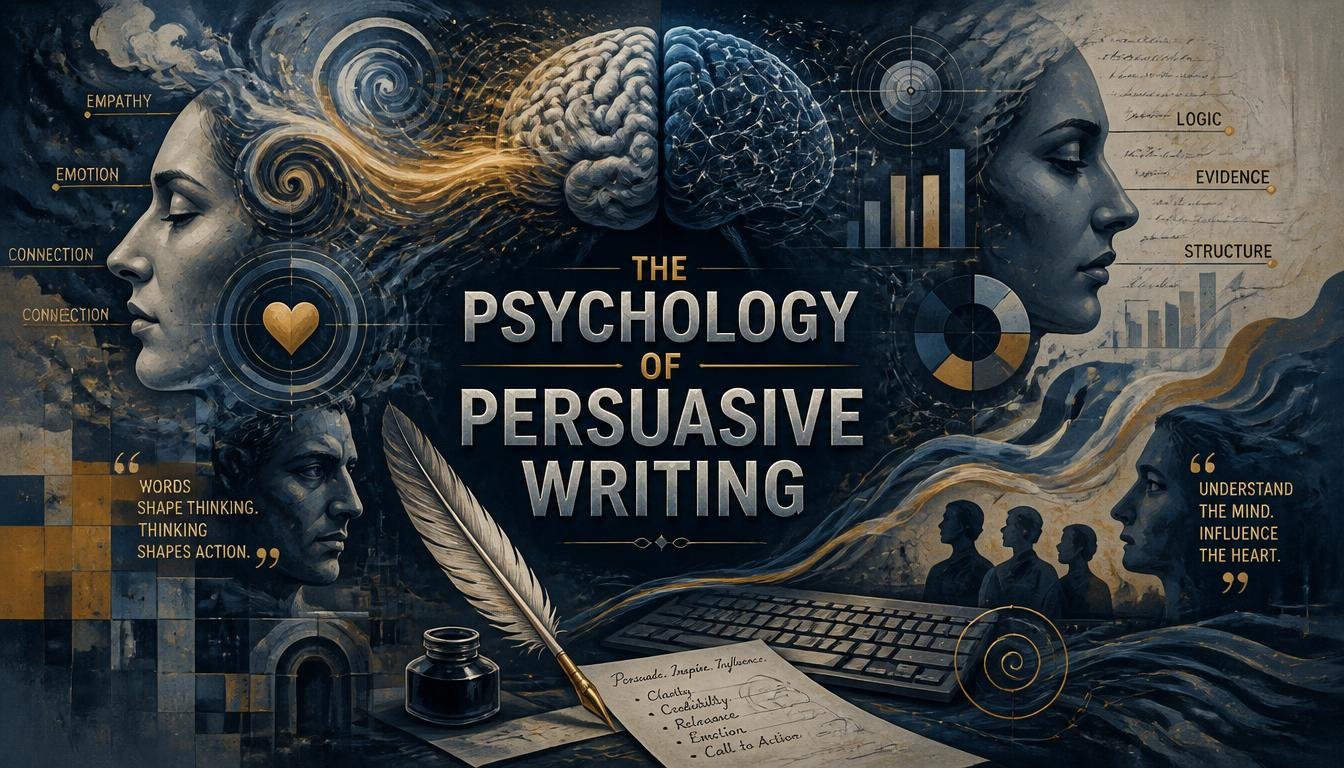
More than two thousand years ago, Aristotle identified three modes of persuasion that remain foundational to understanding persuasive writing today.
Ethos refers to credibility — the audience's trust in the writer or speaker. A message is far more persuasive when it comes from a source the audience believes is knowledgeable, honest, and trustworthy. In writing, ethos is built through demonstrated expertise, transparent sourcing, and a tone that feels authentic rather than manipulative.
Pathos refers to emotional appeal. Humans do not make decisions purely through logical analysis; emotions play a significant role in what we believe and how we act. Persuasive writing often works by connecting a message to feelings the reader already has — hope, fear, pride, empathy, or urgency.
Logos refers to logical appeal — facts, statistics, reasoning, and evidence. While emotion often drives the initial pull toward a decision, logical support helps readers justify that decision to themselves and others.
The most effective persuasive writing typically combines all three. Pure logic without emotional resonance can feel dry and forgettable. Pure emotion without credibility or logic can feel manipulative or shallow. The balance between the three depends on the context, audience, and goal.
Cognitive Biases That Shape Persuasion
Modern psychology has expanded significantly on these classical ideas, identifying specific cognitive patterns that influence how people respond to persuasive messages. Understanding a few of these can dramatically improve the effectiveness of your writing.
Social Proof
People tend to look to others' behavior and opinions when deciding how to act themselves, especially in uncertain situations. This is why testimonials, reviews, and statements like "join thousands of satisfied customers" are so common in persuasive writing. Referencing what others are already doing or believing can make a course of action feel safer and more validated.
Scarcity
People place higher value on things that are perceived as limited or rare. Phrases like "only three spots left" or "offer ends Friday" tap into this bias by creating a sense of urgency. Used honestly, scarcity can be a legitimate motivator; used dishonestly — fabricating false limits — it damages trust once readers realize the scarcity was not real.
Reciprocity
People feel a natural inclination to return favors. Persuasive writing sometimes leverages this by offering something of value upfront — useful information, a free resource, genuine help — before making a request or an ask. This principle underlies much of content marketing: providing real value builds goodwill that makes readers more receptive to a later call to action.
Anchoring
The first piece of information a reader encounters tends to influence how they judge everything that follows. In pricing, for example, showing a higher "original price" next to a discounted price makes the discounted price feel like a better deal, even if the discounted price alone would have seemed reasonable without the comparison.
Loss Aversion
People are generally more motivated to avoid losing something than to gain something of equivalent value. This is why persuasive writing often frames messages in terms of what the reader stands to lose by not acting, rather than purely what they stand to gain. "Don't miss out on this opportunity" often resonates more strongly than "Here is an opportunity," even though both point toward the same action.
Confirmation Bias
People tend to seek out and give more weight to information that confirms what they already believe. Persuasive writing that acknowledges a reader's existing beliefs or concerns before introducing a new idea tends to be received more openly than writing that directly contradicts those beliefs from the outset.
Structuring Persuasive Writing for Maximum Impact
Beyond individual psychological principles, the overall structure of a persuasive piece significantly affects how convincing it feels.
Start with something that captures attention and establishes relevance. Readers decide within seconds whether a piece of writing is worth their continued attention. Opening with a compelling question, a surprising fact, or a scenario the reader recognizes from their own experience increases the odds they will keep reading.
Address the reader's likely objections. Effective persuasive writing does not ignore counterarguments — it anticipates and addresses them. This builds credibility, because it shows the writer has genuinely considered multiple sides rather than presenting a one-sided pitch.
Build a logical progression. Each point in a persuasive piece should build naturally on what came before, guiding the reader step by step toward the conclusion rather than jumping between disconnected arguments.
End with a clear call to action. Persuasive writing that builds a strong case but leaves the reader unsure of what to do next wastes much of its own effectiveness. A clear, specific, and low-friction call to action — "reply to this email," "click here to start your free trial," "share your thoughts below" — significantly increases the odds that persuasion translates into actual behavior.
The Role of Language Choices
Specific word choices carry more persuasive weight than many writers realize.
Concrete over abstract. "This tool saves you three hours a week" is more persuasive than "This tool improves your efficiency," because the concrete claim is easier to visualize and evaluate.
Active voice over passive. As covered in other writing guides, active voice tends to feel more direct and confident, qualities that support persuasion. "We guarantee results" is more compelling than "Results are guaranteed."
Second person over third person. Addressing the reader directly as "you" creates a more personal, immediate connection than writing about a generic "someone" or "customers" in the abstract.
Sensory and vivid language. Language that engages the senses or paints a specific mental picture tends to be more memorable and emotionally engaging than flat, generic description.
Simplicity over complexity. Persuasive writing that is easy to read is generally more effective than writing that requires effort to parse. Complicated sentence structures and unnecessary jargon create friction that reduces persuasive power, even when the underlying argument is sound.
The Ethics of Persuasive Writing
Understanding psychological principles gives writers real power to influence readers' beliefs and decisions, and with that power comes a responsibility to use it ethically. There is an important distinction between persuasion and manipulation.
Persuasion involves presenting a genuine, honest case for a course of action, using techniques that help the reader understand and connect with real value or a real argument.
Manipulation involves exploiting psychological weaknesses to push someone toward a decision that does not actually serve their genuine interests — using fabricated scarcity, misleading claims, or emotional pressure that overrides rational judgment.
The techniques described in this post — social proof, scarcity, reciprocity, and others — are psychologically powerful precisely because they are so deeply embedded in how humans process information. Used honestly, in service of a genuinely valuable product, idea, or cause, they help readers make decisions that are actually good for them. Used dishonestly, they erode trust, and once an audience senses manipulation, persuasive power collapses, often permanently.
Practical Application
The next time you write something meant to persuade — a sales email, a proposal, an opinion piece, or even a simple request to a colleague — consider working through these questions:
- Does my opening capture attention and establish why this matters to the reader?
- Have I balanced logical evidence with genuine emotional resonance?
- Have I anticipated and addressed the reader's likely objections or hesitations?
- Am I using concrete, specific language rather than vague generalities?
- Is my call to action clear and easy to act on?
- Is everything I am claiming honest and verifiable?
Persuasive writing, done well, is not about tricking people into agreement. It is about clearly and compellingly communicating why something genuinely matters, in a way that respects the reader's intelligence and autonomy while still connecting with the psychological realities of how people actually process information and make decisions. Mastering this balance — psychological insight paired with honesty — is what separates writing that genuinely moves people from writing that merely tries to.