
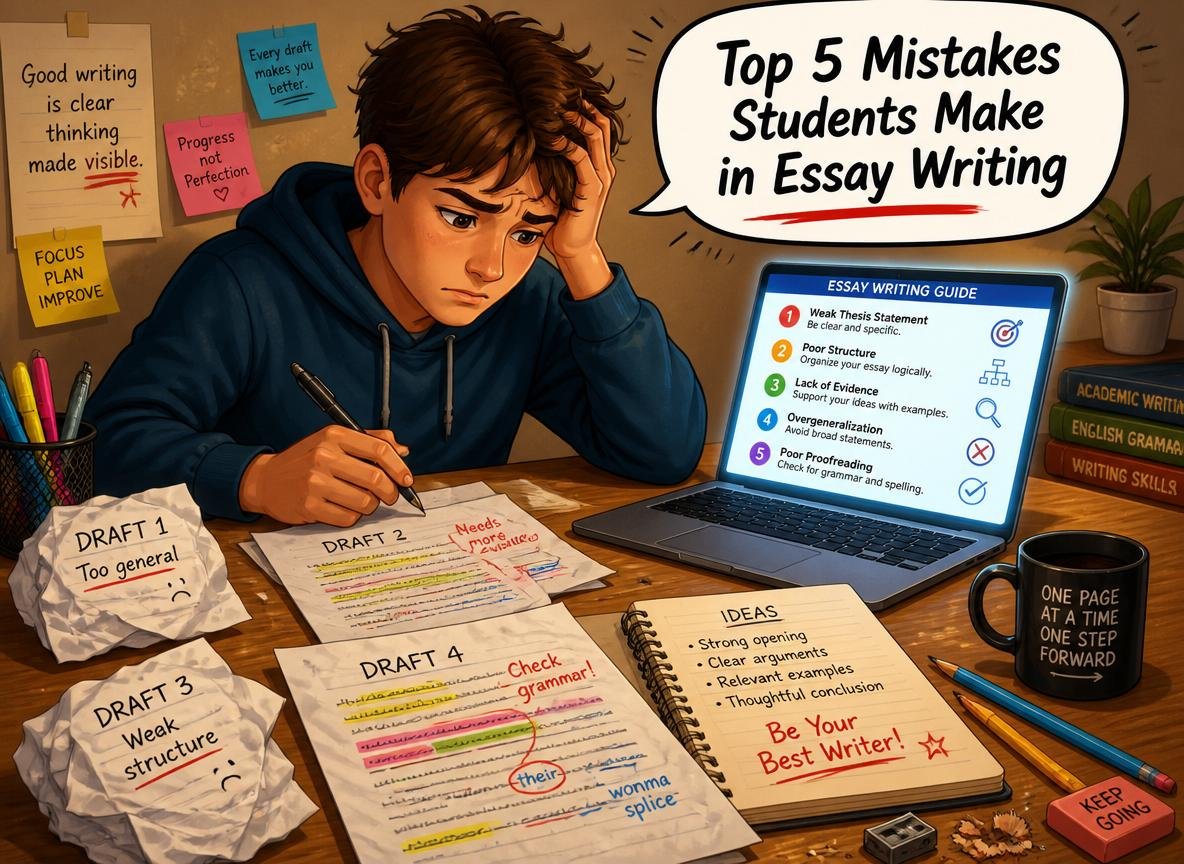
Top 5 Mistakes Students Make in Essay Writing
Essay writing is an essential skill for students at almost every level of education. Whether you are in high school, college, university, or preparing for an important examination, your ability to communicate ideas clearly through writing can have a significant impact on your academic performance.
However, many students struggle with essay writing—not necessarily because they lack knowledge about the subject, but because they make common mistakes that weaken their arguments, organization, clarity, and overall presentation.
A strong essay is more than a collection of facts and sentences. It needs a clear purpose, logical structure, relevant evidence, good paragraph organization, and a conclusion that effectively brings the discussion together.
The good news is that most essay-writing problems can be corrected with practice and careful editing.
In this article, we will examine the top five mistakes students make in essay writing, explain why these mistakes matter, and provide practical strategies for avoiding them.
Why Good Essay Writing Matters
Before looking at the common mistakes, it is useful to understand what makes an essay effective.
A successful essay generally does several things well:
Clearly answers the question
Presents a central argument or thesis
Organizes ideas logically
Uses relevant evidence
Explains rather than simply describes
Connects paragraphs effectively
Uses appropriate academic language
Includes proper citations when required
Ends with a meaningful conclusion
Students often focus heavily on grammar and spelling while overlooking the bigger picture.
A grammatically correct essay can still receive a poor grade if it does not answer the question properly or lacks a clear argument.
This is why understanding the most common essay-writing mistakes is so important.
Mistake 1: Not Understanding the Essay Question
One of the biggest mistakes students make is failing to fully understand what the question is asking.
Students sometimes begin writing immediately after reading the topic.
This can lead to an essay that discusses the general subject but does not actually answer the specific question.
For example, imagine an assignment asks:
“Evaluate the impact of social media on university students' academic performance.”
A student might write a general essay explaining what social media is and describing its advantages and disadvantages.
Although the topic is related, the essay may not adequately evaluate its impact on academic performance.
The question requires the writer to examine the effects and make a reasoned judgment.
How to Avoid This Mistake
Before writing, identify the important words in the question.
Common instruction words include:
Analyze
Break the topic into parts and examine how those parts relate to one another.
Compare
Identify similarities and differences between two or more subjects.
Evaluate
Consider evidence and make a judgment based on that evidence.
Explain
Make an idea clear by describing how or why something happens.
Discuss
Explore different perspectives or aspects of a topic.
Critically evaluate
Go beyond description by examining strengths, weaknesses, evidence, assumptions, and limitations.
Take a few minutes to understand the task before starting your research.
Ask yourself:
“What exactly am I being asked to prove, explain, compare, or evaluate?”
Your answer should guide the entire essay.
Mistake 2: Writing Without a Clear Thesis
Another common problem is starting an essay without deciding what the main argument will be.
A thesis statement is the central claim or position of an essay.
It tells the reader what the essay is ultimately arguing or demonstrating.
Without a clear thesis, an essay can become a collection of unrelated observations.
For example:
Weak thesis:
“Social media is popular among university students.”
This is a fact, but it does not establish a meaningful argument.
A stronger thesis might be:
“Although social media can support communication and access to educational resources, excessive use can negatively affect university students' academic performance by increasing distraction and reducing study time.”
This statement provides a clear direction.
The writer can now organize the essay around:
Educational benefits
Distraction
Time management
Overall impact
How to Create a Strong Thesis
A good thesis should generally:
Directly address the essay question
Express a clear position or central idea
Be specific
Give the essay direction
Be supported by evidence
Avoid making your thesis too broad.
Instead of:
“Technology has changed education.”
Try:
“Digital learning platforms have expanded access to education, but their effectiveness depends heavily on student engagement, technological access, and instructional quality.”
The second statement gives the essay a much clearer focus.
Mistake 3: Poor Essay Structure
Even good ideas can become difficult to understand if they are not organized properly.
A typical academic essay includes three major parts:
Introduction
Body paragraphs
Conclusion
Each part has a specific purpose.
The Introduction
The introduction should introduce the topic and establish the direction of the essay.
A strong introduction often includes:
Background or context
The main issue
Relevant definitions when necessary
The thesis statement
A brief indication of the essay's direction
Avoid making the introduction unnecessarily long.
The reader should quickly understand what the essay is about and what position it will take.
The Body Paragraphs
Each body paragraph should normally focus on one main idea.
A useful structure is:
Point → Evidence → Explanation → Link
For example:
Point
Social media can increase academic distraction.
Evidence
Research may show an association between frequent social media use and reduced study time.
Explanation
Students who frequently switch between academic tasks and social media may find it more difficult to maintain concentration.
Link
Therefore, excessive social media use can interfere with effective study habits.
This structure helps prevent paragraphs from becoming collections of unrelated information.
The Conclusion
The conclusion should bring the main argument together.
It can:
Restate the central argument in a new way
Summarize the key findings
Provide a final perspective
Explain the broader significance
Avoid introducing completely new arguments in the conclusion.
How to Improve Essay Structure
Before writing the full essay, create a simple outline.
For example:
Introduction
Background
Problem
Thesis
Body Paragraph 1
First major argument
Evidence
Explanation
Body Paragraph 2
Second major argument
Evidence
Explanation
Body Paragraph 3
Counterargument
Evidence
Response
Conclusion
Main findings
Final position
An outline can save considerable time because it gives you a clear roadmap before you begin writing.
Mistake 4: Using Evidence Without Explaining It
Many students assume that including statistics, quotations, or research automatically makes an essay stronger.
It does not.
Evidence is useful only when the writer explains how it supports the argument.
Consider this example:
“According to a study, students who spend significant amounts of time on social media may experience reduced study time.”
If the paragraph stops there, the reader may still ask:
Why does this evidence matter?
The writer needs to explain the connection.
For example:
“This finding suggests that frequent social media use can compete with time that students might otherwise devote to academic activities. As a result, students who struggle to control their online activity may have less time available for reading, revision, and completing assignments.”
Now the evidence has been interpreted.
The Difference Between Evidence and Analysis
Evidence tells the reader what happened.
Analysis explains what the evidence means.
Strong academic writing requires both.
A useful question to ask after presenting evidence is:
“So what?”
Why does this evidence matter?
How does it support my thesis?
What does it reveal?
Does it support or challenge another argument?
Answering these questions turns information into analysis.
Avoid Overusing Direct Quotes
Another common mistake is filling an essay with quotations.
Quotes can be useful when the exact wording is important.
However, your essay should primarily demonstrate your own understanding and analysis.
Instead of quoting every source, consider paraphrasing or summarizing when appropriate.
For example:
Direct quotation:
A researcher states that “...”
Paraphrase:
The researcher argues that...
The key is to integrate sources naturally into your argument.
When using another person's ideas, follow the citation rules required by your school, university, or chosen academic style.
Mistake 5: Ignoring Editing and Proofreading
Many students finish their final paragraph and immediately submit the essay.
This is a mistake.
The first draft is rarely the best version.
Editing allows you to identify problems that are difficult to notice while writing.
Common problems include:
Grammar mistakes
Spelling errors
Repeated words
Weak transitions
Unclear sentences
Missing evidence
Inconsistent arguments
Poor paragraph structure
Incorrect citations
Take a Break Before Editing
If possible, do not edit immediately after finishing.
Take a short break.
When you return to the essay later, you may notice problems that were invisible during the writing process.
Read each paragraph carefully.
Ask:
Does this paragraph have one clear main idea?
Does the evidence support the point?
Does the explanation connect to my thesis?
Is the transition to the next paragraph logical?
Read Your Essay Aloud
Reading aloud is a surprisingly effective editing technique.
When you read silently, your brain may automatically correct mistakes.
Reading aloud forces you to process every sentence.
You may notice:
Awkward wording
Repeated phrases
Extremely long sentences
Missing words
Unclear arguments
If a sentence is difficult to say naturally, it may need to be rewritten.
Use Grammar and Writing Tools Carefully
Digital writing tools can help identify:
Grammar errors
Spelling mistakes
Sentence problems
Repeated words
Readability issues
AI-powered text transformation tools can also help students rewrite unclear sentences or improve readability.
For example, a complicated sentence can be transformed into a clearer version while preserving the intended meaning.
However, students should not rely entirely on automated tools.
AI-generated suggestions can sometimes change the meaning of a sentence or introduce inaccurate information.
Always review suggested changes yourself.
Other Common Essay Problems
Although the five mistakes above are among the most important, students should also watch for several additional problems.
Writing Too Generally
Avoid making broad claims without explanation.
Instead of:
“Technology is changing everything.”
Explain exactly what technology is changing and why it matters.
Repeating the Same Idea
If three paragraphs communicate essentially the same argument, combine or restructure them.
Every paragraph should contribute something new.
Weak Transitions
Readers should understand how ideas connect.
Use transitions such as:
However
Furthermore
In contrast
Therefore
For example
As a result
Similarly
Do not use transition words randomly. They should accurately represent the relationship between ideas.
Using Informal Language
Unless the assignment specifically allows a casual style, avoid unnecessary expressions such as:
“A lot of”
“Things”
“Stuff”
“Kids”
“I think it is super important”
Choose precise academic language when appropriate.
Ignoring Assignment Requirements
Always check:
Word count
Formatting
Citation style
Deadline
Required sources
Font requirements
Spacing
Submission format
A strong essay can still lose marks if it ignores basic instructions.
How to Write a Better Essay: Step-by-Step
Here is a practical process students can follow.
Step 1: Read the Question Carefully
Identify the topic and instruction words.
Step 2: Research the Topic
Use reliable academic and authoritative sources.
Step 3: Identify Your Main Argument
Write a preliminary thesis statement.
Step 4: Create an Outline
Organize the major arguments and supporting evidence.
Step 5: Write the Introduction
Introduce the issue and establish your thesis.
Step 6: Write Body Paragraphs
Develop one major idea at a time.
Step 7: Add Evidence
Use relevant research, examples, statistics, or quotations.
Step 8: Analyze the Evidence
Explain why the evidence supports your argument.
Step 9: Write the Conclusion
Bring the major points together and reinforce your central argument.
Step 10: Edit and Proofread
Check structure, meaning, grammar, citations, and formatting.
A Simple Essay Writing Formula
Students who struggle with essay organization can use this simple framework:
Question → Thesis → Points → Evidence → Analysis → Conclusion
For every body paragraph, think:
Point + Evidence + Explanation + Link
This formula is not a replacement for critical thinking, but it provides a useful starting structure.
How AI Can Support Essay Writing
AI tools are increasingly being used as writing assistants.
They can help students:
Brainstorm ideas
Create outlines
Improve sentence clarity
Rewrite confusing passages
Explain difficult concepts
Identify grammar problems
Summarize information
Generate questions for further research
However, students should use these tools responsibly.
The final essay should reflect the student's own understanding and comply with the academic integrity rules of their institution.
Do not use AI to fabricate references, invent evidence, or submit work that violates your school's policies.
AI is most useful when it supports learning rather than replaces it.
Final Essay Checklist
Before submitting your essay, use this checklist.
Content
Did I answer the exact question?
Is my thesis clear?
Does every paragraph support my main argument?
Have I included relevant evidence?
Did I explain the evidence?
Structure
Does the introduction provide clear direction?
Are the body paragraphs logically organized?
Does each paragraph have a clear purpose?
Does the conclusion reinforce the main argument?
Writing
Are my sentences clear?
Have I removed unnecessary words?
Is my vocabulary appropriate?
Have I avoided excessive repetition?
Sources
Are my sources reliable?
Have I cited information that requires attribution?
Is my citation style consistent?
Have I avoided copying another person's work?
Final Review
Did I proofread the entire essay?
Did I check spelling and grammar?
Did I meet the word count?
Did I follow the assignment instructions?
Final Thoughts
Essay writing becomes much easier when students understand the mistakes that commonly weaken their work.
The five major mistakes are:
Not understanding the essay question
Writing without a clear thesis
Using poor structure
Presenting evidence without analysis
Skipping editing and proofreading
Avoiding these problems can significantly improve the clarity and effectiveness of an essay.
Remember that a strong essay is not simply a long piece of writing.
It is a carefully organized argument supported by relevant evidence and thoughtful analysis.
Start by understanding the question.
Develop a clear thesis.
Plan your structure.
Give each paragraph a specific purpose.
Use evidence responsibly and explain why it matters.
Finally, leave enough time to revise and proofread your work.
With regular practice, students can develop stronger writing habits and become more confident academic writers.
The goal is not to write complicated sentences or use impressive vocabulary.
The goal is to communicate your ideas clearly, logically, accurately, and convincingly.
That is the foundation of effective essay writing.