
Web Writing vs. Print Writing: Key Differences Every Writer Should Know
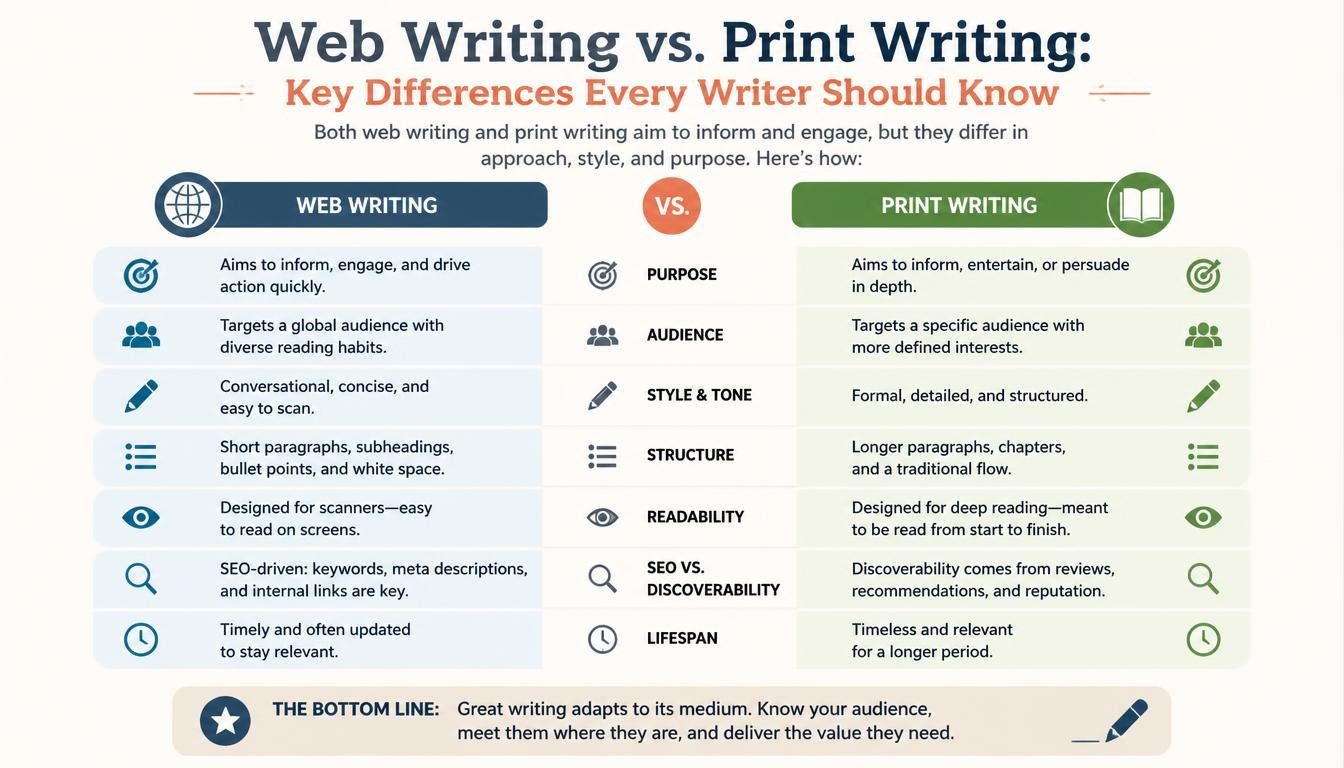
Writing for a screen and writing for a printed page might seem like the same fundamental skill applied to different mediums, but the two actually require noticeably different approaches. Reader behavior, attention patterns, and even how the eye moves across a page differ significantly between web and print, and writers who treat both formats identically often produce content that underperforms in one medium or the other. Understanding these differences helps writers adapt their style effectively to whichever format they're working in.
How Reading Behavior Differs Between Web and Print
Research on reading behavior consistently shows that people read web content differently than printed material. Print readers, especially with books, articles, and other long-form printed content, tend to read more linearly and thoroughly, often committing to reading a full piece once they begin.
Web readers, by contrast, tend to scan rather than read word-for-word, especially on first encounter with a page. Eye-tracking studies have repeatedly shown that web readers often scan in an "F-shaped" or "Z-shaped" pattern — reading the first few lines fully, then scanning down the left side of subsequent paragraphs, picking up only fragments of text rather than reading fully.
This fundamental behavioral difference is the root cause of nearly every stylistic difference between effective web writing and effective print writing.
Structure: Scannable vs. Linear
Web writing needs to be structured for scanning. This means:
- Short paragraphs — often just 2-4 sentences, sometimes even a single sentence
- Frequent subheadings that allow readers to jump to relevant sections
- Bullet points and numbered lists to break up dense information
- Bold text to highlight key phrases a scanning reader might catch even without reading every word
- Front-loaded information — the most important point stated early, since many readers won't reach the end
Print writing can rely more on continuous, linear structure:
- Longer paragraphs are more acceptable, since print readers are more likely to read continuously
- Fewer visual interruptions like bullet points, since the reading experience is expected to flow more naturally from sentence to sentence
- Build-up structure is more viable — you can develop an argument gradually, trusting the reader to follow through to a conclusion
Sentence Length and Complexity
Web writing generally favors shorter sentences and simpler sentence structures, partly because screen reading is measurably more tiring on the eyes than reading print, and shorter sentences reduce cognitive load for readers who are often scanning or reading on mobile devices with limited screen space.
Print writing has more room for longer, more complex sentence structures, since readers engaging with print — particularly books, magazines, and printed journalism — are often in a more focused, sustained reading mode that can accommodate greater syntactic complexity.
The Role of Headlines and Headings
Web headlines often need to work harder and faster. They frequently appear in search results, social media shares, and crowded feeds where they compete directly against dozens of other pieces of content for a reader's attention within a fraction of a second. This has led to web headline conventions that print doesn't share to the same degree — numbered listicles ("7 Ways to..."), direct promises of value ("How to..."), and SEO-conscious phrasing that anticipates how readers actually search.
Print headlines, particularly in traditional journalism or literary contexts, often have more freedom to be clever, understated, or stylistically distinctive, since the reader has typically already committed to picking up the publication and is less likely to be actively comparing it against dozens of competing headlines in the same moment.
Length Considerations
There's no universal rule that web content must be shorter than print content — in fact, some of the best-performing web content, particularly in SEO-driven contexts, is quite long and comprehensive. However, web writing needs to justify its length through clear structure and genuine scannability, since readers can leave a webpage with a single click far more easily than they can abandon a physical magazine or book mid-article.
Print content, once a reader has committed to picking up a publication, generally retains readers more easily through longer stretches of continuous text, since there's more inherent commitment involved in picking up and holding a physical piece of reading material.
Hyperlinks and Interactivity
One of the most fundamental differences between web and print writing is the ability to use hyperlinks. Web writing can:
- Link directly to supporting sources, related content, or further reading
- Allow readers to jump between related pieces of content
- Include interactive elements like embedded videos, tools, or forms
Print writing has no equivalent — supporting information has to be either fully included in the text itself or referenced separately (footnotes, endnotes, bibliography), which changes how writers handle citations, tangential information, and calls to action.
SEO Considerations Unique to Web Writing
Web writing carries an entirely additional consideration that print writing doesn't share: search engine optimization. Web writers need to consider:
- Keyword placement and relevance to help content rank in search results
- Meta descriptions and title tags that don't exist in print at all
- Internal and external linking structure to support both readers and search engine understanding of the content
- Readability for both humans and search algorithms, which sometimes creates tension with purely stylistic writing choices
This SEO layer doesn't exist in print writing at all, since print publications don't need to be "discovered" through search algorithms in the same way.
Tone and Voice Differences
Web writing, particularly on blogs, social media, and many commercial websites, has trended toward a more conversational, direct, and personal tone over the past two decades, partly reflecting the more casual, personal nature of screen-based reading environments.
Print writing, especially in more traditional publications, book publishing, and academic contexts, often maintains more formal conventions, though this varies significantly by publication type — a print magazine aimed at younger readers might use an equally casual tone to a comparable web publication.
Visual Design Considerations
Web writing exists within a broader visual and interactive environment — surrounded by navigation menus, related content suggestions, ads, and other on-page elements competing for attention. This context influences how web content needs to be structured to stand out and remain readable amid surrounding distractions.
Print writing exists within a more controlled visual environment, where the writer (or the publication's designer) has more complete control over exactly what surrounds the text, without competing hyperlinks, pop-ups, or algorithmically inserted content.
When the Line Blurs
It's worth noting that these distinctions aren't absolute. Some web content — particularly long-form journalism, in-depth essays, and literary web publications — deliberately adopts more print-like conventions, trusting readers to engage in sustained, linear reading. Similarly, some print publications, especially those aimed at younger or more casual readers, adopt more scannable, web-influenced structures with shorter paragraphs and more visual breaks.
Understanding the underlying principles — reader behavior, attention patterns, and format constraints — allows writers to make deliberate choices about which conventions genuinely serve their specific piece, rather than rigidly following either "web rules" or "print rules" by default.
Final Thoughts
Writing for the web and writing for print aren't fundamentally different skills, but they do call for genuinely different tactical choices based on how readers actually engage with each medium. Web writing benefits from scannable structure, shorter paragraphs, strategic use of headings and lists, and SEO awareness, while print writing can lean more heavily on linear structure and sustained reader attention. Recognizing which medium you're writing for — and adjusting your approach accordingly — is a practical skill that significantly improves how effectively your writing actually reaches and holds its intended audience.