What Is an AI Text Rewriter and How Does It Work?
Writing is one of the most important forms of communication in the digital world. Every day, people create millions of articles, emails, social media posts, product descriptions, essays, reports, advertisements, and website pages.
But writing high-quality content consistently is not always easy.
Sometimes you have the right information but struggle to find the right words. Other times, you may have written a paragraph that feels repetitive, too complicated, too formal, or simply difficult to read.
This is where an AI Text Rewriter can help.
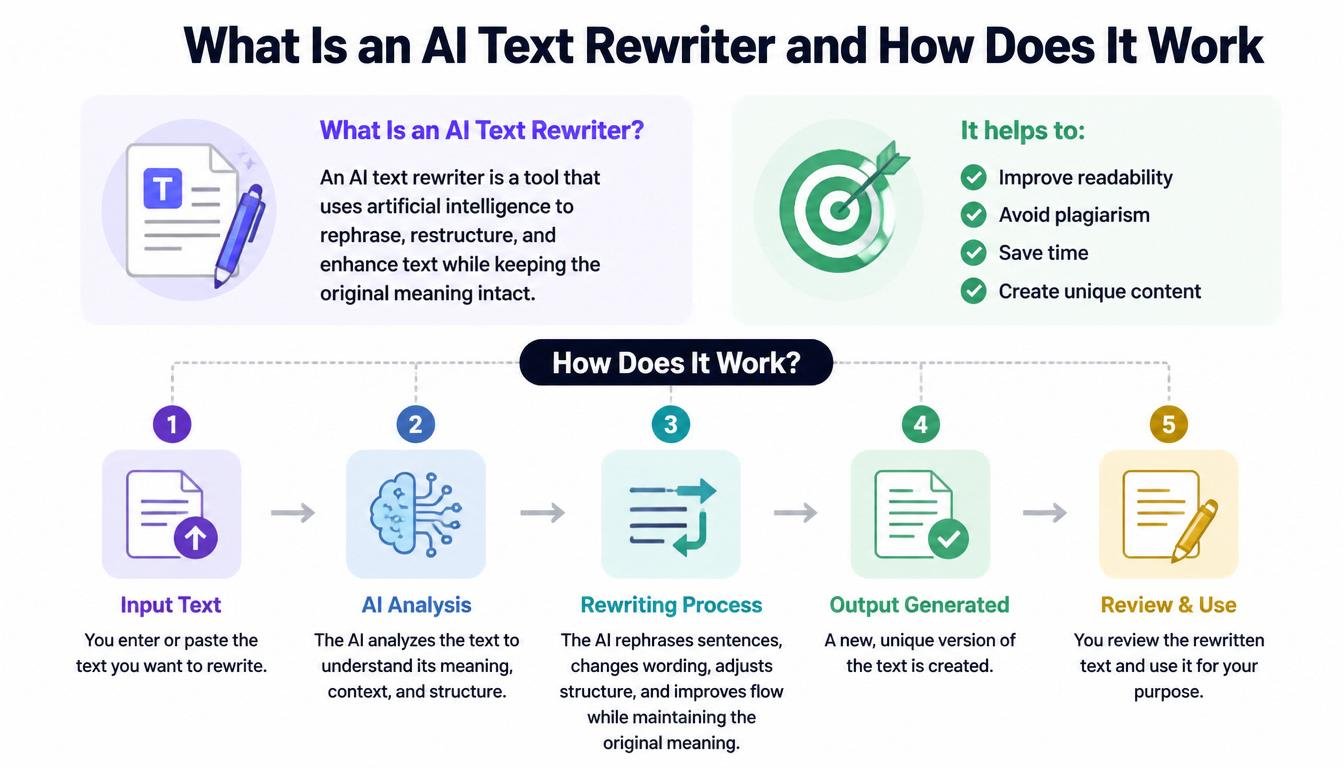
An AI text rewriter is a software tool that uses artificial intelligence and natural language processing to transform existing text into a new version while attempting to preserve the original meaning.
Instead of manually rewriting every sentence, users can provide existing text and let an AI-powered system suggest alternative wording, sentence structures, tones, and styles.
But how does it actually work?
What makes AI rewriting different from simply replacing words with synonyms?
And how can writers use an AI text rewriter effectively without sacrificing quality or originality?
Let's explore everything you need to know.
What Is an AI Text Rewriter?
An AI Text Rewriter is a digital tool designed to rewrite existing content using artificial intelligence.
The basic purpose is simple:
Take existing text → understand its meaning → create a new version with different wording and structure.
For example, consider this sentence:
Original:
“Many people use online tools because they can save time.”
An AI text rewriter might produce:
Rewritten:
“People often rely on online tools to complete tasks more quickly.”
The wording and structure are different, but the main idea remains similar.
Modern AI rewriters can do much more than replace individual words.
Depending on the tool, they can:
Rewrite sentences
Rephrase paragraphs
Paraphrase content
Improve grammar
Simplify language
Adjust tone
Improve readability
Remove unnecessary words
Expand short explanations
Shorten lengthy content
Create alternative versions
This makes AI text rewriters useful for many different types of users.
How Is an AI Text Rewriter Different From a Traditional Rewriter?
Traditional rewriting often involves manually changing individual words.
For example:
Original:
“The software is very useful for creating content.”
A basic synonym-based system might replace “useful” with “helpful.”
The result could be:
“The software is very helpful for creating content.”
The sentence is technically different, but the overall structure remains almost identical.
AI-powered rewriting can analyze the sentence more deeply.
It may produce:
“The software makes the content creation process easier and more efficient.”
Here, the entire sentence structure has changed.
This is one of the key differences between traditional synonym replacement and modern AI-based text transformation.
AI attempts to consider the context rather than treating every word independently.
How Does an AI Text Rewriter Work?
Although the exact technology differs between tools, an AI text rewriter generally follows several stages.
Step 1: The User Provides Text
The process begins when a user enters or uploads text.
This could be:
A sentence
A paragraph
An article
An email
A product description
A social media post
A report
An essay
The system receives the text as input.
Step 2: The AI Analyzes the Text
The AI system analyzes the language and attempts to understand the relationships between words and sentences.
It may examine:
Sentence structure
Word relationships
Context
Grammar
Meaning
Tone
Writing style
This contextual analysis is important because the same word can have different meanings depending on how it is used.
Step 3: The System Identifies Transformation Opportunities
The AI then determines which parts of the text could be changed.
It may identify opportunities to:
Replace certain phrases
Restructure sentences
Combine sentences
Split long sentences
Change the order of information
Simplify wording
Adjust tone
The goal is generally to create a different expression of the same idea.
Step 4: The AI Generates New Text
The system generates one or more possible rewritten versions.
For example:
Original:
“Creating high-quality content requires considerable time and effort.”
Possible transformation:
“Producing valuable content can take a significant amount of time and work.”
The output is then presented to the user.
Step 5: The User Reviews the Result
This is an important step.
AI-generated text should not automatically be considered perfect.
The user should check:
Meaning
Accuracy
Grammar
Context
Tone
Readability
If necessary, the user can edit the result manually.
This human review helps ensure that the final content reflects the intended message.
What Technology Powers AI Text Rewriters?
AI text rewriters typically rely on technologies related to Natural Language Processing (NLP) and machine learning.
Natural Language Processing allows computers to work with human language.
Modern language models can analyze patterns across large amounts of text and generate language based on learned relationships between words and concepts.
Rather than thinking about language exactly as humans do, these systems process language through mathematical representations and statistical patterns.
When you provide a paragraph, the system analyzes the input and predicts suitable language for the requested transformation.
This is why modern AI tools can produce much more natural results than older rule-based rewriting software.
Understanding Context Is Critical
One of the biggest challenges in rewriting is preserving context.
Consider the word “bank.”
It could refer to:
A financial institution
The side of a river
A place where something is stored
A simple synonym replacement system may not understand the difference.
Context-aware AI systems can use surrounding words to determine the likely meaning.
For example:
“She went to the bank to deposit money.”
Clearly refers to a financial institution.
While:
“They sat on the river bank.”
refers to land beside a river.
Context allows AI to choose more appropriate wording.
Common Features of AI Text Rewriters
Different AI rewriters provide different features, but many modern tools offer several transformation options.
Paraphrasing
Paraphrasing changes the wording and sentence structure while maintaining the main idea.
Sentence Rewriting
This focuses on improving individual sentences.
Grammar Improvement
The system can identify and correct certain grammar problems.
Tone Transformation
Text can be changed to sound more professional, casual, friendly, formal, or persuasive.
Simplification
Complex language can be transformed into easier-to-understand wording.
Expansion
Short ideas can be developed into more detailed explanations.
Summarization
Long content can be shortened while retaining important points.
Readability Improvement
Long or complicated sentences can be transformed into clearer language.
These features make AI text rewriters useful for a wide variety of writing tasks.
Who Uses AI Text Rewriters?
AI text rewriters are not limited to professional writers.
They can be useful for many groups.
Bloggers
Bloggers can use AI to improve drafts, rewrite introductions, simplify paragraphs, and create alternative versions of content.
Freelancers
Freelancers can adapt content to different clients and writing styles.
Students
Students can use rewriting tools to improve clarity, understand difficult language, and develop better drafts, subject to their school's academic rules.
Marketers
Marketing professionals can create variations of advertisements, product descriptions, and promotional messages.
Businesses
Companies can use AI to improve emails, customer communication, reports, and website copy.
Social Media Creators
Creators can transform longer ideas into shorter captions, posts, and descriptions.
AI Text Rewriting for Bloggers
Bloggers often spend more time editing than they expect.
A first draft may contain useful information but still need significant improvement.
An AI text rewriter can help with:
Rewriting introductions
Improving transitions
Simplifying paragraphs
Reducing repetition
Creating alternative headings
Making language more conversational
Adapting content for different audiences
However, bloggers should not use AI simply to rewrite articles copied from other websites.
Changing the wording of existing content does not automatically create original value.
A better approach is to use AI with original research, experience, examples, and analysis.
AI Text Rewriting and SEO
SEO is another area where text rewriting tools are frequently used.
Website owners may use them to improve readability, create alternative descriptions, refine headings, and make content more natural.
However, rewriting should not be confused with SEO itself.
Simply changing the words in an article does not guarantee higher search rankings.
Search engines aim to provide users with useful and relevant results.
Google's guidance emphasizes people-first content and warns against creating content primarily for search-engine manipulation.
Therefore, an AI text rewriter should be used as part of a broader content strategy.
Research, expertise, originality, usefulness, and accuracy remain essential.
Can an AI Rewriter Make Content Original?
This is an important question.
An AI rewriter can produce a different version of text, but rewriting does not automatically make copied information original.
Imagine someone copies an article from another website and runs it through an AI rewriter.
Although the sentences may look different, the underlying ideas, structure, and information may still be derived from the original source.
For high-quality content, creators should add their own value.
That can include:
Original research
Personal experience
Unique examples
Expert commentary
New analysis
Updated information
Original data
AI should help transform and improve communication rather than disguise copied content.
Benefits of Using an AI Text Rewriter
There are several reasons why these tools have become popular.
Saves Time
AI can produce alternative wording much faster than manual rewriting.
Improves Productivity
Creators can spend less time on repetitive editing.
Helps With Clarity
Complex sentences can often be made easier to understand.
Provides Multiple Options
Users can compare different versions of the same sentence.
Supports Different Writing Styles
Content can be adapted to different audiences and tones.
Helps Non-Native English Writers
People who are still developing their English writing skills can use AI suggestions to improve clarity and fluency.
Makes Content Repurposing Easier
Existing ideas can be adapted for different platforms and formats.
Limitations of AI Text Rewriters
AI rewriters are useful, but they are not perfect.
They can sometimes:
Change the original meaning
Produce unnatural phrases
Remove important context
Introduce inaccurate information
Overuse certain expressions
Make content sound generic
Misunderstand ambiguous sentences
For this reason, users should always review the output.
The more important the content, the more carefully it should be checked.
Medical, financial, legal, scientific, and other high-stakes information should receive particularly careful human review and fact-checking.
AI Rewriter vs. Human Editor
AI and humans have different strengths.
An AI tool is good at processing large amounts of language quickly.
A human editor is better positioned to understand purpose, context, audience, experience, and subtle meaning.
For example, AI may suggest that a sentence is grammatically correct.
But a human editor may recognize that the sentence does not fit the brand's personality.
The best approach is therefore collaboration.
AI provides speed.
Humans provide judgment.
How to Use an AI Text Rewriter Effectively
A good workflow can make AI rewriting much more useful.
1. Start With Your Own Ideas
Develop the core message yourself.
2. Write a Rough Draft
Focus on communicating the main information rather than making every sentence perfect.
3. Give the AI Clear Instructions
Specify what you want.
For example:
“Rewrite this paragraph in a professional and concise tone while preserving the original meaning.”
4. Compare the Result With the Original
Make sure important information has not been changed.
5. Add Your Own Value
Include examples, insights, experience, and research.
6. Fact-Check Important Claims
Do not assume that AI output is automatically accurate.
7. Perform a Final Human Edit
Read the finished content from the perspective of your audience.
The Future of AI Text Rewriting
AI text rewriting technology is likely to become more sophisticated.
Future systems may better understand individual writing styles, brand voices, cultural context, and audience expectations.
Instead of simply requesting a generic rewrite, users may be able to define highly specific preferences.
For example:
“Rewrite this article in a friendly professional tone, keep all technical terminology, make it understandable for beginners, remove unnecessary repetition, and preserve the original facts.”
AI could then provide a more personalized transformation.
This may make text rewriting an increasingly important part of writing workflows.
Will AI Text Rewriters Replace Writers?
Probably not.
Instead, they are likely to change what writers do.
Writers may spend less time on repetitive sentence-level tasks and more time on:
Research
Creativity
Storytelling
Strategy
Original analysis
Audience understanding
Editing
Fact-checking
The writer's role may become more focused on ideas and communication strategy.
AI can help with language, but humans still decide what deserves to be said and why.
Responsible Use of AI Text Rewriters
Using AI responsibly is important.
Creators should avoid using rewriting tools to:
Plagiarize other people's work
Misrepresent someone else's writing as their own
Create misleading information
Produce large amounts of low-value content
Manipulate search rankings
Instead, AI should be used to improve communication and productivity.
A responsible workflow combines AI assistance with human creativity, fact-checking, originality, and editorial judgment.
Final Thoughts
An AI Text Rewriter is a powerful writing assistant that can transform existing text into clearer, more concise, more engaging, or differently styled versions.
Behind the scenes, these tools use artificial intelligence and natural language processing to analyze language, understand context, identify possible transformations, and generate alternative wording.
For bloggers, freelancers, students, marketers, businesses, and content creators, AI rewriting can save time and make writing workflows more efficient.
But the technology works best when humans remain involved.
AI can suggest a better sentence.
You decide whether it is actually better.
AI can provide an alternative paragraph.
You decide whether it preserves your message.
AI can make writing faster.
You provide the ideas, experience, creativity, and judgment.
The future of writing is therefore unlikely to be about replacing human writers with machines. Instead, it will be about using AI as a powerful assistant that helps people communicate their ideas more effectively.
When used responsibly, an AI text rewriter can become more than a simple rewriting tool.
It can become an important part of a modern writing workflow—helping people spend less time on repetitive language tasks and more time creating content that is useful, original, and meaningful.