
Writing Clear Meeting Minutes and Notes
Meeting minutes serve one core purpose: letting someone who was not paying full attention, or was not even in the room, understand exactly what was decided and what happens next. Yet many meeting notes fail at this basic job, either by capturing too much irrelevant detail or too little actionable information. This guide covers how to write minutes that people actually use.
What Good Minutes Include
Decisions made. The single most important element. If the meeting resulted in a decision, it needs to be stated clearly and unambiguously.
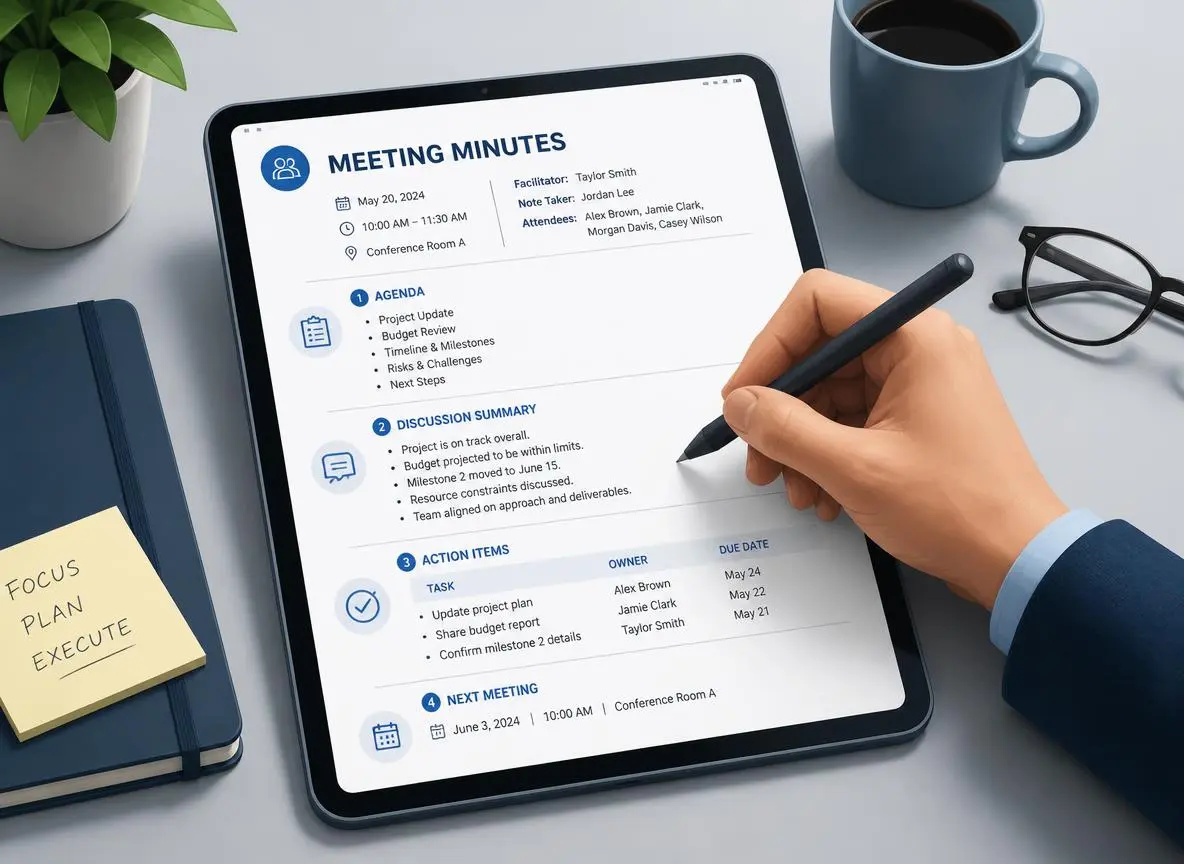
Action items with owners and deadlines. "Follow up with the vendor" is far less useful than "Maria to follow up with the vendor by Friday." Every action item should answer who, what, and by when.
Key discussion points, briefly. Enough context to explain why a decision was made, without transcribing the entire conversation.
Open questions or unresolved issues. Anything that needs further discussion should be flagged clearly rather than left ambiguous.
What to Leave Out
Avoid transcribing conversation verbatim, recording every tangent or side comment, or including opinions expressed but not acted upon unless they are directly relevant to a decision. Minutes are a record of outcomes, not a full transcript.
A Simple, Reusable Structure
Meeting: [Topic]
Date: [Date]
Attendees: [Names]

Decisions:
- [Decision 1]
- [Decision 2]

Action Items:
- [Task] — [Owner] — [Deadline]

Discussion Notes:
- [Brief summary of key points]

Open Questions:
- [Anything unresolved]
This structure works whether the meeting was five minutes or two hours, because it scales naturally — short meetings produce short notes, long meetings produce longer discussion sections, but the categories stay the same.
Writing Style Tips
Use active voice and past tense for decisions: "The team approved the new budget" rather than "The new budget was approved." This keeps ownership clear.
Keep sentences short. Minutes are reference documents, scanned quickly rather than read closely. Bullet points generally work better than paragraphs.
Write minutes soon after the meeting, ideally within a few hours, while details are still fresh. Waiting a day or more significantly increases the risk of inaccuracies or forgotten details.
Send minutes to all attendees for confirmation, especially for meetings involving decisions with real consequences. This creates a shared, agreed-upon record rather than one person's interpretation.
Final Thought
The test of good meeting minutes is simple: could someone who missed the meeting read them and know exactly what to do next? If yes, the minutes have done their job — regardless of how detailed or brief they are.