
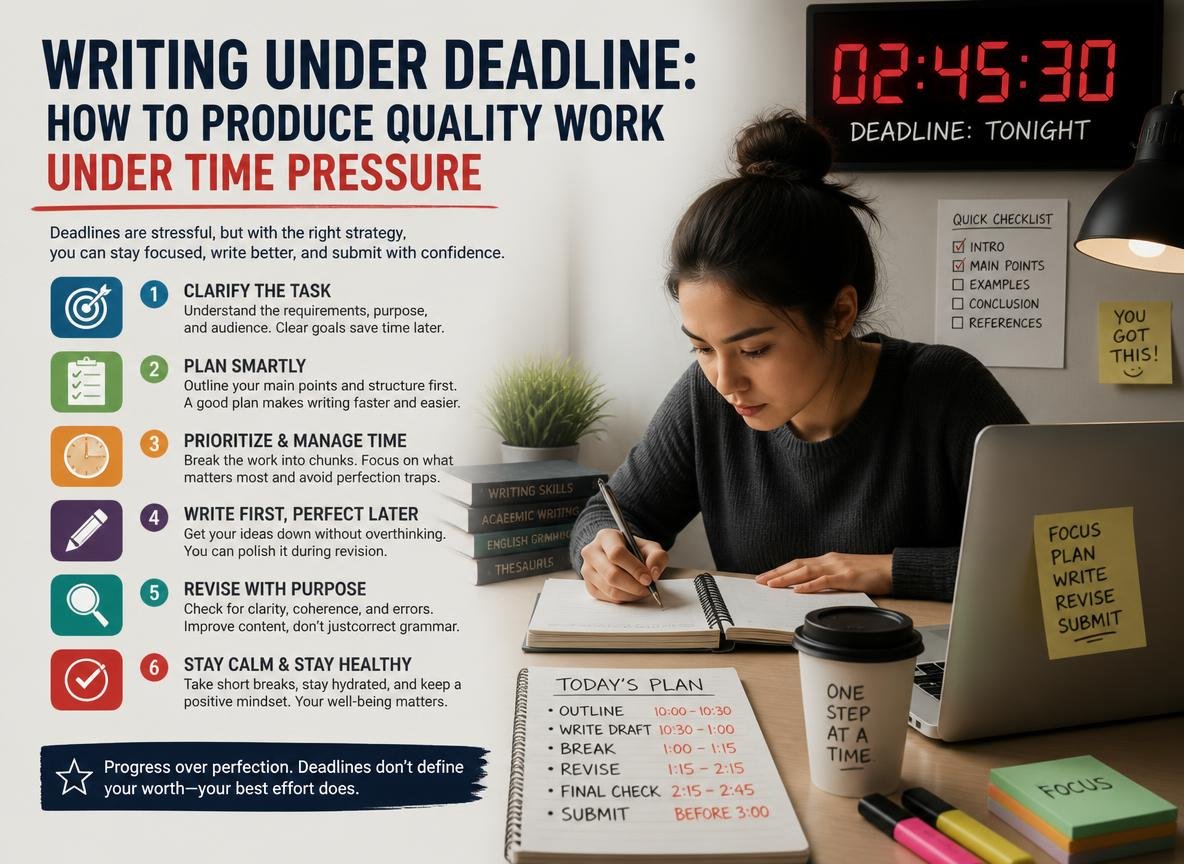
Writing Under Deadline: How to Produce Quality Work Under Time Pressure
Every writer eventually faces the same challenge: a deadline that feels too close and a blank page that feels too empty. Whether you are a student cramming for a paper due at midnight, a journalist racing to file a story, or a content creator trying to hit a weekly publishing schedule, writing under pressure is one of the most common — and most stressful — situations any writer encounters. The good news is that deadline writing is a skill that improves dramatically with the right strategies. This guide covers practical techniques for producing solid work quickly, without sacrificing quality more than necessary.
Why Deadlines Feel So Difficult
Understanding why time pressure disrupts writing helps explain why certain strategies work. Under a looming deadline, many writers experience a kind of mental gridlock: the pressure to produce something good actually makes it harder to produce anything at all. This happens because deadline stress activates the same part of the brain responsible for perfectionism and self-criticism, which competes directly with the more relaxed, exploratory thinking that good first-draft writing requires.
The techniques below are designed specifically to reduce this internal conflict — separating the different mental tasks involved in writing so you are not trying to generate ideas, organize them, and polish the language all at once under stress.
Step 1: Spend a Few Minutes Planning Before You Write
It feels counterintuitive when time is short, but skipping planning almost always costs more time than it saves. Writing without any plan under deadline pressure often leads to false starts, rambling paragraphs, and the need for major restructuring later, which eats up far more time than a brief planning phase would have taken.
Even under severe time constraints, spend three to five minutes jotting down:
- The main point you need to make
- Two or three supporting points or pieces of evidence
- A rough order for presenting them
This does not need to be a formal outline. A short bullet list is enough to give your writing direction and prevent the meandering that often happens when you start typing without any structure in mind.
Step 2: Write the Worst Version First
One of the most liberating mindset shifts for deadline writing is giving yourself explicit permission to write badly on the first pass. Many writers waste enormous amounts of time trying to make each sentence perfect as they write it, which is one of the slowest possible ways to produce a first draft.
Instead, write quickly and roughly, focusing only on getting your ideas down in some form. Do not stop to fix word choice, restructure sentences, or second-guess your phrasing. If you get stuck on a specific word or fact, insert a placeholder like "[CHECK THIS]" or "[BETTER WORD HERE]" and keep moving forward.
This approach works because editing and drafting use different cognitive processes. Trying to do both simultaneously slows down both. Separating them — write fast and rough first, then edit afterward — is almost always faster overall, even though it can feel strange to deliberately produce a messy first draft.
Step 3: Write Out of Order If It Helps
There is no rule requiring you to write a piece from beginning to end. If you are stuck on an introduction, skip it and start with whatever section you feel most confident about. Momentum matters more than sequence when time is limited.
Many experienced writers write introductions last, once they know exactly what the piece actually says, because it is often easier to introduce an argument you have already fully worked out than to introduce one you have not yet written.
Step 4: Use Templates and Structures to Save Time
Under deadline pressure, reinventing your structure from scratch for every piece wastes valuable time. Many types of writing follow well-established patterns that you can rely on without feeling like you are cutting corners.
For persuasive pieces, a simple problem-solution-benefit structure often works well. For narrative or explanatory pieces, a chronological or step-by-step structure is usually reliable. For opinion pieces, stating your position, providing supporting reasons, addressing a counterargument, and concluding with a call to action is a dependable pattern.
Relying on a known structure is not a sign of weak writing; it simply removes one variable from a high-pressure situation, letting you focus your limited time and energy on content rather than reinventing form.
Step 5: Set Mini-Deadlines Within the Larger Deadline
A single large deadline can feel overwhelming, which often leads to procrastination rather than productive pressure. Breaking the task into smaller chunks with their own mini-deadlines creates more manageable, motivating targets.
For example, if you have three hours to write a 1,500-word article, you might set:
- 15 minutes for planning
- 45 minutes to draft the first half
- 45 minutes to draft the second half
- 30 minutes for a structural edit
- 30 minutes for a final proofread pass
- 15 minutes buffer for unexpected issues
Having these smaller checkpoints makes progress visible and prevents the common trap of spending too long on the opening sections while leaving too little time for the rest.
Step 6: Cut Scope, Not Quality, When Time Runs Short
If you realize partway through that you will not have time to cover everything you originally planned, the better solution is usually to narrow your scope rather than rush through everything at a lower quality level.
A shorter piece that thoroughly covers two or three points well is almost always better than a longer piece that covers five points superficially. If time is genuinely limited, decide early which points are essential and which can be cut, rather than discovering with ten minutes left that you still have half the outline to cover.
Step 7: Edit in a Single, Focused Pass
Under normal circumstances, editing in multiple layers (as covered in dedicated self-editing guidance) produces the best results. Under severe time pressure, however, you often only have time for one editing pass, so it needs to be efficient.
Prioritize, in this order:
- Check that the main argument or point is clear. This matters more than anything else.
- Check for any factual errors or missing information. Errors under deadline pressure are common and can be costly.
- Fix any glaring grammar or clarity issues, particularly in the opening and closing sections, which readers pay the most attention to.
- Skip minor stylistic polishing if time genuinely does not allow it — a slightly less elegant sentence is a much smaller problem than missing a deadline or leaving in a factual error.
Step 8: Use Tools to Speed Up Mechanical Tasks
Under deadline pressure, tools that can quickly check grammar, suggest phrasing improvements, or catch typos free up your limited time for the aspects of writing that require genuine judgment, like argument clarity and factual accuracy. Running a rushed draft through a rewriting or grammar tool before submission can catch mechanical issues far faster than a manual review, especially when you do not have time for multiple read-throughs.
Managing the Psychological Side of Deadline Pressure
Technique alone does not solve deadline stress; the psychological experience of racing against time also needs attention.
Accept that "good enough" is a legitimate standard under real time constraints. Perfectionism is often the biggest obstacle to finishing on time. A completed piece that is solid but not perfect is almost always more valuable than an incomplete piece that might have been excellent.
Avoid catastrophic thinking about the deadline. Thoughts like "I'll never finish this in time" tend to increase anxiety and reduce the mental clarity needed to actually write efficiently. Focusing on the next small step, rather than the size of the overall task, tends to reduce this pressure.
Take short breaks even under pressure. A five-minute break to step away from the screen, especially when you feel stuck, often resolves mental blocks faster than continuing to stare at the same paragraph. This may feel counterproductive when time is short, but forcing continued effort past a genuine mental block usually wastes more time than a brief reset would.
Building Better Habits for Future Deadlines
While deadline-writing skills matter, the best long-term solution to deadline stress is reducing how often you find yourself in that position in the first place.
Start earlier, even briefly. Spending just fifteen minutes on a piece a few days before it is due — enough to do initial planning or a rough outline — dramatically reduces the pressure when the actual writing session begins, because you are not starting completely from zero.
Track how long tasks actually take you. Many people underestimate writing time because they only remember their best, most productive sessions. Keeping rough notes on how long past pieces actually took helps you plan more realistically for future deadlines.
Identify your personal patterns around procrastination. If you consistently find yourself writing under last-minute pressure, it is worth examining why — whether it is difficulty starting, perfectionism, or simply underestimating how long tasks take — since addressing the root cause reduces deadline stress far more effectively than only improving your in-the-moment writing speed.
Final Thoughts
Writing well under deadline pressure is less about raw speed and more about working smart: planning briefly before diving in, separating drafting from editing, relying on reliable structures, and accepting imperfection where necessary. With practice, these strategies become second nature, turning what once felt like a panicked scramble into a manageable, even confident process — one where the pressure of a deadline pushes you toward focus rather than paralysis.